Office Address
14, Residency Road, Udaipur, Rajasthan 313001
Office Address
14, Residency Road, Udaipur, Rajasthan 313001


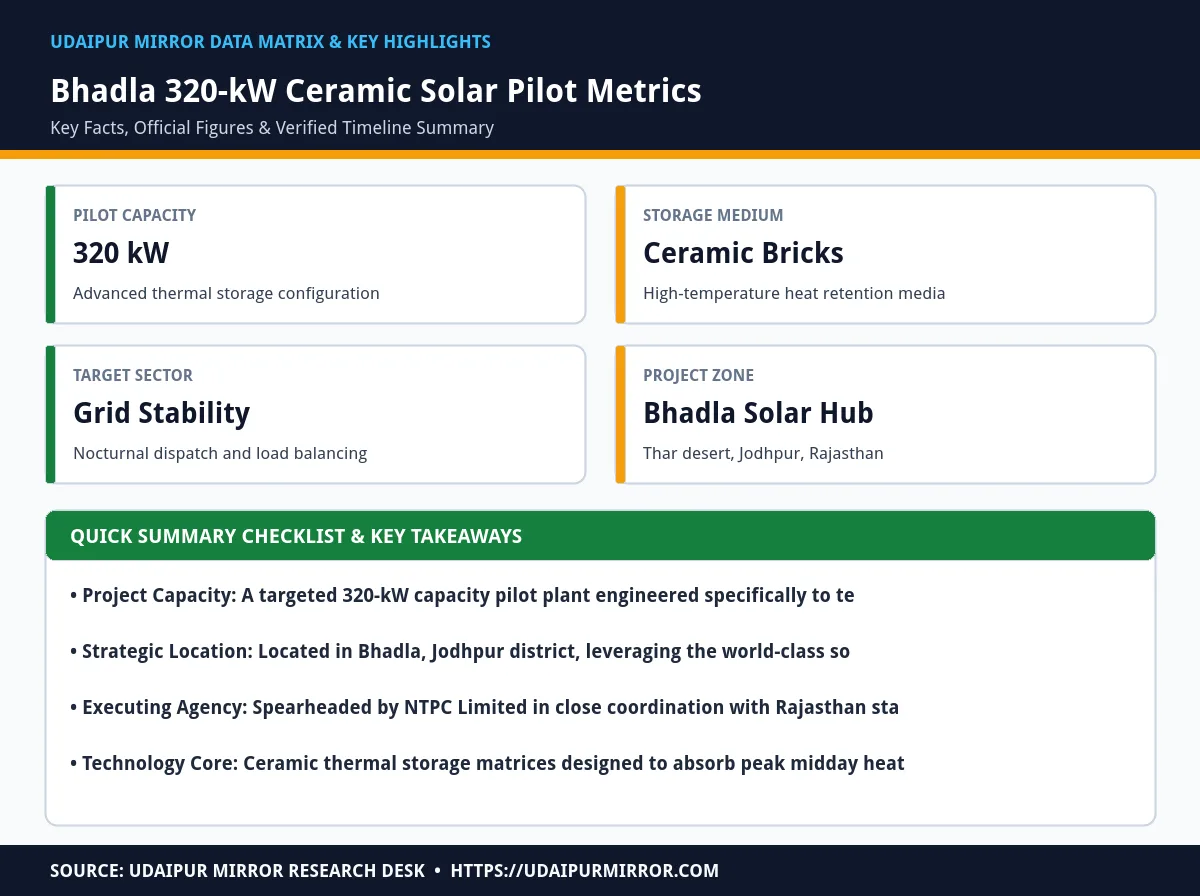
JAIPUR: JAIPUR — In a major technological leap for India’s renewable energy landscape, the Rajasthan government has officially approved NTPC’s innovative ceramic thermal-storage solar pilot at bhadla, setting a new precedent for round-the-clock clean energy generation in the Thar desert. Announced on Monday, November 2, 2026, this 320-kilowatt pilot installation aims to tackle the notorious intermittency challenges of utility-scale solar farms by capturing excess daytime solar thermal energy in specialized ceramic storage units and dispatching it smoothly into regional grids after sundown.
⚡ Quick Highlights: Rajasthan Approves NTPC Ceramic Thermal Storage Solar at Bhadla
The Thar desert hosts some of India’s largest photovoltaic installations, including the ultra-mega Bhadla solar park. However, conventional solar setups suffer from sharp generation drop-offs once the sun sets, creating peak-load management headaches for DISCOMs. NTPC’s new 320-kW ceramic thermal-storage pilot directly addresses this vulnerability by storing surplus thermal energy during peak irradiance hours instead of curtailing generation.
As energy markets evolve, households are also balancing their personal finances alongside massive infrastructure shifts—much like families monitoring market assets or tracking shifts in gold rate today November 2. Intelligent energy management is becoming a cornerstone of modern household and industrial economics across Rajasthan.
“Thermal storage is the missing puzzle piece for Rajasthan's solar dominance, allowing us to capture midday desert heat and convert it into dispatchable grid power after dark.” — Senior Renewable Energy Analyst, Jaipur
While utility-scale projects like the Bhadla thermal-storage pilot spearhead grid stability, residential consumers across JVVNL, AVVNL, and JdVVNL jurisdictions continue adopting rooftop solar systems under the PM Surya Ghar Muft Bijli Yojana. Review the updated 2026 cost, subsidy, and savings breakdown below before filing your DISCOM online application.
| System Capacity | Average Benchmark Cost | Central Subsidy (PM Surya Ghar) | Estimated Monthly Savings | Payback Period |
|---|---|---|---|---|
| 1 kW System | Rs 60,000 | Rs 30,000 | Rs 1,200 – Rs 1,500 | 3.2 Years |
| 2 kW System | Rs 1,20,000 | Rs 60,000 | Rs 2,500 – Rs 3,000 | 3.0 Years |
| 3 kW System | Rs 1,80,000 | Rs 78,000 | Rs 4,000 – Rs 4,800 | 2.8 Years |
| 5 kW System | Rs 3,000,000 | Rs 78,000 (Capped) | Rs 6,500 – Rs 7,500 | 3.5 Years |
The pilot utilizes high-density ceramic elements capable of enduring temperatures exceeding 800 degrees Celsius. When solar collectors or concentrated solar thermal mirrors focus energy during peak daylight, the thermal energy is transferred to the ceramic core. This heat is retained with minimal thermal loss until the grid operator signals a requirement for dispatch during evening hours.
This technology bypasses the chemical degradation issues associated with conventional lithium-ion battery storage, offering a durable, maintenance-free alternative for large-scale desert installations. Educational institutions and technical boards are closely monitoring these trials, with engineering candidates preparing through updates similar to the up special tet admit card 2026 out notification cycles, reflecting a broader national push toward specialized technical skills.
“Ceramic storage bridges the gap between photovoltaic generation and continuous baseload reliability without relying heavily on imported battery components.” — NTPC Technical Project Director
While mega-parks like Bhadla handle wholesale power generation, retail consumers across Jaipur Vidyut Vitran Nigam (JVVNL), Ajmer Vidyut Vitran Nigam (AVVNL), and Jodhpur Vidyut Vitran Nigam (JdVVNL) continue leveraging net metering guidelines to slash monthly utility bills. Under the PM Surya Ghar Muft Bijli Yojana, urban and rural homeowners can integrate rooftop PV systems seamlessly.
Applicants must file through the official national portal, select empanelled vendors, and coordinate with DISCOM engineers for bilateral net meter installation. Unlike regions where administrative delays have stalled vendor onboarding—such as noted in reports covering the delhi government yet to finalise vendors for rooftop solar scheme—Rajasthan’s DISCOMs maintain an active, streamlined digital pipeline for speedy approvals and subsidy disbursements.
“Our streamlined online portal ensures that residential net metering applications are cleared within 15 working days across all three Rajasthan DISCOM zones.” — Rajasthan Renewable Energy Corporation Official
The approval of NTPC’s ceramic thermal storage pilot arrives at a critical juncture when grid readiness and transmission evacuation bottlenecks threaten to cap green energy expansion. By placing storage solutions directly at generation hubs, transmission losses are minimized, and voltage profiles remain steady across long-distance high-voltage direct current (HVDC) corridors leading to northern and western load centers.
Furthermore, local employment opportunities in advanced green technologies are expanding rapidly across Jodhpur, Bikaner, and Jaisalmer districts. Technicians trained in thermal storage maintenance and high-voltage grid synchronization are finding lucrative roles as desert solar parks scale toward multi-gigawatt capacities.
“Decentralized thermal storage in Bhadla acts as a shock absorber for high-capacity transmission lines, ensuring power reaches distant urban centers without tripping local substations.” — Power Transmission Grid Consultant
The pilot aims to test high-temperature ceramic storage materials in the Thar desert climate to capture excess daytime solar heat and dispatch electricity smoothly after sundown, mitigating grid intermittency.
During peak daylight hours, concentrated solar heat is absorbed by dense ceramic blocks. After sunset, the stored thermal energy is utilized to create steam, driving turbines to generate continuous electricity for the grid.
Homeowners receive a central financial assistance subsidy of Rs 30,000 for 1 kW, Rs 60,000 for 2 kW, and up to Rs 78,000 for systems sized 3 kW and above, credited directly to bank accounts after inspection.
Net metering applications are handled regionally by Jaipur Vidyut Vitran Nigam (JVVNL), Ajmer Vidyut Vitran Nigam (AVVNL), and Jodhpur Vidyut Vitran Nigam (JdVVNL) through their online portal systems.
Add Udaipur Mirror as a preferred source on Google to see more of our travel guides in your AI overviews.