Office Address
14, Residency Road, Udaipur, Rajasthan 313001
Office Address
14, Residency Road, Udaipur, Rajasthan 313001


NEW YORK: Planning for a secure financial future requires constant evaluation of your personal savings against national benchmarks, making the analysis of the average 401(k) balance by age an essential tool for every working professional. As financial landscapes shift and economic pressures mount across global markets, understanding how much your peers have stashed away in employer-sponsored accounts provides a vital reality check. Whether you are just starting out in your early twenties or entering the home stretch toward retirement, tracking these figures helps calibrate your contribution rates, employer match utilization, and overall asset allocation strategy for long-term growth.
⚡ Quick Highlights: Average 401(k) Balance by Age: 20s to Retirement Savings Guide
When reviewing retirement data, financial analysts frequently emphasize the stark difference between average and median 401(k) balances. Because a small percentage of ultra-high earners hold massive fortunes in their retirement accounts, the mathematical average is heavily skewed upward. Conversely, the median balance—the midpoint where half the population has more and half has less—paints a much more realistic picture of the typical American worker’s financial preparedness.
While checking your own savings against these figures is helpful, it is equally important not to get discouraged if your portfolio currently sits below the national average. Factors such as career interruptions, student loan debt, and regional cost-of-living differences heavily influence individual savings trajectories. Meanwhile, local citizens managing household budgets can also explore essential administrative guidelines through resources like the Rajasthan SSO Portal & Jan Aadhaar Update 2026 for broader financial planning context.
“The most effective retirement strategy is not trying to beat the market average, but maintaining consistent contributions through every economic cycle.” — Senior Wealth Strategist
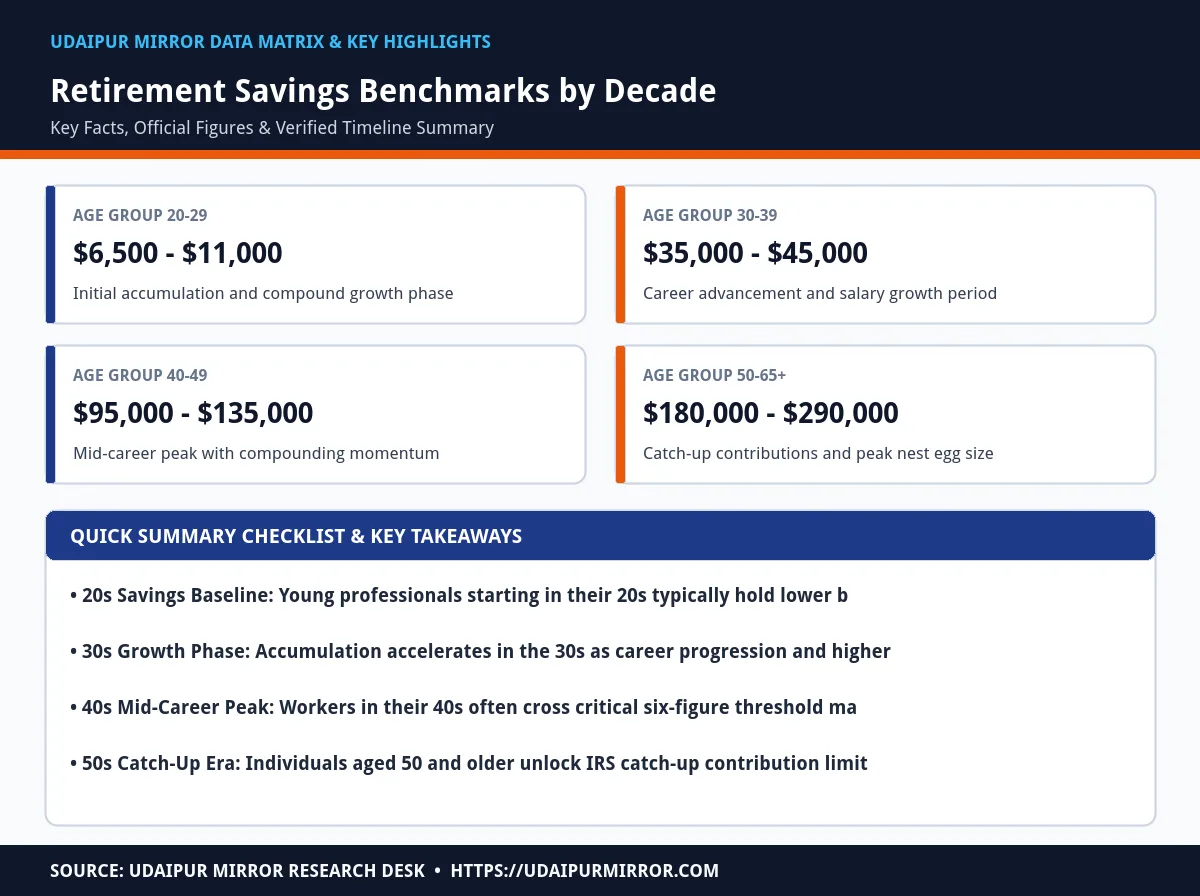
Review the detailed breakdown below comparing median versus average 401(k) account balances across various age demographics, alongside recommended savings multiples.
| Age Bracket | Average Balance | Median Balance | Recommended Multiple | Key Priority |
|---|---|---|---|---|
| 20 to 29 | $11,200 | $6,100 | 0.5x Salary | Capture full employer match |
| 30 to 39 | $45,600 | $21,400 | 1.0x to 2x Salary | Increase contribution percentage |
| 40 to 49 | $135,100 | $47,900 | 3x to 4x Salary | Diversify portfolio assets |
| 50 to 59 | $215,300 | $89,500 | 6x to 7x Salary | Utilize catch-up contributions |
| 60 to 65+ | $290,400 | $112,500 | 8x to 10x Salary | Shift toward capital preservation |
The foundational decades of your working life dictate the ultimate size of your retirement fund, primarily due to the undeniable power of compound interest. In your 20s, the primary objective should be enrolling in your employer’s 401(k) plan immediately and contributing at least enough to secure the full employer match. Leaving free money on the table is one of the most detrimental mistakes a young professional can make.
As individuals transition into their 30s, career promotions and salary bumps create opportunities to steadily elevate contribution percentages. Financial planners suggest increasing your savings rate by at least one percent every single year or whenever a pay raise occurs. For domestic readers balancing career aspirations with local obligations, managing personal finances efficiently often goes hand in hand with staying updated on regional schedules, such as reviewing the Udaipur Power Cut Notice to ensure uninterrupted remote work and digital banking.
“Time in the market beats timing the market, and starting in your twenties gives your investments decades to absorb market volatility.” — Certified Financial Planner
By the time workers reach their 40s and 50s, peak earning years typically align with heightened financial responsibilities, including mortgage payments, child education, and elder care. Despite these competing demands, this mid-career phase requires aggressive portfolio consolidation. Investment strategies should be routinely audited to ensure asset allocation aligns with your ultimate target retirement date without exposing capital to excessive risk.
For workers aged 50 and older, the Internal Revenue Service permits catch-up contributions, allowing individuals to stash away significantly higher amounts annually than standard contribution limits permit. This mechanism serves as a crucial lifeline for anyone who got a late start on their retirement planning, helping bridge the gap before exiting the workforce permanently. (Also read: RPSC RAS Prelims Exam Date 2026 Revised: Check New Schedule and Official Notification Details).
“Catch-up contributions in your fifties provide a powerful second wind for retirement accounts that may have fallen behind schedule.” — Retirement Income Certified Professional
The average 401(k) balance for workers in their 30s generally ranges between $35,000 and $45,000, though median balances tend to be lower, sitting around $21,000 to $25,000.
Financial advisors generally recommend having roughly three to four times your annual salary saved in retirement accounts by the time you reach age 40, scaling up to six times by age 50.
Catch-up contributions are additional pre-tax or Roth funds that workers aged 50 and older are legally permitted to deposit into their 401(k) accounts above standard annual IRS limits.
The average balance is heavily skewed upward by high earners with substantial investment portfolios, whereas the median represents the exact midpoint of all accounts held by everyday workers.
Add Udaipur Mirror as a preferred source on Google to see more of our travel guides in your AI overviews.