Office Address
14, Residency Road, Udaipur, Rajasthan 313001
Office Address
14, Residency Road, Udaipur, Rajasthan 313001


NEW DELHI: NEW DELHI — The election commission waris punjab de inquiry gained significant national traction on Wednesday as top administrative authorities confirmed they are closely evaluating security dossiers and intelligence reports. The poll panel’s stance comes amid heightened scrutiny over political and socio-religious groups attempting to influence democratic frameworks, prompting closer administrative alignment between central law enforcement agencies and state election machinery. While civic administrators manage multi-phase electoral preparations across various jurisdictions, monitoring bodies remain vigilant against external influences that could potentially undermine the integrity of the electoral process, ensuring full adherence to constitutional mandates and democratic norms.
⚡ Quick Highlights: ECI Awaits Report on Waris Punjab De Separatist Claims
The Election Commission of India’s decision to await formal administrative verification regarding Waris Punjab de underscores the delicate balance between civil liberties and national security oversight during active political cycles. As regional bodies adapt to evolving socio-political dynamics, monitoring authorities remain resolute in preventing any entity with documented extremist affiliations from directly or indirectly influencing democratic outcomes. Furthermore, civil infrastructure developments, such as the regional progress observed around the Kota-Bundi Greenfield Airport, continue alongside these administrative security reviews, highlighting the multi-layered focus of modern Indian governance.
Security analysts note that intelligence dossiers submitted by regional law enforcement agencies undergo rigorous scrutiny at multiple levels before formal advisories are issued. The ECI acts as the constitutional arbiter ensuring that public assemblies, political discourse, and organizational funding strictly adhere to the Representation of the People Act and constitutional bounds. (Also read: Udaipur Deepotsav Fire Surge: 100 Incidents in 4 Days Marks 567% Spike Due to Dry Weather | दीपोत्सव पर 100 जगह आगजनी).
“The sanctity of the electoral process requires absolute transparency and uncompromising defense against external subversion or extremist infiltration.” — Senior Electoral Administrator
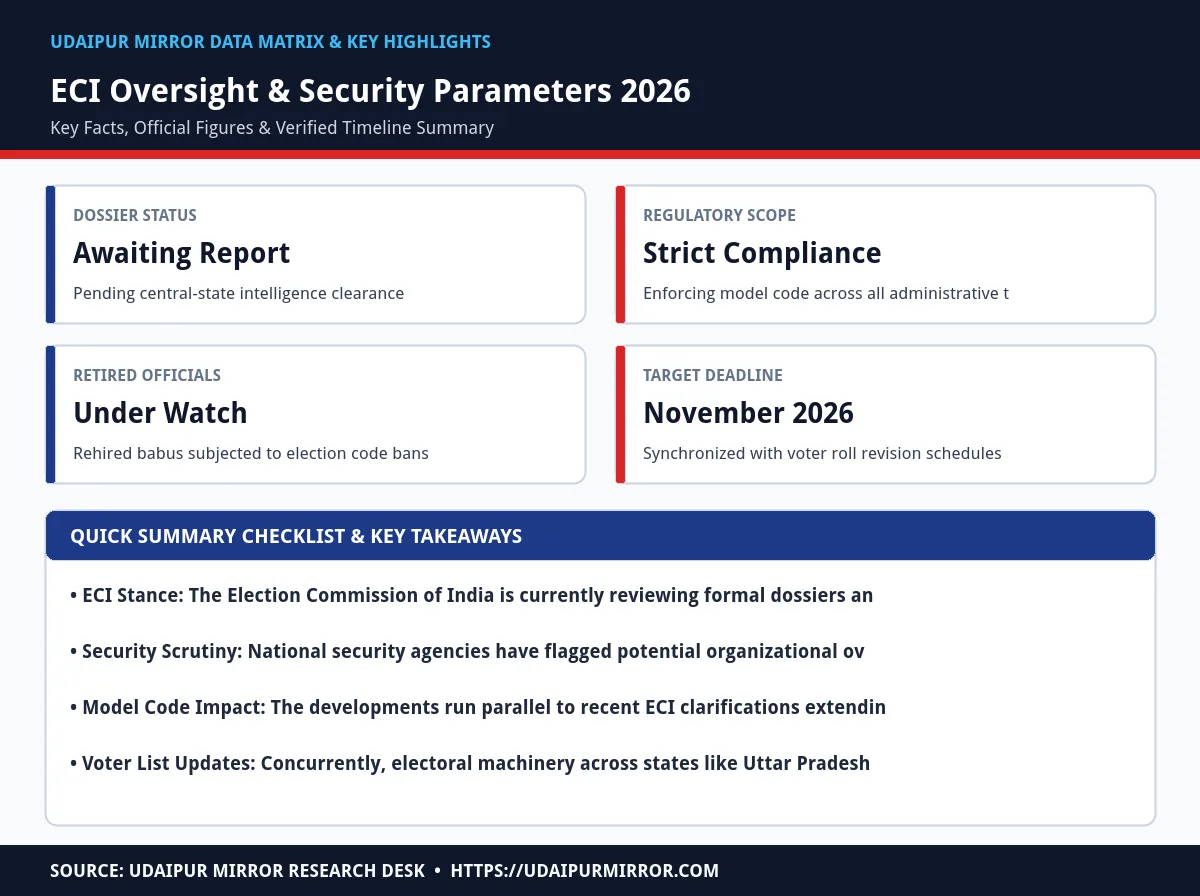
The following schedule details recent regulatory interventions, administrative policy expansions, and report deadlines issued by the Election Commission of India and affiliated state bodies.
| Date | Authority / Body | Action / Directive | Scope & Application |
|---|---|---|---|
| November 11, 2026 | Election Commission of India | Awaiting report on Waris Punjab de links | National security and electoral integrity |
| November 10, 2026 | Election Commission of India | Extended poll curbs to retired officials | All state governments and rehired babus |
| November 10, 2026 | Chief Electoral Officer UP | Draft voter list push to November 17 | Uttar Pradesh electoral rolls |
| October 2026 | Infrastructure Division | Airport and urban modernization review | State development projects like Kota-Bundi Greenfield Airport |
| Festival Period 2026 | District Administration | Emergency response and public safety audits | Managing urban incidents similar to Udaipur Deepotsav Fire Surge |
In tandem with security reviews, the Election Commission has widened its regulatory net to encompass administrative personnel. Recent directives explicitly state that the Model Code of Conduct applies equally to retired government officials who are re-engaged or rehired by state administrations. This proactive governance measure aims to eliminate potential conflicts of interest and partisan influence within bureaucratic machinery during sensitive election windows. Similar administrative vigilance is reflected in urban management and public safety monitoring, comparable to local disaster response protocols seen during emergency surges like the Udaipur Deepotsav Fire Surge.
The inclusion of retired bureaucrats under strict poll code observation closes a historical regulatory loophole. Civil servants who retain advisory or contract roles within ministries will now face the same restrictions on public pronouncements, official patronage, and movement as active-duty personnel.
“Extending poll curbs to retired and rehired officials ensures a level playing field and reinforces public faith in bureaucratic neutrality.” — Constitutional Law Expert
While national security dossiers command central attention, state electoral offices continue rigorous ground-level preparations. The Uttar Pradesh electoral office recently adjusted its draft voter list publication timeline to November 17 while retaining the statutory final publication deadline of January 4. These meticulous roll revisions ensure that eligible citizens are neither disenfranchised nor subjected to administrative hurdles.
Local governance bodies are also scaling up public outreach programs, digital tracking mechanisms, and grievance redressal portals to streamline voter verification. Such institutional upgrades parallel public health and digital administrative initiatives, ensuring that civic infrastructure meets contemporary standards of efficiency and accountability. (Also read: Rajasthan Government Sets October 2027 Deadline for Kota-Bundi Greenfield Airport Completion).
“Accurate electoral rolls form the bedrock of a robust democracy, requiring relentless verification and transparent timeline execution.” — Chief Electoral Officer Representative
The intersection of separatist link investigations and routine electoral administration highlights the complex environment in which Indian governance operates. The ECI’s measured approach—waiting for verified intelligence reports before making structural determinations—demonstrates institutional maturity. By balancing free expression with uncompromising national security protocols, India’s democratic framework continues to safeguard its foundational values against domestic and external challenges.
As reports from intelligence divisions are finalized, political parties and civil society organizations await the commission’s next steps, which are expected to set definitive benchmarks for handling controversial entities in future electoral cycles.
“India's democracy thrives on vigilance, where security and constitutional rights are protected with equal measure.” — Governance and Policy Analyst
The Election Commission of India has stated it is actively awaiting comprehensive administrative and intelligence reports regarding alleged separatist linkages before taking further regulatory action.
The ECI has extended the Model Code of Conduct to include retired government officials who are rehired or engaged on contract by state and central administrations, subjecting them to strict poll restrictions.
The Election Commission pushed the draft voter list publication in Uttar Pradesh to November 17, while retaining the final publication deadline of January 4.
The ECI monitors organizational links to ensure that groups with extremist or unconstitutional agendas do not subvert the democratic process or violate the Model Code of Conduct.
Add Udaipur Mirror as a preferred source on Google to see more of our travel guides in your AI overviews.