Office Address
14, Residency Road, Udaipur, Rajasthan 313001
Office Address
14, Residency Road, Udaipur, Rajasthan 313001


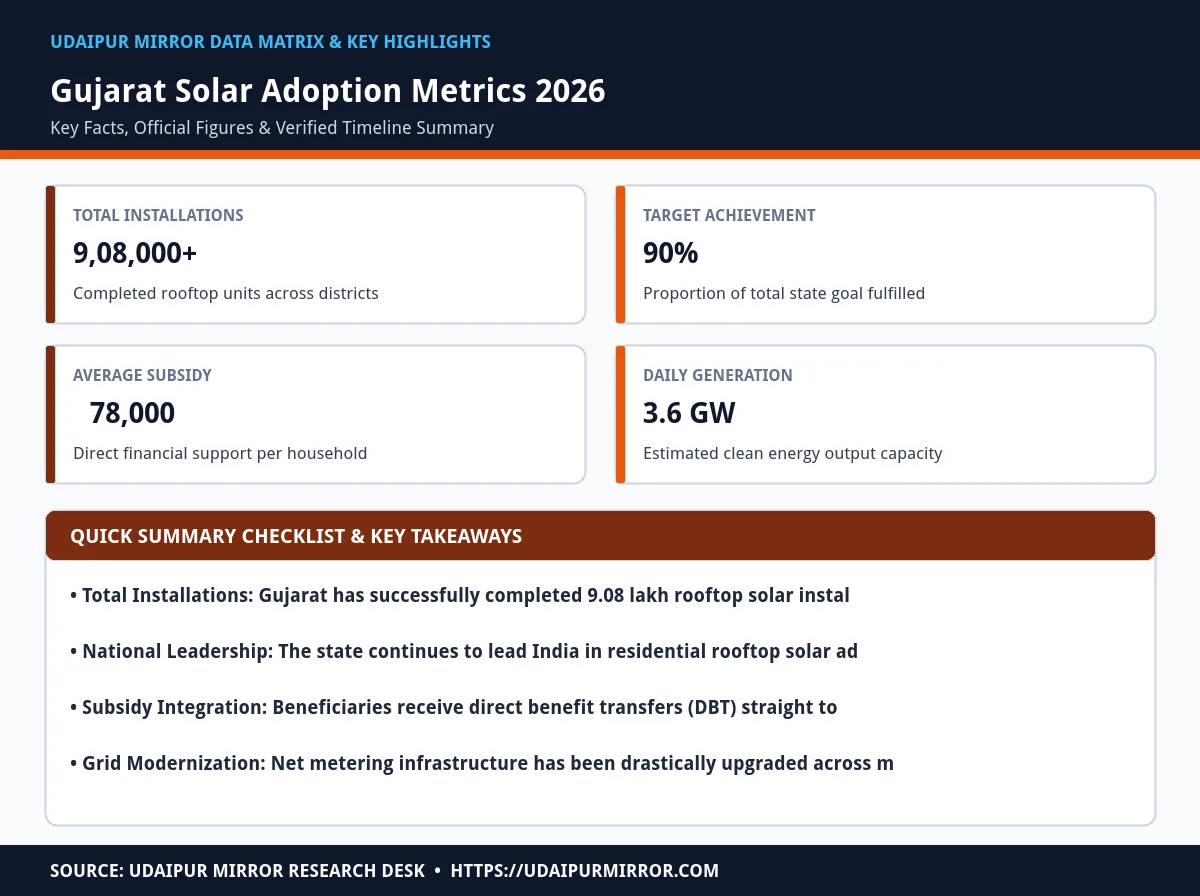
GANDHINAGAR: GANDHINAGAR — Setting a benchmark in India’s renewable energy landscape, Gujarat has successfully achieved 90 percent of its target under the ambitious pm surya ghar muft bijli yojana, recording an impressive milestone of 9.08 lakh rooftop solar installations across the state. State government officials confirmed that the rapid rollout has significantly reduced household electricity bills while bolstering commercial and residential green transitions. As citizens embrace clean energy subsidies, neighboring states like Rajasthan are also scaling up infrastructural frameworks, echoing similar large-scale initiatives seen in industrial sectors such as Indus Towers Adds 300 MW Solar Power Across 50,000 Sites to Bolster Rajasthan Green Energy, highlighting a broader regional momentum toward sustainable power generation.
⚡ Quick Highlights: Gujarat Hits 90% PM Surya Ghar Target With 9.08 Lakh Rooftop Solar
Gujarat’s aggressive push toward decentralized renewable energy has yielded remarkable outcomes, with state energy department figures showing 9.08 lakh operational rooftop solar systems. The administrative machinery streamlined vendor registration, simplified net-metering approvals, and established single-window clearance portals for applicants.
This monumental achievement not only places the state firmly on track to meet its clean energy quotas but also serves as a working model for neighboring states aiming to decentralize power generation. Similar shifts toward sustainable heritage management can also be observed in cultural zones, reminiscent of how visitors explore traditional landmarks as detailed in the Ambrai Ghat & Gangaur Ghat Udaipur Guide 2026.
“Reaching 90 percent of our target demonstrates the unwavering commitment of Gujarat's citizens and discoms toward sustainable, self-reliant energy futures.” — State Energy Department Spokesperson
Review the standard subsidy slabs, average installation costs, and expected monthly power generation metrics for residential consumers adopting rooftop solar systems under the national framework.
| System Capacity | Eligible Subsidy (INR) | Avg. Monthly Generation | Target Beneficiary Group |
|---|---|---|---|
| 1 kW | ₹30,000 | 110 – 130 Units | Small Households |
| 2 kW | ₹60,000 | 220 – 260 Units | Medium Families |
| 3 kW to 10 kW | ₹78,000 Max | 350 – 1100 Units | Large Residential Units |
| Above 10 kW | Not Applicable | 1200+ Units | Housing Societies / Commercial |
A core driver behind the rapid uptake of rooftop solar units is the robust financial structure backed by both central and state subsidies. Homeowners installing systems up to 3 kW receive substantial financial support deposited directly into their bank accounts following successful grid synchronization and inspection.
Furthermore, national policy debates often touch upon economic policies and legislative accountability, much like ongoing parliamentary discourse where leaders spar over fiscal governance and administrative reforms, akin to debates highlighted when Sitharaman Challenges Rahul Gandhi to Debate SIR and EVMs in Parliament.
“The financial autonomy provided by solar rooftops transforms ordinary households into power producers, substantially lowering household budget pressures.” — Renewable Energy Analyst
Scaling up to nearly a million installations required a massive overhaul of transformer capacities and grid synchronization protocols. Discoms deployed smart meters capable of tracking bi-directional energy flow accurately, ensuring consumers receive proper credit for feeding excess solar generation back into the municipal grid.
Engineering teams conducted rigorous safety audits across urban neighborhoods and rural clusters to prevent grid overload and ensure compliance with national electrical safety codes. (Also read: Sitharaman Challenges Rahul Gandhi to Debate SIR and EVMs in Parliament).
“Upgrading our distribution transformers was critical to handling peak daytime injection from residential rooftops without destabilizing local grids.” — Chief Electrical Inspector, Gujarat
With 90 percent of the mandated objective successfully secured, state authorities have turned their attention toward addressing pending applications in remote rural pockets and high-rise cooperative housing societies. Special camps are being organized to assist elderly residents and technically unequipped households with online documentation.
The remaining 10 percent of installations are slated for completion ahead of schedule, cementing Gujarat’s status as a pioneer in domestic solar adoption and setting a high standard for nationwide green energy initiatives.
“We are fully mobilized to clear the remaining applications and ensure every willing household in Gujarat reaps the benefits of clean energy.” — Discom Managing Director
The scheme aims to install rooftop solar systems in 1 crore households across India, providing up to 300 units of free electricity per month while promoting clean energy adoption.
For a 2 kW residential rooftop solar system, the central government provides a standardized subsidy of ₹60,000, credited directly to the beneficiary’s bank account.
Gujarat has achieved 90 percent of its designated state target by successfully completing 9.08 lakh rooftop solar installations, leading national adoption metrics.
Net metering involves a bi-directional smart meter that records both electricity consumed from the grid and excess solar power exported back, allowing consumers to earn energy credits.
Add Udaipur Mirror as a preferred source on Google to see more of our travel guides in your AI overviews.






[…] Announces IDCW Payouts Across Large & Mid Cap, Mid Cap and Small Cap Schemes 4 seconds ago ⚡ Articles Gujarat Achieves 90% of PM Surya Ghar Target With 9.08 Lakh Rooftop Solar Installations 25… Articles Ambrai Ghat & Gangaur Ghat Udaipur Guide 2026: Best Sunset Spots, Photography Rules, […]