Office Address
14, Residency Road, Udaipur, Rajasthan 313001
Office Address
14, Residency Road, Udaipur, Rajasthan 313001

UDAIPUR: Homeowners across Rajasthan and India looking to eliminate monthly electricity expenses can now seamlessly execute a pm surya ghar muft bijli yojana solar subsidy apply online registration through the central portal. Designed to provide up to 300 units of free electricity per month to one crore households nationwide, the scheme offers a direct central government financial assistance grant of up to ₹78,000 for residential rooftop solar plant installations.
⚡ Quick Highlights: PM Surya Ghar Muft Bijli Yojana Solar Subsidy Apply Guide 2026
The PM Surya Ghar Muft Bijli Yojana represents India’s premier rooftop solar initiative aimed at transforming residential power consumption into a clean, decentralised energy ecosystem. Operating under the Ministry of New and Renewable Energy, the scheme enables individual house owners to install grid-connected solar panels with direct subsidy transfers into their Aadhaar-linked bank accounts.
By taking proactive measures to complete a pm surya ghar muft bijli yojana solar subsidy apply, families can offset their escalating summer power tariffs while simultaneously earning credits through solar surplus generation. The central financial assistance guarantees ₹30,000 per kilowatt for system capacities up to 2 kW, and an incremental ₹18,000 for the third kilowatt, capping maximum central support at ₹78,000. (Also read: Udaipur Sightseeing Guide 2026: 1 to 3 Day Itineraries, Lake Boating Rates, Entry Fees & Sunset Spots).
“Decentralised rooftop solar power empowers everyday citizens to turn their open roof spaces into productive green assets while ensuring zero monthly electricity charges.” — Senior Renewable Energy Official, MNRE Technical Division
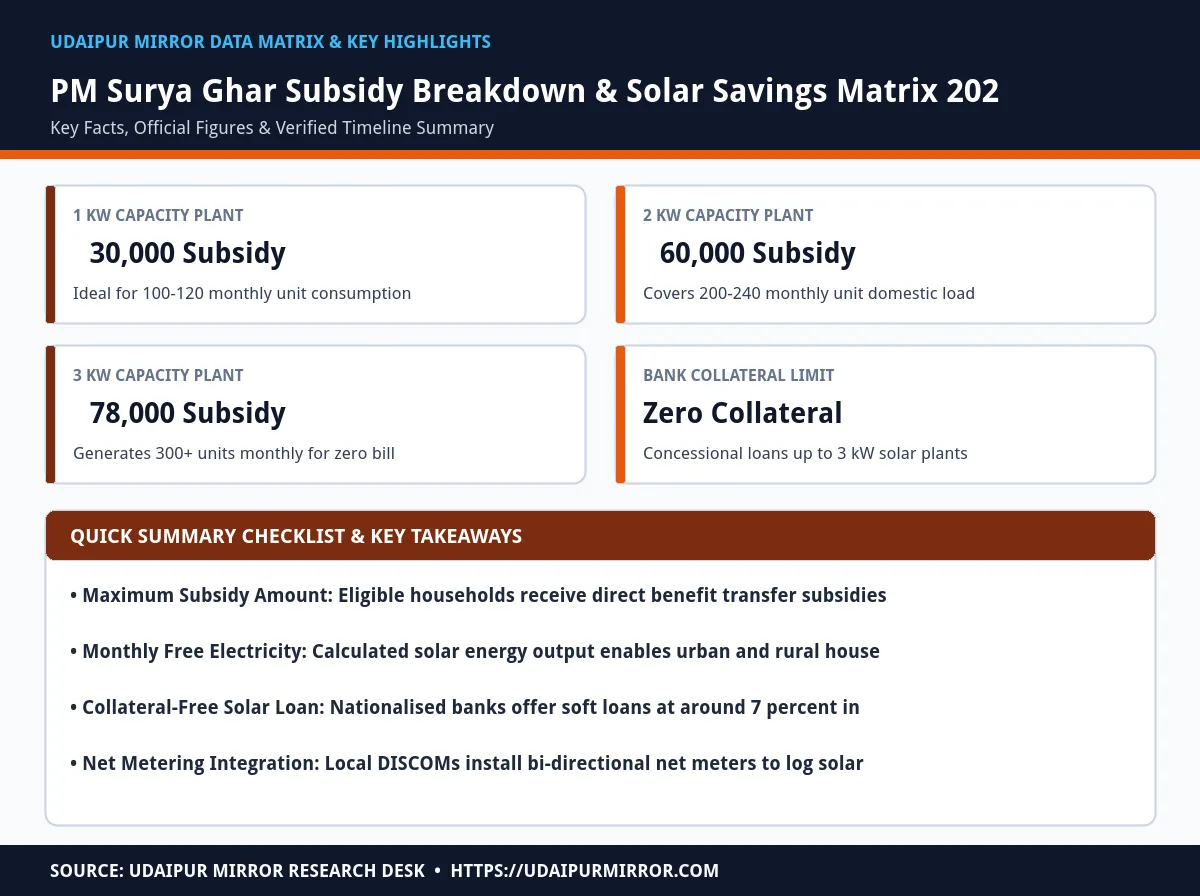
The Ministry of New and Renewable Energy (MNRE) regulates the Central Financial Assistance (CFA) slab limits based on benchmark plant capacity and consumer sanction load. The table below outlines system costs, subsidy allotments, roof area needs, and unit yields for households in FY 2026-27.
| Rooftop Solar Capacity | Central Subsidy (CFA) | Approx. Total Plant Cost | Required Roof Area | Est. Monthly Generation |
|---|---|---|---|---|
| 1 kW System | ₹30,000 Fixed | ₹50,000 – ₹55,000 | 100 Sq. Ft. | 120 – 135 Units |
| 2 kW System | ₹60,000 Fixed | ₹1,00,000 – ₹1,10,000 | 200 Sq. Ft. | 240 – 270 Units |
| 3 kW System | ₹78,000 Capped | ₹1,45,000 – ₹1,60,000 | 300 Sq. Ft. | 360 – 400 Units |
| 4 kW to 10 kW System | ₹78,000 Capped | ₹2,00,000 – ₹4,50,000 | 400 – 1000 Sq. Ft. | 480 – 1300 Units |
| Housing Societies (GHS/RWA) | ₹18,000 per kW (up to 500kW) | Varies by capacity | Common Roof Space | Common Utility Offset |
Before launching an online registration, domestic consumers must ensure their property meets specific physical and administrative criteria mandated by central regulations. The applicant must hold a valid residential electricity connection in their name with an active consumer number (K-Number / CA Number) issued by the local electricity distribution company.
As civic authorities streamline urban housing frameworks, residents situated in expanded municipal zones—such as regions highlighted in Udaipur Development Authority Expands Jurisdiction by Adding 70 New Villages Across Badgaon, Girwa & Mavli: Total Reaches 206—must verify that their property papers and electricity utility bills carry matching owner details to eliminate documentation delays.
“Matching the name on the electricity bill with the Aadhaar identity and bank account is the single most vital factor for hassle-free direct benefit transfer.” — State Nodal Officer, Solar Cell

Executing an online application requires navigating the unified national portal (`pmsuryaghar.gov.in`). Applicants must select their respective state, pick their local electricity distribution company (e.g., AVVNL, JVVNL, or JDVVNL in Rajasthan), and submit their consumer account number alongside an active mobile phone number.
Once registered, users login using their mobile OTP to apply for rooftop solar installation. After entering property details and sanctioned load requirements, the application automatically routes to the regional DISCOM technical desk for feasibility approval within 7 to 10 working days. (Also read: Udaipur Development Authority Expands Jurisdiction by Adding 70 New Villages Across Badgaon, Girwa & Mavli: Total Reaches 206).
Upon receiving technical feasibility approval, the consumer enters into an agreement with an empanelled solar vendor. The vendor installs ALMM-approved solar modules (Approved List of Models and Manufacturers) along with BIS-certified grid-tied solar inverters within the stipulated timeline.
Following physical installation, the vendor submits the commissioning application on the portal. DISCOM engineers visit the site to inspect the solar plant, test safety isolators, and install a bi-directional net meter. Consumers planning property enhancements alongside tourism trips can consult the Udaipur Sightseeing Guide 2026: 1 to 3 Day Itineraries, Lake Boating Rates, Entry Fees & Sunset Spots for local utility timelines and regional travel updates while awaiting meter sanctioning.
“Net metering allows domestic users to banking surplus midday solar power into the utility grid and draw it back during night hours without additional unit charges.” — Senior Electrical Inspector, State DISCOM
To alleviate initial capital requirements, nationalised banks provide soft loan facilities at concessional interest rates (around 7% per annum) for rooftop solar plants up to 3 kW capacity without asking for asset collateral. Household investments typically reach payback equilibrium within 3 to 3.5 years, after which generated power represents net savings.
Over a standard 25-year solar module lifecycle, a 3 kW rooftop solar system generates upwards of 1,00,000 power units. Factoring in current domestic electricity slabs, a average urban family saves approximately ₹25,000 to ₹32,000 annually on energy bills, while making a tangible reduction in carbon footprint.
The scheme offers a maximum direct subsidy of ₹78,000 for residential rooftop solar installations of 3 kW capacity or higher. Systems up to 1 kW receive ₹30,000, while 2 kW systems receive ₹60,000.
Any Indian citizen residing in an owned residential property with a valid domestic electricity connection in their name and sufficient shadow-free rooftop area can apply through the official national portal.
After plant commissioning and net meter installation by DISCOM, the central government credits the subsidy directly into the consumer’s bank account within 30 days.
No, the PM Surya Ghar Muft Bijli Yojana central subsidy is exclusively meant for residential households and Group Housing Societies (GHS/RWA) for common utility connections.
Add Udaipur Mirror as a preferred source on Google to see more of our travel guides in your AI overviews.






[…] Schemes for Journalists and Launches Four Major Urban Residential Projects 2 seconds ago ⚡ Articles PM Surya Ghar Muft Bijli Yojana: Complete Guide to Apply for Solar Subsidy, Eligibility, a… Articles Udaipur Sightseeing Guide 2026: 1 to 3 Day Itineraries, Lake Boating Rates, Entry Fees […]