Office Address
14, Residency Road, Udaipur, Rajasthan 313001
Office Address
14, Residency Road, Udaipur, Rajasthan 313001


BENGALURU: BENGALURU — The transformative impact of central government green energy initiatives has once again come to the forefront as a household in Karnataka records a complete zero electricity bill following the successful deployment of the pm surya ghar yojana. This landmark scheme, designed to promote sustainable residential power consumption across India, continues to gather massive momentum by helping citizens harness solar energy, significantly lowering grid dependency and offering immense fiscal relief to middle-class families grappling with soaring utility tariffs.
⚡ Quick Highlights: PM Surya Ghar Yojana: Zero Electricity Bill Success in Karnataka
The recent experience shared by a Karnataka beneficiary underscores the practical success of the flagship national solar initiative. By transitioning to rooftop solar installations, families are effectively shielding themselves from fluctuating energy prices while contributing to environmental sustainability. The scheme encourages citizens to take charge of their power production.
As civic administration and urban bodies review regional development, similar sustainable models are being integrated into broader infrastructure dialogues. For instance, discussions around historical tourism upgrades like the BCC to Build World’s Largest Maharana Pratap Statue in Haldighati Under INR 168 Crore Tourism Project reflect a growing emphasis on modernizing public spaces with green sensibilities in mind.
Furthermore, local community engagement remains vital for spreading awareness about government schemes. Grassroots meetings mirror activities seen during urban drives, similar to when Ward 67 mobilized residents as detailed in Ward 67 Mobilizes for Upcoming Padyatra as Local Development Initiatives Kick Off in Udaipur, ensuring that welfare benefits successfully reach grassroots beneficiaries.
“Our electricity bills have dropped to absolute zero, and we are even feeding surplus clean energy back into the local power grid.” — Karnataka Scheme Beneficiary
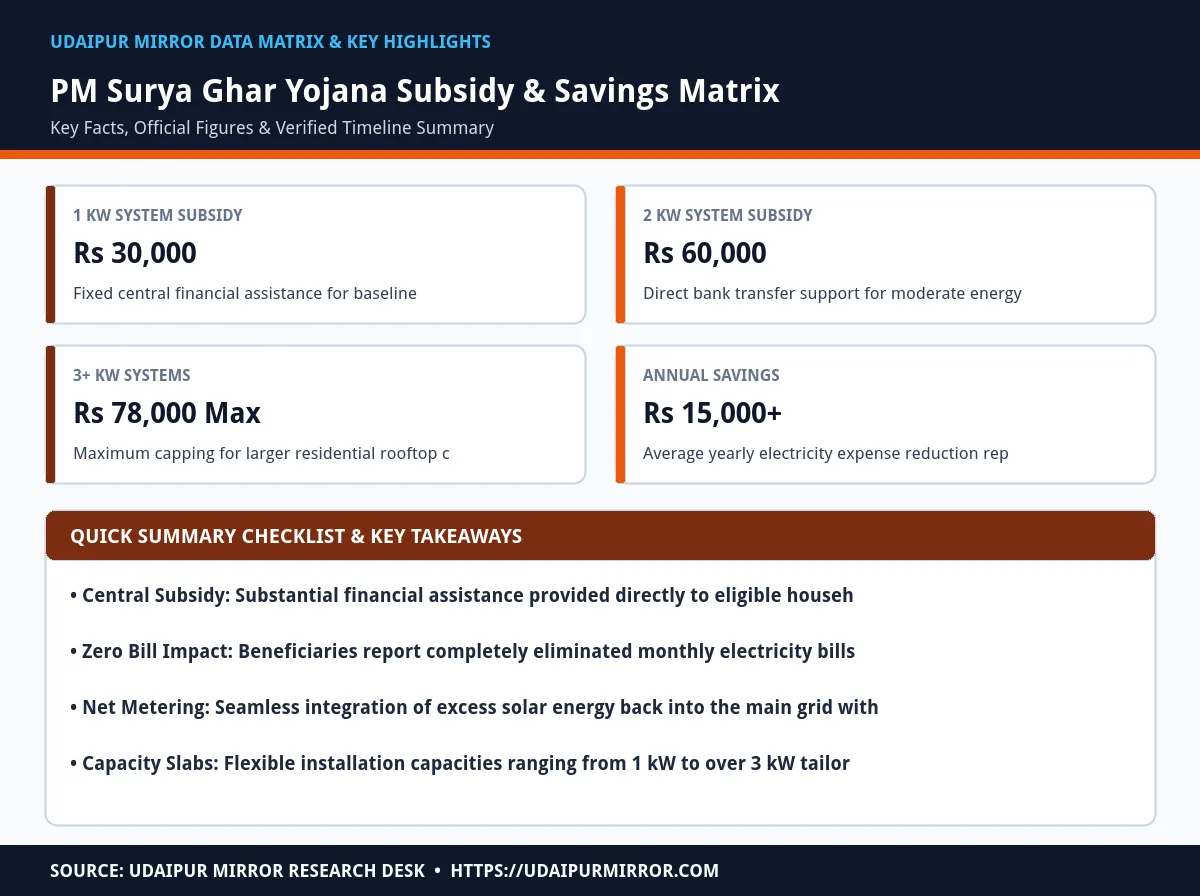
Review the standard financial matrix associated with residential solar rooftop installations under national subsidy guidelines to determine the best configuration for your monthly power consumption.
| System Capacity | Central Subsidy (INR) | Approx. Daily Gen. | Avg. Monthly Savings |
|---|---|---|---|
| 1 Kilowatt (kW) | Rs 30,000 | 4 – 5 Units | Rs 1,200 – Rs 1,500 |
| 2 Kilowatt (kW) | Rs 60,000 | 8 – 10 Units | Rs 2,500 – Rs 3,000 |
| 3 Kilowatt (kW) | Rs 78,000 | 12 – 15 Units | Rs 4,000 – Rs 5,000 |
| Above 3 kW | Rs 78,000 (Max) | 15+ Units | Rs 6,000+ |
Applying for the initiative is a streamlined digital procedure designed to minimize bureaucratic hurdles. Applicants must visit the official portal, register with their local electricity distribution company (DISCOM) consumer number, and submit necessary identity and property verification documents.
Once technical feasibility is approved by the local discom authority, empanelled vendors carry out the installation of approved solar panels and inverter systems, followed by net meter inspection and final commissioning.
“The entire digital application process took minimal effort, and the subsidy was credited directly after net meter verification.” — Local Solar Consumer
A critical component of the rooftop solar framework is net metering. This bidirectional meter records both electricity imported from the grid and solar energy exported back into it. Consumers only pay for the net electricity consumed, maximizing their financial savings.
The direct benefit transfer (DBT) of subsidies directly into bank accounts ensures transparency and removes middlemen from the installation reimbursement pipeline, fostering widespread trust among citizens. (Also read: Ward 67 Mobilizes for Upcoming Padyatra as Local Development Initiatives Kick Off in Udaipur | वार्ड 67 में पदयात्रा तैयारी बैठक).
“Net metering changes the consumer equation completely by turning every rooftop into an active micro-power station.” — Energy Sector Analyst
Beyond Karnataka, states across India are witnessing unprecedented enthusiasm for residential solar adoption. Local administrative bodies and political frameworks are observing shifting public preferences, much like how structural political dynamics shifted during regional elections such as the contest covered in Bargaon Panchayat Elections 2026: Internal Feud Costs Congress Dearly as BJP Secures 18 Out of 30 Sarpanch Seats, where citizen expectations heavily dictated electoral outcomes.
By prioritizing tangible welfare measures like subsidized power and clean energy infrastructure, governments are addressing core citizen demands for economic relief and sustainable infrastructure development.
“Clean energy adoption is no longer an urban luxury; it is becoming a cornerstone of household economic stability.” — Policy Researcher
The scheme aims to provide free electricity up to a specific unit limit for residential households by subsidizing rooftop solar panel installations across India.
Eligible households receive a fixed central subsidy of Rs 60,000 for installing a 2 kW rooftop solar configuration.
A bidirectional net meter measures both electricity consumed from the grid and excess solar power exported to it, allowing consumers to offset their bills.
Citizens can apply online through the official national portal by registering with their local electricity distribution company consumer credentials.
Add Udaipur Mirror as a preferred source on Google to see more of our travel guides in your AI overviews.