Office Address
14, Residency Road, Udaipur, Rajasthan 313001
Office Address
14, Residency Road, Udaipur, Rajasthan 313001

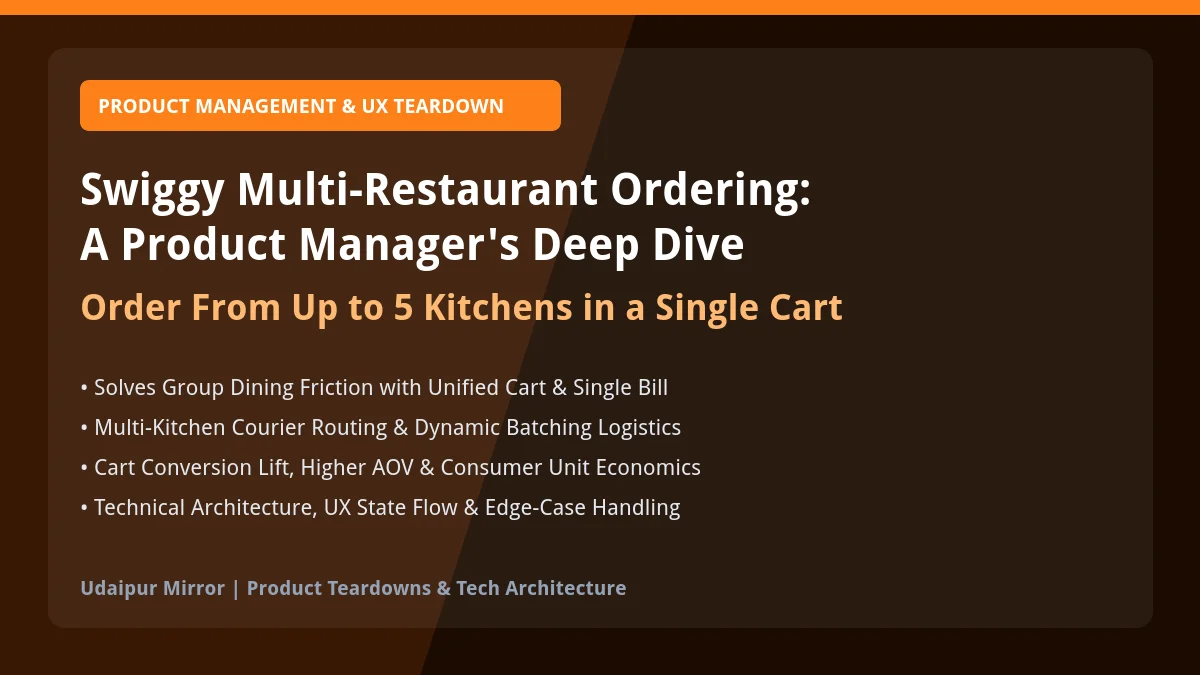
Swiggy has launched a game-changing Multi-Restaurant Ordering feature that allows customers to order items from up to five different restaurants in a single checkout flow with unified payment and tracking.
Anyone hosting a family dinner or house party knows the familiar dilemma: one person wants a sandwich, another wants a healthy salad, and someone else is craving biryani. Previously, satisfying everyone at the same table required multiple separate orders, distinct checkouts, and repeated payment flows across different apps. Following major innovations in quick-commerce and instant logistics platforms, Swiggy’s new feature redesigns food discovery around human occasions rather than rigid restaurant boundaries.
Analyzing this feature from a product management perspective highlights three critical dimensions of modern consumer app design:
Customers think in terms of occasions like weekend get-togethers and family meals, not restaurant boundaries. The core job-to-be-done is simple: help everyone at the table get what they want with minimal friction and effort.
While the front-end user experience looks seamless, the real operational challenge lies behind the scenes. Different partner restaurants operate with varying preparation times, order acceptance rates, and cancellation risks. Synchronizing these moving parts while ensuring on-time delivery is a formidable logistics hurdle, mirroring the sophisticated supply chain integrations seen across modern tech ecosystems.
Swiggy’s Multi-Restaurant Ordering feature allows users to add items from up to five different restaurants into a single cart, complete the purchase with one payment, and track all deliveries together.
It eliminates the friction of placing separate orders when people in the same household or group want food from different culinary spots, saving time and simplifying payment flows.
The primary challenges involve synchronizing different food preparation times across multiple kitchens, managing delivery partner routing, and handling kitchen-level cancellations or delays smoothly.
Disclaimer: This article is for informational and product management analysis purposes only. All feature descriptions are based on public product releases and UI observations.
Add Udaipur Mirror as a preferred source on Google to see more of our travel guides in your AI overviews.