Office Address
14, Residency Road, Udaipur, Rajasthan 313001
Office Address
14, Residency Road, Udaipur, Rajasthan 313001

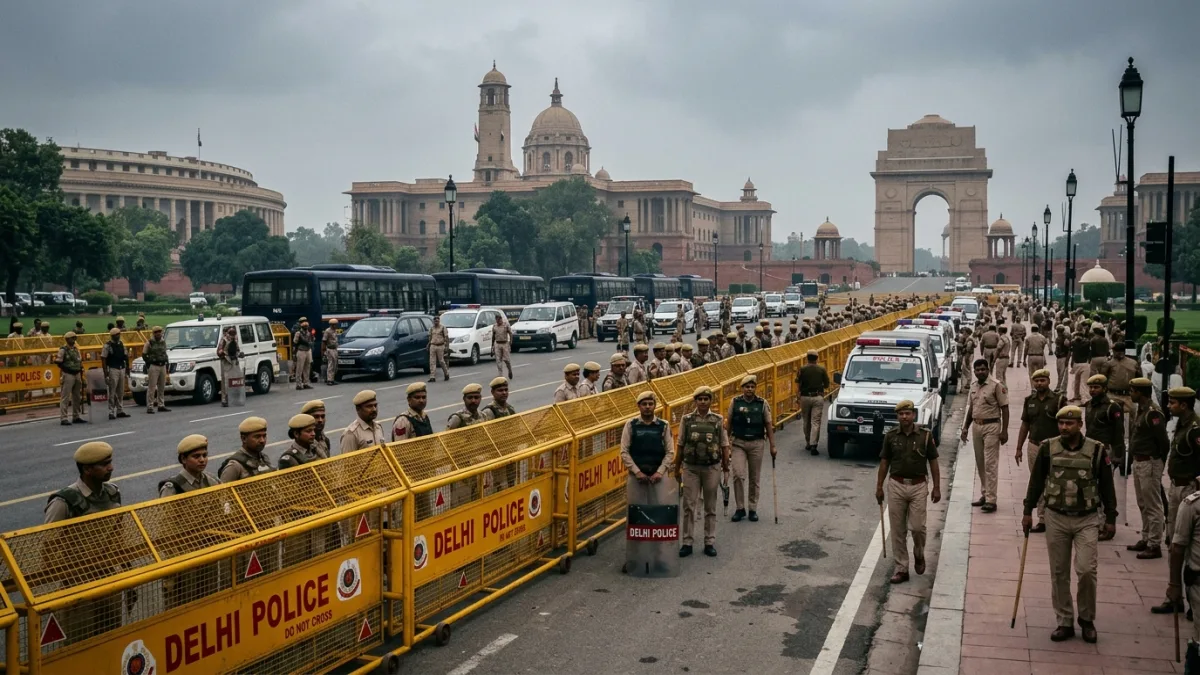
A day of unprecedented administrative lockdown and sweeping preventive detentions gripped the national capital on Saturday, October 10, 2026, as authorities dismantled the planned demonstration by the Cockroach Janta Party (CJP) at Jantar Mantar. Demanding the immediate resignation of Chief Election Commissioner (CEC) Gyanesh Kumar and the complete withdrawal of the Special Intensive Revision (SIR) of electoral rolls, the youth-driven political outfit saw its top leadership detained directly off their arrival flights at Indira Gandhi International (IGI) Airport, while over 3,300 demonstrators, political figures, and student activists were rounded up across New Delhi.
Despite the preventive detention of the outfit’s senior leaders, secondary organizers led by Ajinkya Shinde released pre-recorded contingency broadcasts calling on youth cadres and student bodies to proceed towards Jantar Mantar. What followed was a high-stakes standoff characterized by multi-tier barricades, rapid busing of detainees to makeshift holding centres, and an intense legal debate over democratic protest rights under Section 163 of the Bharatiya Nagarik Suraksha Sanhita (BNSS).
From the early hours of Saturday morning, central New Delhi was converted into a heavily fortified perimeter. Delhi Police, reinforced by Rapid Action Force (RAF) and Central Reserve Police Force (CRPF) battalions, established three-tier concentric security cordons around Jantar Mantar, Parliament Street, Patel Chowk, and the Central Secretariat.
Protesters began arriving in small batches via local rail transit and inter-state buses after metro access to Central Delhi was closed off. Around 10:30 AM, clusters of demonstrators carrying black flags, satirical placards featuring the CJP emblem, and copies of the Constitution attempted to gather at Tolstoy Marg and Janpath. Within minutes, police teams deployed barricades and commenced mass busing operations, directing detainees to temporary holding facilities in Bawana, Narela, and Burari sports complexes.
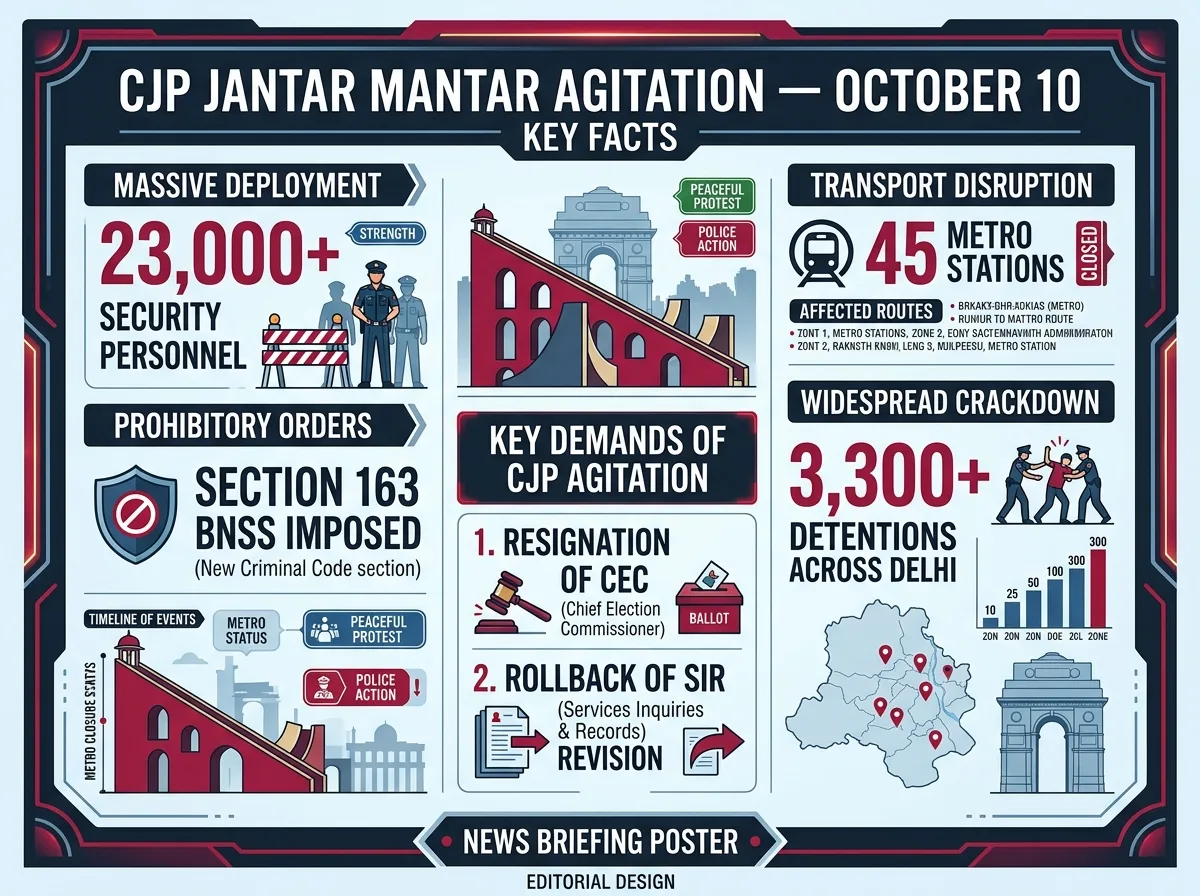
The Cockroach Janta Party, which evolved from a satirical digital youth collective into a grassroots Gen Z political organization, centered its agitation around two non-negotiable institutional grievances:
The Delhi Police’s operation was notable for its pre-emptive execution. Shortly after 7:15 AM, Delhi Police Special Cell operatives intercepted CJP founder Abhijeet Dipke, co-convenor Saurav Das, and national organizer Ashutosh Ranka directly as their commercial flight touched down at Terminal 3 of Indira Gandhi International (IGI) Airport. The leaders were escorted off the tarmac into waiting police vehicles before they could exit the airport concourse.
Simultaneously, key figures coordinating legal support and policy portfolios—including legal lead Ratna Singh and student coordination leads—were intercepted at New Delhi and Hazrat Nizamuddin railway stations. Several prominent opposition politicians and public figures attempting to join or express solidarity with the youth demonstration were also detained across the capital:
| Name / Organization | Role / Affiliation | Location of Detention | Status / Custody Site |
|---|---|---|---|
| Abhijeet Dipke | Founder, Cockroach Janta Party (CJP) | IGI Airport (Runway T3) | Preventive custody |
| Saurav Das & Ashutosh Ranka | National Co-convenors, CJP | IGI Airport (Runway T3) | Preventive custody |
| Ajinkya Shinde | Designated Protest Commander | Janpath / Tolstoy Marg Cordon | Detained at site |
| Arvind Kejriwal, Mamata Banerjee, Pinarayi Vijayan | Prominent Opposition Leaders | Central Delhi Borders & Transit Hubs | Detained / Escorted to State Bhawans |
| Dhruv Rathee | Digital Creator & Influencer | Gurugram Residence (Joint Operation) | Preventive custody |
| SFI & Student Delegation Leaders | University Student Alliances | Patel Chowk & Mandi House | Bawana & Burari Holding Grounds |
In a poignant personal development, while in preventive detention at an undisclosed police facility, Abhijeet Dipke was informed of the demise of his grandmother, Savitribai Shankarrao Dipke. Delhi Police authorities confirmed that arrangements were being facilitated for him to travel under escort to attend her last rites.
Delhi Police justified the sweeping clampdown by stating that CJP organizers failed to comply with the statutory requirement of a 10-day advance notice for demonstrations at Jantar Mantar. Citing intelligence inputs regarding potential law-and-order disruptions and massive traffic gridlock on central arterial routes, the Delhi Police Commissioner clamped prohibitory orders under Section 163 of the Bharatiya Nagarik Suraksha Sanhita (BNSS) (the new criminal procedural equivalent of Section 144 of the IPC).
The administrative measures included:
The security clampdown in New Delhi created immediate ripple effects across northern and western India. Over 250 long-distance and passenger express trains were cancelled, short-terminated, or diverted. Travelers originating from southern Rajasthan faced severe disruptions with the outright cancellation of the iconic Mewar Express (Train 12963/12964) between Udaipur City and Hazrat Nizamuddin.
Commuters heading to New Delhi from Udaipur, Rajsamand, and Chittorgarh had to rapidly shift to emergency flight alternatives or luxury multi-axle buses bypassing Delhi city limits. For detailed guidance on alternative corridors, read our dedicated logistics report on Udaipur to Delhi Travel Alternatives: Flights, Luxury Buses & Bypass Routes, along with our morning transit bulletin on the CJP Protest Delhi Transit & Mewar Express Cancellation Impact.
The detention of over 3,300 citizens in a single day has triggered swift legal mobilizations. Senior advocates representing the demonstrators have approached the Supreme Court and the Delhi High Court, challenging the invocation of Section 163 BNSS as an overbroad suppression of peaceful assembly under Article 19(1)(b) of the Constitution.
Constitutional experts note that while municipal police forces maintain legitimate discretion to regulate traffic and public order, the blanket pre-emptive detention of leaders landing at airports without specific registered First Information Reports (FIRs) sets a contentious legal precedent. The Election Commission of India has thus far declined to offer formal comment on the political resignation demands, maintaining that the Special Intensive Revision is a routine, constitutionally mandated cleanup exercise.
The Cockroach Janta Party (CJP) is a youth-centric political movement in India that originated as a satirical digital collective and has transitioned into an active pressure group advocating for electoral integrity, employment opportunities, and bureaucratic accountability.
Delhi Police denied permission citing the absence of a mandatory 10-day prior written notice, concerns over potential traffic gridlock in the high-security New Delhi district, and intelligence alerts regarding law-and-order disruptions.
Authorities reported that between 3,000 and 3,300 protesters, including top organizers, university student delegations, and allied political figures, were detained across New Delhi and transported to temporary administrative holding facilities.
Delhi Metro Rail Corporation (DMRC) officials stated that closed stations will progressively resume regular operations following security clearances and the gradual lifting of prohibitory restrictions by the Delhi Police.
Add Udaipur Mirror as a preferred source on Google to see more of our travel guides in your AI overviews.