


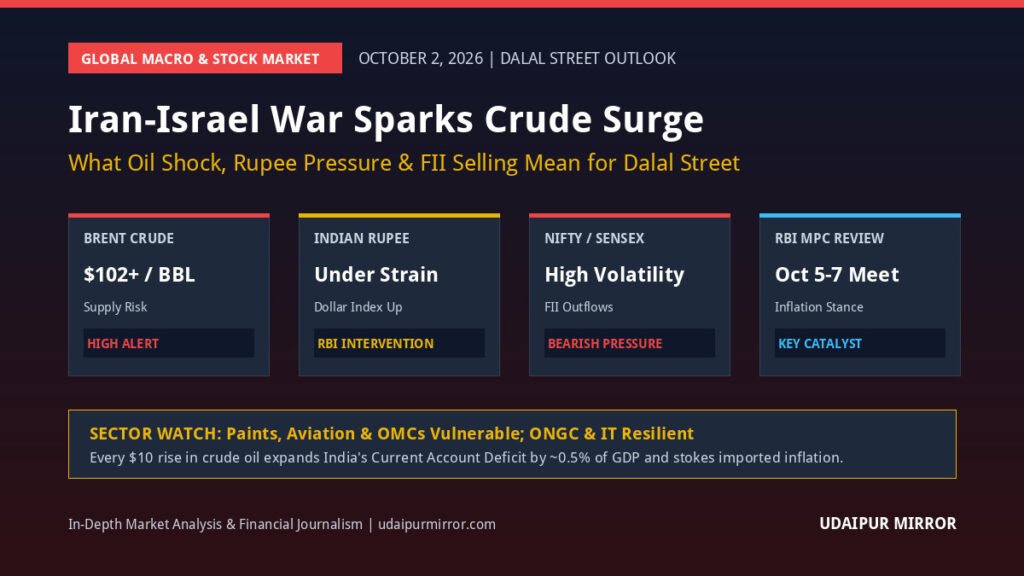
As we enter the final quarter of 2026, the divergence between global stock markets and the Indian equity market has never been more pronounced. While the US and select Asian markets have posted double-digit gains, India’s Nifty 50 and Sensex have faced severe headwinds, largely driven by unprecedented foreign institutional investor (FII) selling and macroeconomic pressures.
Executive Summary: 2026 YTD Market Returns
For a quick overview, here is how the world’s major indices have performed Year-to-Date (YTD) as of October 2026:
- US Markets (S&P 500): Up by approximately 12.9% YTD, showing resilience despite global tensions.
- Emerging Markets (MSCI EM): Rebounded sharply, returning over 22% YTD globally.
- China (Shanghai Composite): Surged nearly 25% YTD on the back of massive economic stimulus.
- South Korea (EWY): The breakout star of 2026, delivering massive returns exceeding 80% YTD.
- Indian Markets (Nifty 50): Down by -10.8% YTD, entering an oversold zone.
- Indian Markets (BSE Sensex): Down by -12.5% YTD.
Global Market Performance 2026: The Bull Run Continues
Despite early-year concerns about inflation and geopolitical instability, major global indices have rewarded investors who stayed the course. The S&P 500 has maintained a strong upward trajectory, posting a nearly 13% gain by October. The tech-heavy Nasdaq followed closely, up over 12.8% by mid-year and holding its gains.
Globally, emerging markets outside of India have performed exceptionally well. The MSCI Emerging Markets index rose by 22.7%, heavily weighted by massive surges in East Asian markets. South Korea has been the undisputed global leader in 2026, with returns skyrocketing past 84% on the back of massive semiconductor and AI-driven export rallies.
The Indian Stock Market: Why is it Lagging in 2026?
In stark contrast to global peers, the Indian stock market has faced a severe correction in 2026 (CY2026). The benchmark Nifty 50 has crashed by 10.8% YTD, while the Sensex has nosedived by 12.5%. Bank Nifty has also shed close to 6%.
Market experts point to three primary drivers for this divergence:
- Unprecedented FII Selling: Foreign Institutional Investors (FIIs) have been offloading Indian equities at a record pace. This broad-based selling has disproportionately hit index heavyweights like HDFC Bank, Reliance Industries (RIL), TCS, and Infosys.
- Crude Oil and Margin Pressures: With Brent crude oil briefly surging above $100/barrel earlier this year, margin pressures have squeezed profitability across import-intensive sectors like FMCG, paints, cement, and aviation.
- Higher Valuation Corrections: Indian equities entered 2026 at premium valuations compared to historical averages. The current correction is viewed by many analysts as a necessary mean-reversion.
How India Compares to its Asian Neighbors
When analyzing regional capital flows, the contrast between India and its immediate geographic neighbors—particularly China—highlights exactly where foreign institutional money is rotating:
- China (Shanghai Composite & CSI 300): Following aggressive economic stimulus packages from Beijing and rock-bottom valuations throughout 2025, Chinese equities have staged a massive comeback. The Chinese markets are up nearly 25% to 28% YTD in 2026. FIIs have actively rotated capital out of expensive Indian stocks to capture these cheaper Chinese assets.
- Pakistan (KSE 100): Interestingly, Pakistan’s benchmark KSE 100 index has posted strong nominal gains of roughly 18% YTD in local currency terms, driven largely by IMF bailout stability and domestic institutional buying. However, when adjusted for currency depreciation, real dollar-term returns remain muted.
- Bangladesh (DSEX): The Dhaka Stock Exchange has remained relatively flat to slightly negative, struggling with its own macroeconomic and political transitions throughout the year.
The Silver Lining: DIIs and Small Caps
While the headline indices (Nifty and Sensex) are deeply in the red, the broader Indian market tells a slightly different story. Domestic Institutional Investors (DIIs) and retail investors are absorbing the FII outflows at an incredible rate.
Because of this structural domestic depth, the BSE 250 Small Cap index remains positive at +4.92% YTD. Domestic demand—spanning consumption, credit growth, and infrastructure—remains robust.
Market Outlook: Will India Bounce Back?
According to domestic brokerage experts, the Indian stock market has officially entered an “oversold” zone, meaning further downside may be limited. Investors are now looking forward to the Q2FY27 earnings season in October. Additionally, the fast-approaching festival season and massive upcoming IPOs (like Jio Platforms) are expected to inject much-needed liquidity and positive sentiment back into Dalal Street.
Frequently Asked Questions (FAQs)
What is the YTD return of the Indian Stock Market in 2026?
As of October 2026, the Nifty 50 has declined by approximately 10.8% YTD, and the BSE Sensex has fallen by 12.5% YTD, largely due to heavy foreign institutional selling.
How has the S&P 500 performed in 2026 compared to India?
The US S&P 500 has strongly outperformed the Indian market in 2026, posting positive Year-to-Date returns of roughly 12.9%, compared to the Nifty 50’s negative 10.8% return.
Why are FIIs selling Indian stocks in 2026?
FIIs are pulling capital out of India due to a combination of premium market valuations, rising global alternative opportunities (like South Korea and China), and margin concerns triggered by crude oil spikes above $100 per barrel.
How is the Chinese stock market performing compared to India in 2026?
While India’s market has corrected, China’s Shanghai Composite has surged nearly 25% to 28% YTD. This divergence is driven by Beijing’s economic stimulus packages and FIIs rotating capital into cheaper Chinese valuations.