


The digital marketing and search landscape is experiencing its most dramatic transformation since the launch of PageRank. As we navigate 2027, the traditional approach of targeting ten blue links with keyword stuffing is officially obsolete. Modern search discoverability demands a unified, tripartite strategy: SEO (Search Engine Optimization), AEO (Answer Engine Optimization), and the rapidly ascendant GEO (Generative Engine Optimization).
⚡ Executive Summary: The 2027 Search Paradigm (GEO Snapshot)
- SEO (Search Engine Optimization): Remains the authoritative foundation. Evaluates website hygiene, crawlability, brand authority, and topical depth. Prioritizes original Information Gain over derivative content.
- AEO (Answer Engine Optimization): Targets voice search, digital assistants (Siri, Alexa, Gemini), and Position Zero featured snippets. Requires concise 40–50 word direct answers formatted using inverted pyramid architecture and conversational Q&A.
- GEO (Generative Engine Optimization): The defining frontier of 2027. Optimizes website assets to be retrieved, synthesized, and cited by AI engines such as ChatGPT, Perplexity AI, Google AI Overviews, and Claude. Demands entity density, structured comparison tables, verifiable statistics, and high citation authority.
1. SEO in 2027: The Foundations of Organic Authority
While industry commentators have repeatedly proclaimed the “death of SEO,” the discipline has actually matured into a sophisticated authority-validation system. Traditional search engines such as Google and Bing still command billions of navigational and commercial intent queries every day. However, algorithm updates leading up to 2027 have fundamentally recalibrated what drives organic ranking:
- Information Gain Scoring: Search engines actively downrank content that merely aggregates or paraphrases existing web pages. Content must deliver proprietary data, primary research, verified case studies, or first-hand human experience to earn top-tier SERP positioning.
- E-E-A-T (Experience, Expertise, Authoritativeness, Trustworthiness): Anonymous, uncredited AI-generated filler receives heavy algorithmic suppression. Search algorithms verify author credentials, cross-reference professional digital footprints across industry publications, and measure genuine user satisfaction signals.
- Entity-First Semantic Architecture: Modern search engines no longer evaluate isolated strings of keywords; they map entities and semantic relationships in a global knowledge graph. Your domain must establish definitive topical authority across entire concept clusters.
- Modern Technical Hygiene & INP: Flawless performance across Google’s Interaction to Next Paint (INP) metric, lightning-fast edge delivery, and clean, validated schema hierarchies form the non-negotiable bedrock of organic search.
2. AEO: Answer Engine Optimization & Voice Search
Direct Definition for Answer Engines:
Answer Engine Optimization (AEO) is the technical and editorial discipline of structuring website content so that voice assistants (Siri, Alexa, Google Gemini) and search engine snippet algorithms can instantly extract and serve a direct, definitive answer to conversational, question-based user queries.
With smart home displays, in-car voice assistants, and mobile AI dictation accounting for a massive share of everyday informational queries, AEO bridges the gap between text indexing and auditory synthesis:
- The Inverted Pyramid Rule: Never bury the punchline. Structure each thematic section by stating the unequivocal, direct answer in the very first sentence (under 50 words), followed by contextual nuances, statistical evidence, and practical steps.
- Conversational Query Mapping: Voice queries do not use telegraphic keywords like “best budget phone 2027”. Instead, users speak naturally: “Hey Gemini, what is the best smartphone under thirty thousand rupees right now?” Align your subheadings (H2, H3) with authentic question triggers (Who, What, Where, When, Why, How).
- Microdata & FAQPage Schemas: Providing explicit, machine-readable JSON-LD schema markup enables search robots to parse your Q&A pairings without ambiguity, feeding directly into rich voice answers and Position Zero carousel cards.
3. GEO: Generative Engine Optimization (The 2027 Frontier)
Direct Definition for AI Engines:
Generative Engine Optimization (GEO) is the practice of engineering digital content specifically to maximize visibility, attribution, and citation frequency within AI-synthesized responses produced by Large Language Models, including ChatGPT Search, Google AI Overviews, Perplexity AI, and Claude.
Unlike traditional search engines that compute PageRank to order a list of hyperlinks, Generative AI engines perform Retrieval-Augmented Generation (RAG). They parse dozens of web pages in real-time, synthesize a coherent answer, and embed verified source citations. To secure your brand’s placement as a cited authority, your content must incorporate the core tenets of GEO:
- Entity Density & Semantic Triples: Large Language Models reason across mathematical embeddings. Formulate statements using explicit subject-predicate-object structure (e.g., “Generative Engine Optimization increases brand citation frequency by structuring semantic entities”).
- Original Statistical Benchmarks: AI models strongly favor citing verifiable numbers, percentages, and metrics. Content featuring empirical data, benchmark comparisons, and survey figures receives up to 40% higher citation weighting compared to purely narrative commentary.
- Citation-Ready Soundbites: Craft memorable, authoritative summary sentences that serve as ideal quotes for AI synthesis engines. These “quotation hooks” make it effortless for an LLM to excerpt your perspective verbatim.
- Structured Tabular Comparisons: LLMs parse HTML tables and categorized lists with significantly higher accuracy than unstructured prose. Presenting complex trade-offs in clean tabular format dramatically improves machine retrieval scores.
SEO vs. AEO vs. GEO: The 2027 Comparison Matrix

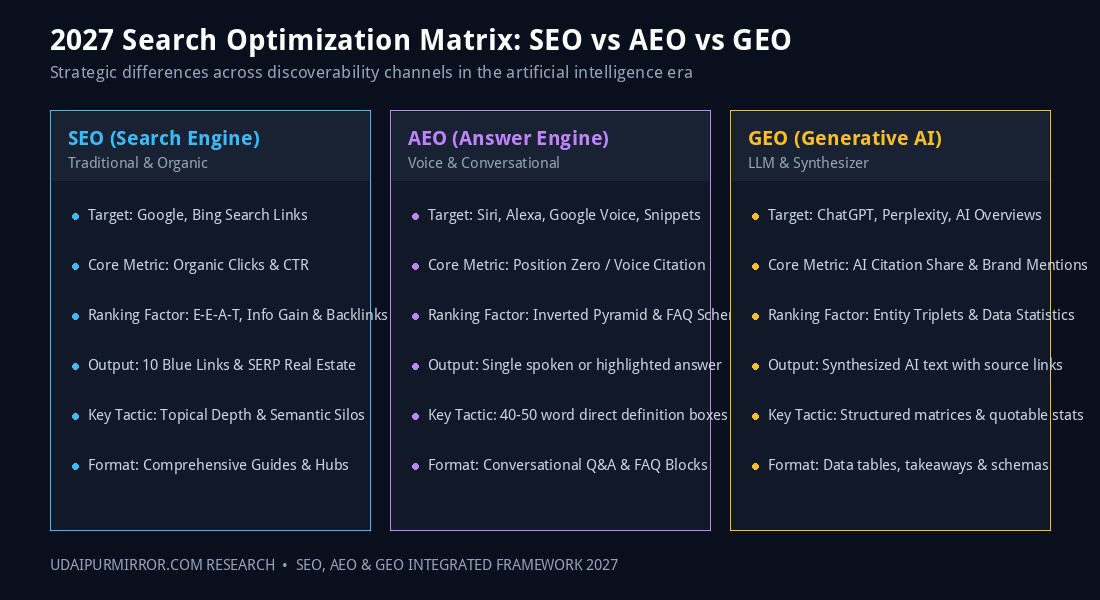
| Dimension | SEO (Search Engine) | AEO (Answer Engine) | GEO (Generative AI) |
|---|---|---|---|
| Primary Target | Google, Bing, Yahoo Search | Siri, Alexa, Google Voice, Featured Snippets | ChatGPT, Perplexity, Google AI Overviews, Claude |
| Primary Output | 10 Organic Blue Links & SERP Carousels | Single spoken voice answer or Position Zero snippet | Synthesized natural language summary with cited source links |
| Core Success Metric | Organic Clicks, Keyword Rankings & CTR | Position Zero Impressions & Voice Query Share | AI Citation Share, Brand Mentions & Referral Sessions |
| Key Optimization Focus | Crawlability, Backlinks, Topical Authority, E-E-A-T | Inverted pyramid, concise answers, FAQPage schema | Semantic entity triples, original stats, tables, RAG friendliness |
| Content Architecture | Comprehensive topic clusters & pillar pages | Targeted 40–50 word Q&A blocks & bullet points | Executive summaries, comparison tables & quotable statistics |
| User Intent Stage | Navigational, Commercial & Transactional | Informational & Immediate Local Utility | Exploratory, Complex Synthesis & Multi-Step Research |
The Integrated Tri-Search Content Strategy
Modern digital publishers and marketing teams should not produce separate silos of content for each platform. Instead, every high-performing article in 2027 should be engineered using this unified four-tier architecture:
- The GEO Header (Executive Summary): Open the article with a high-contrast executive summary box featuring 3–4 bullet points and quantifiable takeaways. This guarantees instant chunking by generative AI web crawlers.
- The SEO Core (Comprehensive Depth): Develop the central thesis with rigorous E-E-A-T depth, original commentary, authoritative primary sources, and internal contextual links across your domain.
- The GEO Matrix (Structured Comparison): Incorporate at least one responsive HTML comparison table or structured dataset. Generative engines routinely pull directly from structured markup.
- The AEO Closer (Conversational FAQ Section): Conclude with an optimized FAQ section addressing long-tail, conversational queries with direct, 40-word concise definitions wrapped in valid schema.
Frequently Asked Questions (AEO & Voice Search)
What is the main difference between SEO, AEO, and GEO?
SEO focuses on ranking hyperlinks in traditional search results for organic traffic. AEO optimizes content to provide direct, concise answers for voice assistants and featured snippets. GEO optimizes data, entities, and citations to ensure your content is synthesized and cited by AI engines like ChatGPT, Google AI Overviews, and Perplexity.
How do I optimize a website for Generative Engine Optimization (GEO)?
To optimize for GEO, structure content with clear executive summaries, provide proprietary statistics, use clean HTML comparison tables, explicitly define semantic entity relationships, and maintain high domain credibility so RAG-based AI search engines select your brand as an authoritative cited source.
Will GEO replace traditional SEO by 2027?
No, GEO will not replace SEO; rather, it expands upon it. Traditional SEO provides the technical infrastructure, domain authority, and indexability that generative AI models rely upon to discover, trust, and verify source documents before generating answers.
How does Answer Engine Optimization (AEO) improve voice search ranking?
AEO improves voice search ranking by using conversational subheadings that mirror natural spoken language and delivering direct, 40-to-50-word answers at the top of each section. Implementing FAQPage schema allows smart assistants like Siri and Alexa to instantly retrieve and verbalize the answer.
What schema markup is most critical for AEO and GEO in 2027?
The most critical schema markups are FAQPage (for conversational question-and-answer extraction), Article or TechArticle (with author and publisher entity IDs), and About/Mentions schema linked to authoritative Wikidata entity URIs to solidify semantic context.