Office Address
14, Residency Road, Udaipur, Rajasthan 313001
Office Address
14, Residency Road, Udaipur, Rajasthan 313001


NEW DELHI / UDAIPUR: Navigating the congested alleyways and densely packed residential colonies of Indian metros and tier-2 cities like Udaipur demands supreme dimensional agility. As urban real estate gets tighter and vehicle density climbs, finding compact vehicles that offer high maneuverability has become a priority for modern buyers. For urban residents dealing with restrictive apartment basements and congested roadways, choosing the right set of wheels is vital. When evaluating urban mobility solutions, buyers heavily prioritize footprint efficiency alongside modern powertrain options, a trend heavily mirrored as EVWorld.com platform expansion targets global electric mobility shifts. Outfitting your garage with the ideal urban commuter means focusing on turning radius, visibility, and overall body width. This comprehensive guide details the top 8 cars for narrow lanes india that make driving and parking effortless in tight spaces.
⚡ Quick Highlights: Best Cars for Narrow Lanes and Tight Parking in India 2026
Driving through older residential sectors, traditional bazaars, and congested housing societies across Indian cities presents a daily obstacle course. Narrow lanes flanked by parked two-wheelers, stray cattle, and oncoming traffic require exceptional spatial awareness and vehicle agility. In response to these everyday hurdles, automotive manufacturers have engineered specialized compact hatchbacks and micro electric vehicles that thrive where bulky full-size SUVs struggle.
Choosing a vehicle with a tight turning radius and a narrow body shell prevents scratched bumpers and constant stress during morning commutes. Furthermore, as automakers collaborate closely with component suppliers on local platforms—much like how industry discussions shape future EV manufacturing—consumer choices are shifting toward purpose-built urban runabouts. (Also read: EVWorld.com Platform Expansion Targets Global Electric Mobility Shifts in Late 2026).
“The real test of an urban car in India is not its highway top speed, but how effortlessly it slips through a narrow street market without scratching its mirrors.” — Senior Automotive Analyst
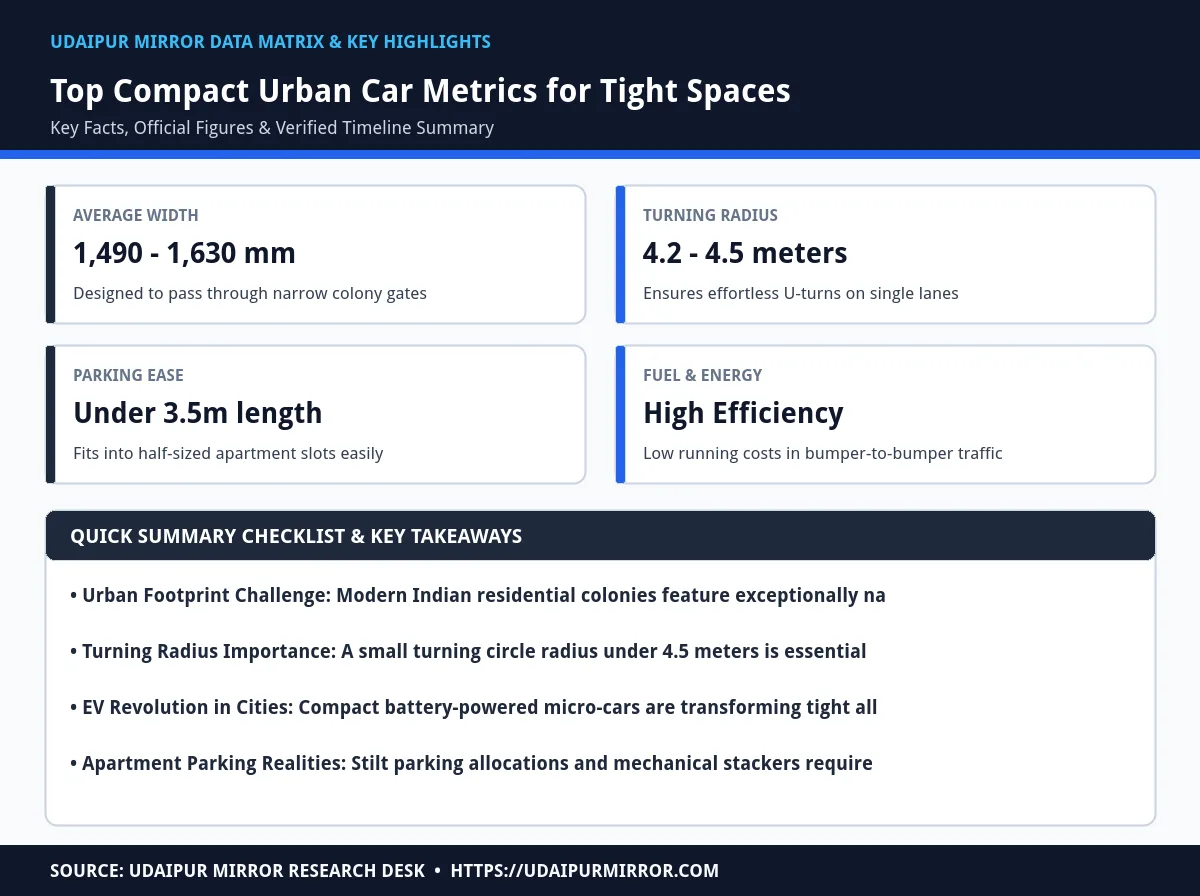
Review this detailed technical comparison table highlighting dimensions, turning radii, and powertrain specifications of the top compact vehicles built for narrow lanes and tight apartment parking complexes in India.
| Car Model | Length x Width (mm) | Turning Radius | Powertrain Options | Estimated On-Road Price |
|---|---|---|---|---|
| Maruti Suzuki Alto K10 | 3530 x 1490 mm | 4.5 meters | Petrol / CNG | Rs. 4.80 – 6.20 Lakh |
| MG Comet EV | 2974 x 1505 mm | 4.2 meters | Pure Electric (EV) | Rs. 7.50 – 9.80 Lakh |
| Maruti Suzuki S-Presso | 3565 x 1520 mm | 4.5 meters | Petrol / CNG | Rs. 5.00 – 6.30 Lakh |
| Renault Kwid | 3731 x 1579 mm | 5.0 meters | 1.0L Petrol | Rs. 5.10 – 6.80 Lakh |
| Tata Tiago | 3765 x 1677 mm | 4.9 meters | Petrol / CNG / EV | Rs. 6.00 – 9.50 Lakh |
| Hyundai Grand i10 Nios | 3810 x 1680 mm | 4.8 meters | Petrol / CNG | Rs. 6.50 – 9.20 Lakh |
Apartment living in metropolitan hubs and expanding tier-2 cities often comes with constrained parking spaces. Mechanical stackers, stilt parking lots with rigid pillar placements, and narrow basement ramps require micro electric vehicles that pack punchy performance into minuscule footprints. The MG Comet EV, for instance, has redefined urban commuting with its boxy, skateboard platform that maximizes interior room while minimizing exterior dimensions.
With instant torque delivery and zero tailpipe emissions, urban EVs glide through stop-and-go traffic smoothly. Industry developments continue to accelerate as Tata Motors keeps Mahindra in rearview as EV sales drive passenger vehicle lead, proving that compact and sub-compact electric offerings are capturing massive market share across the country.
“Micro electric vehicles represent the pinnacle of smart urban space utilization, offering big cabin comfort inside a parking footprint smaller than a standard motorcycle bay.” — EV Fleet Operations Director
For buyers who prefer tried-and-tested internal combustion engines or dual-fuel CNG options, traditional segment mainstays like the Maruti Suzuki Alto K10 and S-Presso remain undefeated champions of tight-lane driving. Their lightweight construction, highly responsive small-displacement petrol engines, and minimal overhangs ensure that drivers can slip into tight gaps where larger sedans dare not venture.
Additionally, the rising popularity of small cars in smaller cities highlights a broader demographic shift. Buyers in regional commercial hubs are demanding affordable, highly maneuverable cars that offer low maintenance costs alongside modern touchscreen infotainment systems and essential safety features like dual airbags and ABS. (Also read: Goyal, Skoda Auto Discuss EV Manufacturing & Localisation in India).
“Simplicity and mechanical reliability make petrol hatchbacks the undisputed kings of narrow lane commuting across semi-urban India.” — Fleet Maintenance Manager
Before finalizing any new vehicle purchase for tight apartment parking, buyers must conduct a practical assessment of their daily route and parking bay dimensions. Measuring the clearance between apartment pillars, checking ramp steepness, and testing the turning circle during a test drive in your actual residential lane are vital steps to avoid post-purchase regret.
Opting for features such as electrically foldable ORVMs (outside rear-view mirrors), rear parking sensors, and reversing cameras with adaptive guidelines can dramatically reduce the friction of parking in restricted spaces. Making these informed choices guarantees long-term driving peace of mind.
“Always measure your apartment parking width including the pillar projections before booking a vehicle; a few centimeters can make or break your daily parking routine.” — Urban Infrastructure Consultant
Micro electric vehicles like the MG Comet EV feature ultra-compact dimensions and a tight turning radius of around 4.2 meters, making them exceptionally easy to maneuver in narrow alleyways.
Yes, cars like the Maruti Suzuki Alto K10 and S-Presso offer narrow body widths under 1.55 meters and short lengths, allowing them to fit into constrained stilt parking bays effortlessly.
A vehicle width between 1,490 mm and 1,650 mm is considered ideal for navigating congested Indian residential lanes and traditional market streets without scraping obstacles.
Most micro EVs designed for city commuting come with battery packs that can be conveniently charged overnight using a standard 15-amp household wall socket, eliminating the need for expensive dedicated wall-box chargers.
Add Udaipur Mirror as a preferred source on Google to see more of our travel guides in your AI overviews.