Office Address
14, Residency Road, Udaipur, Rajasthan 313001
Office Address
14, Residency Road, Udaipur, Rajasthan 313001


NEW DELHI: NEW DELHI — Marking a pivotal milestone in the country’s green technology transition, the Ministry of New and Renewable Energy has officially initiated the framework for the india wind repowering plan. Announced on Wednesday, November 11, 2026, this strategic blueprint targets an immediate 8 GW capacity upgrade across legacy wind generation sites, unlocking an unprecedented 50 percent efficiency and capacity gain without requiring additional vast land allocations.
⚡ Quick Highlights: India Wind Repowering Plan: 8 GW Upgrade & Capacity Gains
India’s wind energy sector has matured significantly over the past three decades, but thousands of early-generation wind turbine generators (WTGs) installed in prime wind resource zones are currently operating at a fraction of modern technological capability. These legacy assets occupy premium land parcels characterized by optimal wind velocities. By implementing the india wind repowering plan, developers can dismantle sub-megawatt turbines and replace them with state-of-the-art multi-megawatt variants.
Industry analysts point out that modernizing these sites is far more cost-effective than developing entirely greenfield projects, as transmission infrastructure, internal access roads, and statutory environmental clearances are already established. Furthermore, addressing infrastructure bottlenecks is critical, echoing sentiments expressed by industry leaders on how Grid Flexibility Must Keep Pace with Renewable Growth, Declares Archana Bhatnagar to avoid curtailment losses.
“Repowering is no longer just an option; it is an absolute economic and ecological imperative for maximizing our rich coastal and inland wind corridors without putting additional stress on land availability.” — Senior Renewable Energy Policy Analyst, New Delhi
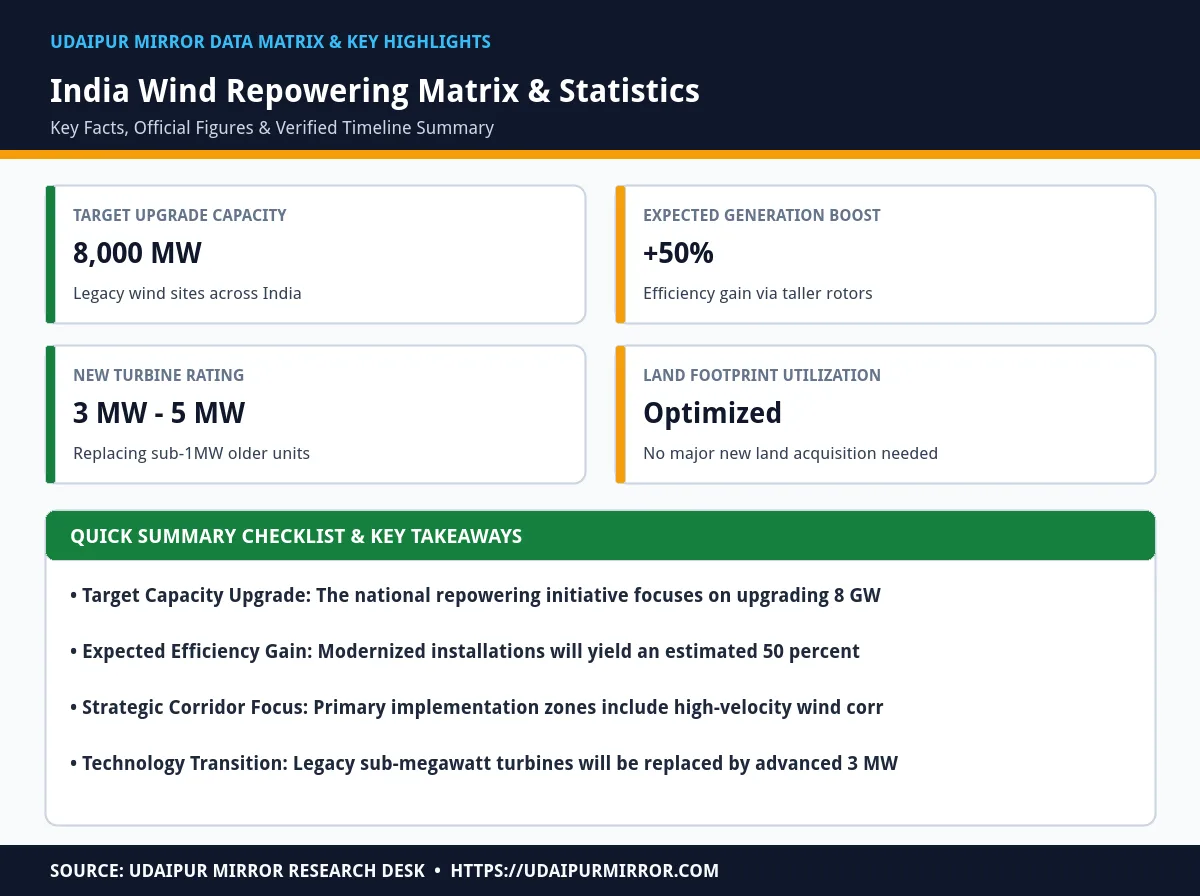
The transition from legacy sub-megawatt wind installations to modern utility-scale hardware represents a fundamental paradigm shift in India’s renewable energy yield. The table below outlines the core technical metrics comparing older setups with the newly mandated repowering standards.
| Technical Parameter | Legacy Wind Turbines (Pre-2015) | Repowered Modern Turbines (2026) | Performance Improvement |
|---|---|---|---|
| Average Unit Capacity | 0.5 MW to 0.8 MW | 3.0 MW to 5.0 MW | 5x to 6x Higher Output |
| Rotor Diameter | 50 to 70 meters | 130 to 160 meters | Swept area increased by 300% |
| Hub Height | 60 to 80 meters | 120 to 160 meters | Access to stronger high-altitude winds |
| Capacity Utilization Factor (CUF) | 20% to 22% | 35% to 42% | Nearly doubled generation efficiency |
| Land Use Efficiency | Low (High footprint per MW) | High (Max power per hectare) | 50% higher generation per sq km |
The core objective of the 8 GW upgrade initiative is achieving a targeted 50 percent boost in national wind power generation from the same geographical footprint. Older turbines, typically restricted to hub heights under 80 meters, frequently miss stronger, steadier winds blowing at higher altitudes. Modern repowered turbines feature towering masts exceeding 130 meters coupled with massive rotor diameters.
This expansive swept area allows the blades to capture kinetic energy even in low-wind conditions, substantially smoothing out generation intermittency. State nodal agencies are currently coordinating with independent power producers (IPPs) to audit existing foundations to determine whether structural retrofitting or complete re-pounding is necessary for the heavier 3 MW+ nacelles.
“Taller towers and wider swept areas transform mediocre wind sites into high-yield powerhouses, dramatically improving the financial viability for asset owners.” — Wind Energy Technology Director, IndexBox Analytics
Executing an 8 GW overhaul requires seamless coordination between central regulators, state transmission utilities, and financial institutions. The Ministry’s revised guidelines provide clear pathways for power purchase agreement (PPA) extensions and banking of power during the dismantling and reconstruction phases. Concessional financing lines from domestic green bonds and international climate funds are being mobilized to ensure project developers secure low-cost debt.
State distribution companies (DISCOMs) are also overhauling their interconnection protocols to accommodate higher localized injection capacities. Ensuring transparent settlement mechanisms for net-energy and dynamic tariff integration remains a top priority as these upgraded mega-farms come back online over the next 24 to 36 months. (Also read: RSSB Computer Anudeshak Document Verification 2026: 3,038 Candidates Shortlisted, Online Scrutiny Form Schedule Released @rssb.rajasthan.gov.in).
“Financial institutions are increasingly eager to back brownfield repowering projects due to their proven historical wind data and established grid interconnects.” — Green Infrastructure Financing Lead
The plan aims to upgrade 8 GW of legacy, low-capacity wind turbine generators across India, achieving a projected 50 percent increase in power generation capacity by replacing older machines with modern 3 MW to 5 MW units.
By utilizing existing wind farm sites, developers replace sub-megawatt turbines with modern turbines featuring taller hub heights (130+ meters) and larger rotor diameters, capturing stronger winds and dramatically improving generation efficiency.
States with high-velocity wind corridors and legacy installations—primarily Tamil Nadu, Gujarat, Maharashtra, and Rajasthan—are slated to be the primary beneficiaries of the repowering initiative.
Repowering lowers the levelized cost of energy (LCOE), reduces maintenance overheads, maximizes existing land and transmission infrastructure, and significantly accelerates India’s clean energy transition without extensive new land acquisition.
Add Udaipur Mirror as a preferred source on Google to see more of our travel guides in your AI overviews.