Office Address
14, Residency Road, Udaipur, Rajasthan 313001
Office Address
14, Residency Road, Udaipur, Rajasthan 313001


JAIPUR: The Government of Rajasthan has rolled out strict operational protocols for the rajasthan jan aadhaar 2.0 framework, making biometric and OTP-based verification mandatory for all residents across the state. As administrative machinery tightens welfare delivery mechanisms, citizens must complete their mandatory family authentication to avoid disruptions in state-backed subsidies, ration distribution, and direct benefit transfer (DBT) schemes. While families frequently navigate administrative updates—such as exploring Bhuwana & Sukher Real Estate Guide 2026: 2 & 3 BHK Apartment Rates, RERA Plots & Trends for housing documentation—securing updated Jan Aadhaar credentials remains the foremost priority for accessing government welfare portals.
⚡ Quick Highlights: Rajasthan Jan Aadhaar 2.0 Guide 2026: Mandatory e-KYC & Portal
The evolution of state identification in Rajasthan has reached a critical milestone with the implementation of the updated platform. The framework is designed to create a single identifier for identity, address, and entitlement tracking across all state welfare schemes. Under the revised guidelines, completing e-KYC is no longer optional; it is a legal prerequisite for receiving monthly rations, scholarship disbursements, pension benefits, and healthcare subsidies. Every family member above the age of 5 must undergo biometric fingerprint authentication or Aadhaar-linked OTP verification.
Administrative authorities have reiterated that profiles failing to complete verification risk temporary suspension of benefit transfers. Citizens can execute this process conveniently from home using their personal computer or mobile device via the state single sign-on interface. Meanwhile, cultural and intellectual gatherings in the state, such as those covered during Udaipur Witnesses Historic Memory Feat: Mahashatavadhani Muni Divyaprasannakirti Sagar Answers 500 Questions Without Pen or Paper | उदयपुर में अद्वितीय स्मरण शक्ति का प्रदर्शन, highlight the rich heritage of Rajasthan while modern governance portals streamline everyday citizen services.
“Complete biometric authentication at your nearest e-Mitra or via the SSO portal immediately to prevent any disruption in monthly welfare subsidies and food security benefits.” — State Directorate of Jan Aadhaar, Government of Rajasthan
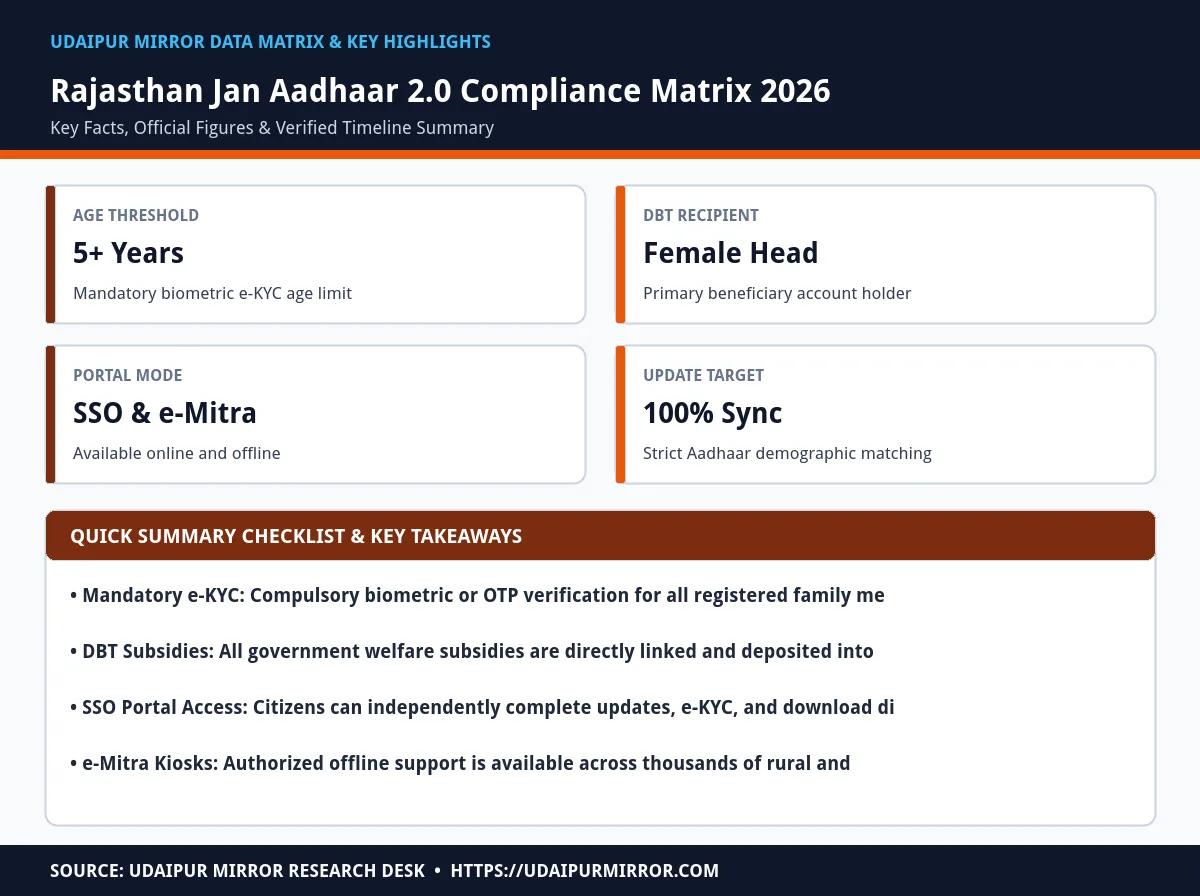
The following structured matrix outlines the essential operational procedures, required documentation, and execution channels for completing mandatory compliance under the updated Jan Aadhaar 2.0 framework.
| Operational Task | Target Group / Condition | Execution Channel | Mandatory Documents |
|---|---|---|---|
| Mandatory e-KYC | All members aged 5 and above | Rajasthan SSO Portal / e-Mitra | Aadhaar Card, Biometric / Registered Mobile |
| Adding Newborn | Children below 5 years | Jan Aadhaar Portal via SSO ID | Birth Certificate, Parents Jan Aadhaar & Aadhaar |
| Name / DOB Correction | Individual family members | e-Mitra Kiosk with Biometric | Original Aadhaar Card, Supporting ID Proof |
| Female Head Update | Family profile restructuring | District e-Mitra / Sadar Office | Passbook, Aadhaar, Consent Affidavit |
| Digital Card Download | All verified families | Jan Aadhaar Mobile App / SSO | Valid SSO Credentials & OTP verification |
Executing the verification process online requires an active single sign-on profile. Citizens can log into the official portal using their digital credentials and navigate directly to the dedicated citizen dashboard. Once inside the dashboard, selecting the ‘Jan Aadhaar e-KYC’ tab initiates the automated verification wizard, which fetches real-time demographic data from the central Unique Identification Authority database.
Users must carefully verify each family member’s details against physical records before submitting final authentication. If discrepancies appear during the session, the portal flags the specific field for mandatory offline correction at a certified kiosk. Ensuring absolute alignment between Aadhaar and Jan Aadhaar data prevents administrative rejection and expedites digital card issuance.
“Digital governance relies entirely on data accuracy. Double-check your spelling, gender tags, and birth dates before hitting final submit on the portal.” — Senior IT Department Official, Jaipur
For citizens facing technical hurdles, connectivity issues, or biometric mismatch errors on the web portal, authorized physical service outlets provide comprehensive assistance. Across urban sectors and rural gram panchayats, certified operators are equipped with biometric scanners and direct backend portal access to resolve complex profile errors swiftly.
Visitors must carry original physical documents, including Aadhaar cards for all participating family members and registered bank passbooks. Operators execute manual overrides where necessary, ensuring that demographic updates—such as correcting spelling errors in names, updating changed surnames after marriage, or adjusting birthdates—are synchronized directly with central state servers. (Also read: Udaipur Honors Jain Sadhvis on Completing 85 Fasts and 38th Ayambil Oli | साध्वी अभिनंदन एवं आयंबिल ओली पूर्णाहुति).
“e-Mitra kiosks serve as the backbone of grassroots digital inclusion, bridging the gap for citizens who require assisted biometric authentication.” — District e-Mitra Coordinator
Expanding family records to include newborn children is a streamlined digital procedure under the updated platform. Parents can initiate an inclusion request directly through the portal by uploading the official birth certificate issued by local municipal authorities or medical institutions. The system automatically cross-references parent identification numbers to establish legitimate lineage and lineage tracking.
For correcting existing demographic details—such as name spelling mismatches, gender entries, or exact date of birth errors—the portal mandates that data strictly mirrors the applicant’s official Aadhaar card. Any deviation between the two databases requires a prior update at an Aadhaar enrollment center before submitting rectification requests on the Jan Aadhaar platform.
“Adding a newborn within the stipulated timeframe ensures seamless integration into state health insurance and child nutrition programs without administrative delay.” — Child Welfare Department Spokesperson
A cornerstone of the welfare architecture is the mandatory channeling of all state-sponsored financial assistance, subsidies, and cash transfers directly into the bank account designated for the female head of the family. This policy empowers women by placing household financial management squarely in their hands, ensuring transparency and reducing intermediaries in welfare distribution.
To prevent payment rejections or delayed deposits, the designated female head’s bank account must be fully Aadhaar-seeded, active, and compliant with National Payments Corporation of India (NPCI) mapping rules. Citizens can verify their seeding status online through financial portals or inspect their account mapping directly at their respective bank branches before finalizing their family e-KYC submissions.
“Empowering women through direct benefit linkage has transformed grassroots welfare delivery, ensuring every rupee reaches the intended family household securely.” — Social Justice and Empowerment Minister, Rajasthan
Yes, biometric or OTP-based e-KYC is strictly mandatory for all registered family members aged 5 years and above to maintain active status and receive state welfare benefits.
Yes, you can complete the e-KYC online using a mobile device or computer by logging into the official Rajasthan SSO portal with your digital credentials and Aadhaar-linked mobile number.
You must first update your details on your Aadhaar card at an authorized enrollment center. Once corrected, you can submit matching rectification requests on the Jan Aadhaar portal or via an e-Mitra kiosk.
All state welfare subsidies and direct benefit transfers (DBT) are deposited exclusively into the active, Aadhaar-seeded bank account linked to the designated female head of the family.
Add Udaipur Mirror as a preferred source on Google to see more of our travel guides in your AI overviews.





[…] News French Tourist Who Died in Udaipur Cremated, Ashes to Be Sent to France 5 seconds ago ⚡ Articles Rajasthan Jan Aadhaar 2.0 Guide 2026: Mandatory e-KYC, Adding Family Members & Benefit… Auto Top Electric Cars Under ₹20 Lakh: Comprehensive Range and Variant Guide for Indian Buyers 3 […]