Office Address
14, Residency Road, Udaipur, Rajasthan 313001
Office Address
14, Residency Road, Udaipur, Rajasthan 313001


NEW DELHI: NEW DELHI — Navigating the complexities of property accumulation requires more than traditional brick-and-mortar purchases, and finding a smarter way to invest in real estate became the focal point of discussion at the ongoing Economic Times Wealth Expo 2026. Industry leaders gathered in the capital to decode modern asset allocation strategies, with prominent speakers highlighting how technological evolution and structured financial products are reshaping property portfolios across India. For everyday retail investors balancing equity SIPs and debt instruments, understanding alternative avenues like fractional ownership has never been more critical.
⚡ Quick Highlights: Smarter Way to Invest in Real Estate: Senthil Kumar at ET Wealth Expo
The Economic Times Wealth Expo 2026 served as a crucible for modern wealth creation strategies, drawing thousands of retail investors, chartered accountants, and financial advisors to New Delhi. Among the standout sessions, the panel discussion moderated around alternative wealth vehicles captured immense attention. Industry leaders unpacked the changing dynamics of the Indian property market, emphasizing that locking capital into unproductive residential plots is rapidly losing favor among financially literate millennials and Gen-Z accumulators.
Delivering his keynote presentation, Senthil Kumar walked the audience through the structural inefficiencies of traditional brick-and-mortar investments. He underscored that while emotional attachment to land remains deeply rooted in Indian households, empirical data points toward commercial leasing and financialized property products as superior wealth multipliers. Meanwhile, urban property seekers in Tier-2 and Tier-3 cities continue to evaluate local housing options, as seen in regional expansions like Bhuwana & Sukher Real Estate Guide 2026, even as institutional money pivots toward Grade-A commercial spaces.
“The future of real estate investing does not lie in hoarding physical concrete that demands constant maintenance and legal oversight. It lies in institutional-grade commercial assets packaged for fractional accessibility.” — Senthil Kumar, Financial Expert & Speaker at ET Wealth Expo 2026
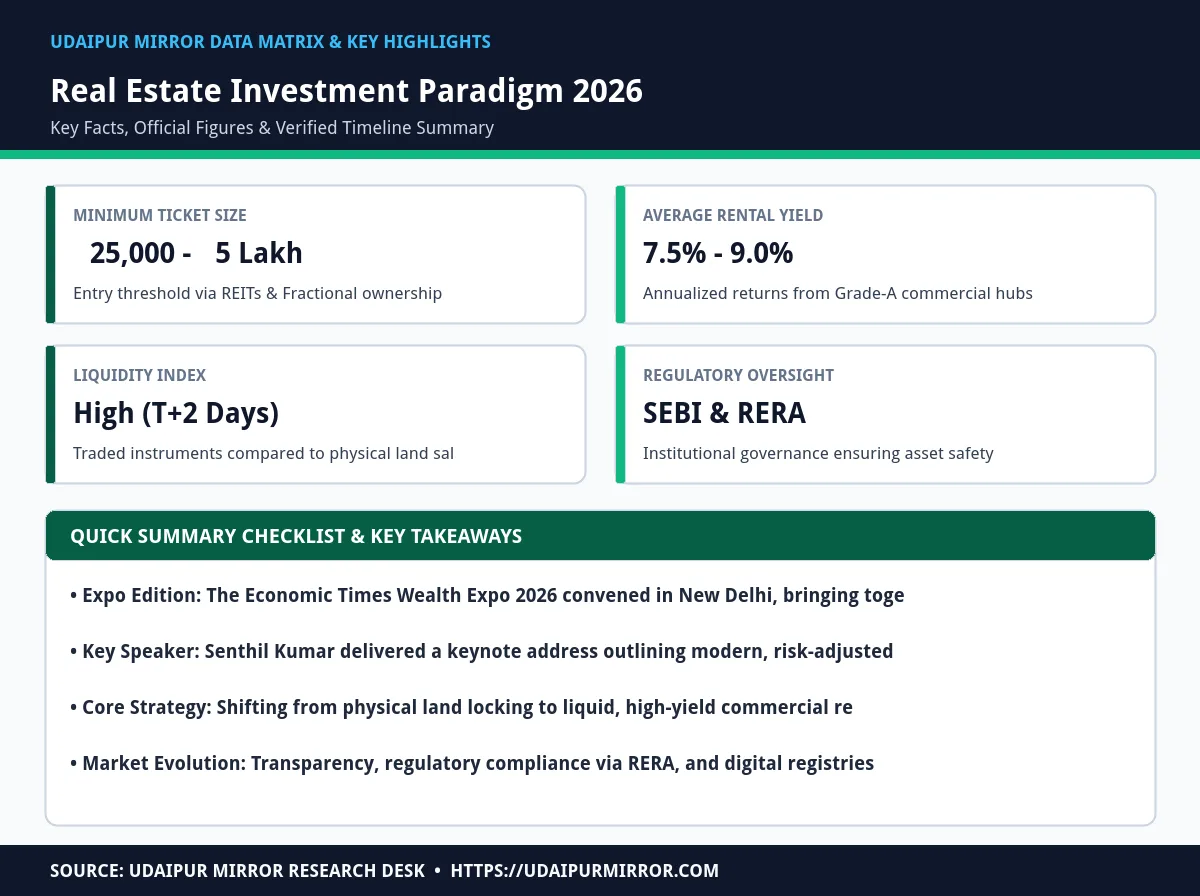
When exploring a smarter way to invest in real estate, retail investors must weigh traditional physical holdings against modern financialized instruments like REITs, InvITs, and fractional platforms. Below is a detailed comparative breakdown for FY 2026-27:
| Investment Vehicle | Entry Capital | Liquidity & Trading | Average Rental Yield | Tax Treatment (FY 2026-27) |
|---|---|---|---|---|
| Physical Residential/Plot | ₹50 Lakhs – ₹5 Crores+ | Very Low (Months to Years) | 2.0% – 3.0% | LTCG after 2 years with indexation/flat rules |
| Real Estate Investment Trusts (REITs) | ₹10,000 – ₹50,000 | High (Exchange Traded Daily) | 6.5% – 8.0% | Dividends taxed as per slab; Capital gains apply |
| Fractional Ownership Platforms (FOPs) | ₹10 Lakhs – ₹25 Lakhs | Moderate (Secondary marketplace) | 8.0% – 10.0% | Taxed under capital gains and business income |
| Infrastructure Investment Trusts (InvITs) | ₹1 Lakh – ₹2 Lakhs | High (Exchange Traded Daily) | 8.5% – 11.0% | Pass-through status with specific distribution rules |
| Commercial Real Estate Mutual Funds | ₹500 (via SIP) | High (Open-ended fund rules) | 7.0% – 9.0% | Equity/Debt taxation based on underlying asset mix |
For decades, high-value commercial real estate—such as IT parks, Grade-A office towers, and warehousing logistics hubs—remained exclusively accessible to ultra-high-net-worth individuals (UHNWIs) and private equity funds. However, the emergence of Real Estate Investment Trusts (REITs) and SEBI-regulated Fractional Ownership Platforms (FOPs) has democratized this segment. Retail investors can now participate in prime commercial rentals with ticket sizes as low as a few thousand rupees.
During his session, Senthil Kumar elaborated on how these digital-first platforms ensure transparency, regular cash flow distributions, and professional asset auditing. Unlike standalone apartments where rental yields rarely exceed 3 percent, Grade-A commercial spaces frequently generate yields hovering between 7.5 and 10 percent per annum. This steady quarterly payout mimics fixed-income security while retaining equity-like capital appreciation upside over long investment horizons.
“When you invest in a REIT or fractional commercial asset, you are buying into the productivity of India's corporate growth story rather than just a locked room.” — Senthil Kumar
Achieving long-term financial independence requires a harmonious blend of equity mutual funds, sovereign debt instruments, retirement buckets, and optimized real estate holdings. Financial advisors at the expo stressed that property should constitute no more than 15 to 20 percent of an investor’s overall net worth, preventing liquidity crunches during economic downturns. Over-allocation to physical real estate has historically crippled middle-class families by locking up emergency funds into unmarketable land parcels.
As citizens streamline their documentation and financial identities through digital portals—similar to families updating records via the Rajasthan Jan Aadhaar 2.0 Guide 2026—the ease of verifying asset ownership and executing financial transactions has improved exponentially. Modern investors are encouraged to audit their portfolios annually, trimming underperforming physical assets and redirecting liquidity into high-yield financialized real estate instruments.
For novice investors stepping into the property ecosystem for the first time, leaping straight into commercial property syndicates or REITs requires a foundational understanding of market cycles. Senthil Kumar advised beginners to start small through mutual fund routes or publicly traded REIT units before committing larger sums to fractional ownership structures. This incremental approach allows investors to experience market volatility and liquidity dynamics without risking critical life savings.
Furthermore, keeping abreast of regulatory updates, budget announcements regarding capital gains tax, and macroeconomic interest rate cycles remains vital. Whether you are managing professional certifications like medical aspirants tracking the Rajasthan NEET PG Admission 2026 counseling rounds or building a robust retirement nest egg, disciplined capital allocation is the bedrock of enduring financial security.
Senthil Kumar emphasized shifting from traditional physical real estate locking to liquid, high-yield financialized instruments like REITs, InvITs, and fractional ownership platforms.
REITs offer high liquidity through stock exchange trading, professional management, low entry capital (starting around ₹10,000), and higher rental yields, whereas physical property requires large capital and has very low liquidity.
Grade-A commercial real estate typically generates annual rental yields between 7.5% and 10%, which is significantly higher than the 2% to 3% yields common in residential properties.
Financial planners generally recommend capping real estate exposure at 15% to 20% of an investor’s total net worth to maintain portfolio liquidity and prevent over-concentration.
Add Udaipur Mirror as a preferred source on Google to see more of our travel guides in your AI overviews.