Office Address
14, Residency Road, Udaipur, Rajasthan 313001
Office Address
14, Residency Road, Udaipur, Rajasthan 313001


NEW DELHI: NEW DELHI — As modern urban professionals increasingly question the conventional retirement age of 60, the Financial Independence, Retire Early (FIRE) movement has gained tremendous traction across India. At the heart of this paradigm shift is the FIRE calculator early retirement framework, which helps young earners compute exact target wealth accumulation goals. Financial advisors are increasingly debating whether a ₹2 crore or a ₹2.5 crore corpus is sufficient to sustain a comfortable post-work lifestyle for three decades or more, factoring in persistent domestic inflation and rising medical expenses.
⚡ Quick Highlights: FIRE Calculator: Need ₹2 Crore or ₹2.5 Crore to Retire Early?
When planning to step away from full-time employment in your late 30s or 40s, standard retirement calculators often prove inadequate because they assume a 30-year post-work lifespan starting at age 60. An early retiree leaving the workforce at 40 must fund a 50-year horizon. In this context, financial experts emphasize that while a ₹2 crore corpus might seem substantial today, it can deplete rapidly under the strain of compounding inflation.
The fundamental rule of thumb in retirement planning is the 25x rule, which states that your target retirement fund should be at least 25 times your annual living expenses. For an individual spending ₹8 lakh annually, ₹2 crore fits the baseline. However, unexpected lifestyle creep, medical emergencies, and family milestones often push actual expenses higher, making a ₹2.5 crore target a safer psychological and financial cushion. (Also read: Gold and Silver Hit Lowest Prices in a Year as Interest Rate Hikes Loom).
“Retiring early is less about the absolute number in your bank account and more about aligning your annual drawdown rate with sustainable equity growth.” — Senior Certified Financial Planner
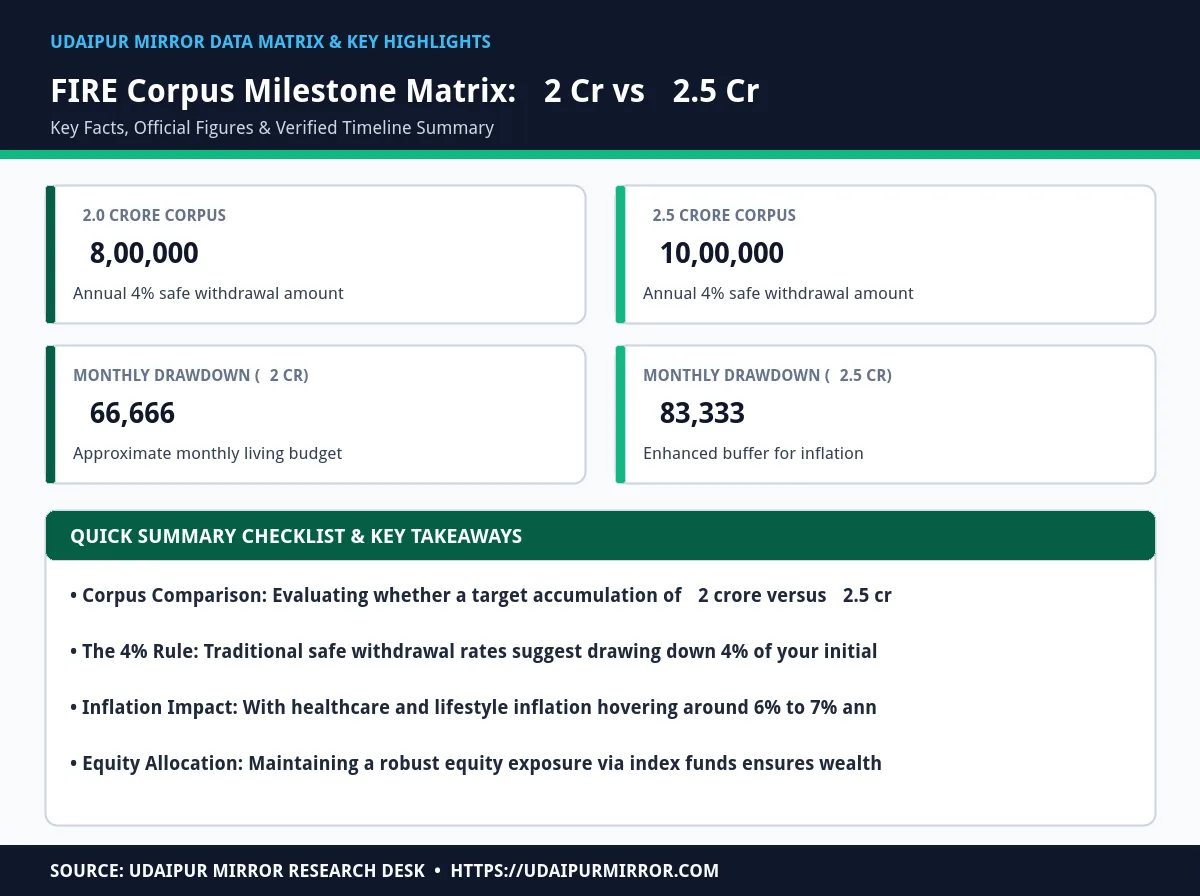
The table below outlines how different annual household expense levels dictate your required early retirement corpus based on a standard 25x to 30x multiplier rule. To explore alternative investment avenues that can compound your capital before retiring, look at how broader market indices and stock milestones reflect overall economic strength.
| Annual Living Expense | 25x Multiplier Corpus | 30x Multiplier Corpus | Recommended Equity Split |
|---|---|---|---|
| ₹6,00,000 (₹50k/month) | ₹1.50 Crore | ₹1.80 Crore | 60% Equity / 40% Debt |
| ₹8,00,000 (₹66k/month) | ₹2.00 Crore | ₹2.40 Crore | 65% Equity / 35% Debt |
| ₹10,00,000 (₹83k/month) | ₹2.50 Crore | ₹3.00 Crore | 70% Equity / 30% Debt |
| ₹12,00,000 (₹1L/month) | ₹3.00 Crore | ₹3.60 Crore | 75% Equity / 25% Debt |
Accumulating the corpus is only half the battle; managing the drawdown phase determines whether your wealth survives market downturns. The 4% safe withdrawal rate, pioneered by financial researchers, suggests that drawing 4% of your portfolio in year one and adjusting it for inflation in subsequent years will safely sustain a 30-year retirement. For a 50-year horizon, wealth managers recommend trimming the initial withdrawal rate to 3.2% or 3.5% to mitigate sequence-of-returns risk.
Investors must also consider shifting market conditions and macroeconomic headwinds before making final portfolio adjustments. As global central banks alter monetary policies, asset classes react differently—much like how precious metals fluctuate during shifting interest rate cycles. Diversifying across large-cap equity mutual funds, hybrid funds, and fixed-income instruments ensures a balanced risk-reward profile during your retirement years.
“Sequence of returns risk can devastate an early retirement portfolio if a major market correction occurs right after you quit your job.” — Wealth Management Specialist
For investors currently sitting at a ₹2 crore milestone who aspire to reach ₹2.5 crore, disciplined compounding via Systematic Investment Plans (SIPs) remains the most reliable vehicle. Increasing your monthly SIP contribution by even 10% annually can shave years off your timeline. Furthermore, utilizing low-cost index funds or dynamic asset allocation funds helps optimize returns without exposing the portfolio to excessive unsystematic risk.
Ultimately, achieving FIRE is not merely a mathematical exercise but a lifestyle choice. Retirees must balance frugality with enjoying the freedom they have purchased. Building secondary income streams, such as consulting, freelance work, or passion projects, can also drastically reduce the pressure on your core retirement nest egg. (Also read: Shares of NSE Surge to All-Time High as Market Capitalisation Crosses ₹5 Trillion Milestone).
“A top-up in your monthly SIP amount during salary hikes can bridge a ₹50 lakh deficit faster than most aggressive stock picking.” — Principal Investment Strategist
The core formula relies on the 25x rule, multiplying your annual living expenses by 25 (or 30 for extra safety) to determine your target corpus. For instance, if you spend ₹8 lakh annually, your target is ₹8,00,000 x 25 = ₹2 crore.
₹2 crore can be sufficient for single individuals or couples with modest lifestyles and low fixed expenses. However, for urban families facing high inflation, healthcare, and education costs, experts recommend aiming for ₹2.5 crore or more.
While the traditional rule suggests a 4% annual withdrawal rate, financial advisors recommend a conservative 3.2% to 3.5% withdrawal rate for early retirees whose retirement horizon spans 40 to 50 years.
A bucket strategy is recommended: keep 2 years of expenses in liquid/arbitrage funds, 3 to 5 years in short-term debt, and the remainder in equity mutual funds to ensure long-term inflation-beating growth.
Add Udaipur Mirror as a preferred source on Google to see more of our travel guides in your AI overviews.