Office Address
14, Residency Road, Udaipur, Rajasthan 313001
Office Address
14, Residency Road, Udaipur, Rajasthan 313001


NEW DELHI: NEW DELHI — In a major push toward India’s net-zero carbon goals, the Solar Energy Corporation of India (SECI) has officially announced that seci targets 10 gw own capacity by the year 2030. Speaking on Tuesday, November 17, 2026, SECI Managing Director Akash Tripathi outlined the state-run enterprise’s comprehensive blueprint to expand its operational footprint, optimize renewable asset portfolios, and secure prestigious Maharatna public sector undertaking status amid a rapidly evolving domestic green tech landscape.
⚡ Quick Highlights: SECI Targets 10 GW Clean Capacity by 2030: MD Akash Tripathi
The Solar Energy Corporation of India (SECI) has long functioned as the central anchoring entity for India’s monumental renewable energy tenders. However, under the visionary leadership of Managing Director Akash Tripathi, the institution is fundamentally pivoting from a pure intermediary facilitator to a major asset owner. As financial markets monitor commodity fluctuations—such as when gold and silver hit lowest prices amid shifting global interest rate expectations—infrastructure investors are channeling long-term capital into robust green energy assets with predictable cash flows.
Reaching a self-owned generating capacity of 10 gigawatts by 2030 requires substantial equity deployment, advanced project execution capabilities, and rigorous financial discipline. Attaining Maharatna PSU status will grant SECI enhanced financial autonomy, empowering the board to approve capital expenditures up to ₹5,000 crore without requiring direct government clearance. This administrative agility is crucial as India races to meet its binding international climate commitments. (Also read: Gold and Silver Hit Lowest Prices in a Year as Interest Rate Hikes Loom).
“Our strategic imperative is clear: by scaling our own asset portfolio to 10 GW by 2030, SECI will solidify its financial standing and achieve Maharatna status.” — Akash Tripathi, Managing Director, SECI
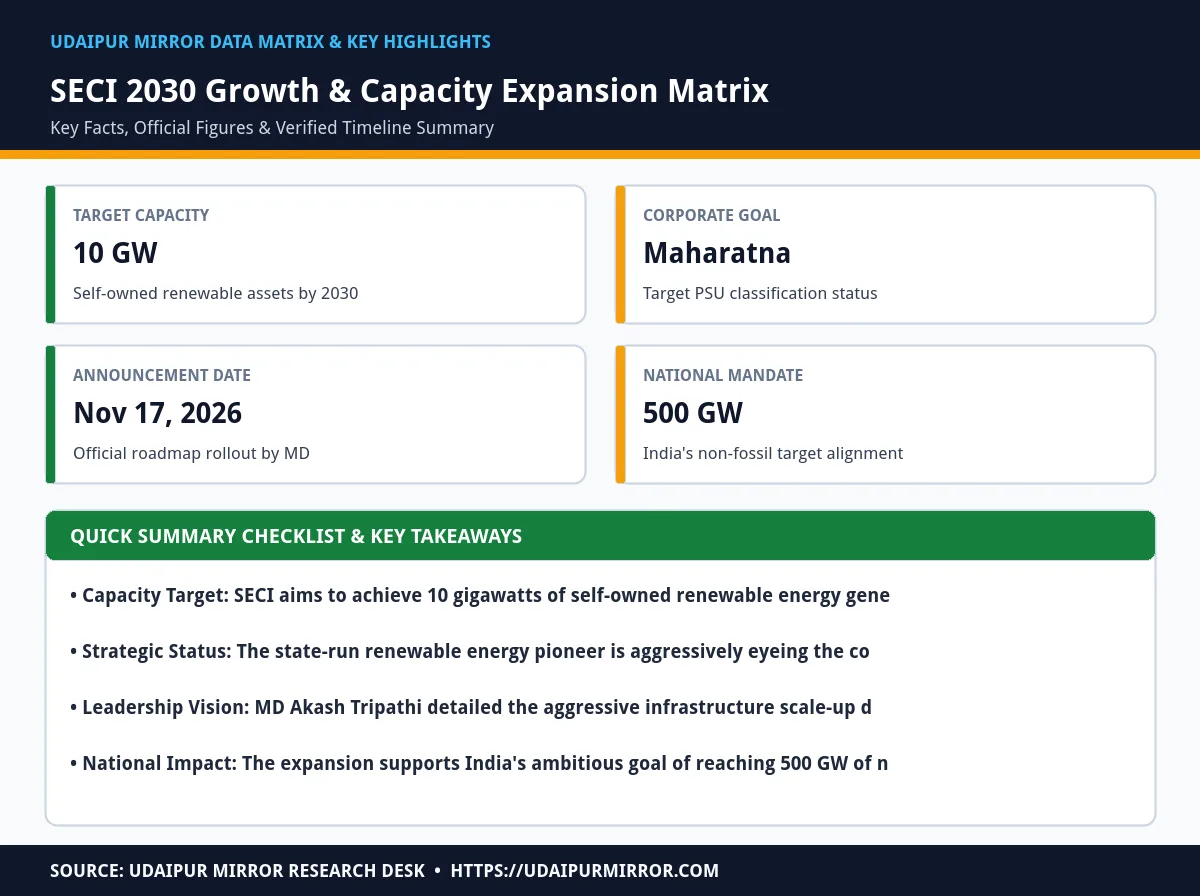
The following comparative matrix outlines SECI’s targeted self-owned capacity milestones against broader national clean energy rollout benchmarks for fiscal year 2026-2030.
| Strategic Metric | Current Baseline (2026) | Interim Milestone (2028) | Target Goal (2030) | Strategic Impact |
|---|---|---|---|---|
| SECI Owned Capacity | ~1.5 GW | 5.0 GW | 10.0 GW | Maharatna Eligibility |
| National Solar Share | 85.2 GW | 180.0 GW | 280.0 GW | Base Grid Expansion |
| Wind-Solar Hybrid | 12.4 GW | 35.0 GW | 75.0 GW | Peak Load Management |
| Energy Storage Integration | 4.2 GWh | 15.0 GWh | 40.0 GWh | Grid Stability Enhancement |
| Projected Capital Outlay | ₹15,000 Cr | ₹45,000 Cr | ₹90,000 Cr | Asset Portfolio Growth |
While SECI’s expansion roadmap is exceptionally ambitious, the broader renewable energy sector faces notable macroeconomic headwinds. Developers across the country are grappling with fluctuating component costs, financing expenses, and tightening grid integration norms. In parallel, local manufacturing ecosystems are expanding rapidly, echoing trends seen when industrial hubs scale up, much like how Jalgaon leads solar revolution initiatives with tens of thousands of decentralized rooftop installations.
To mitigate rising capital expenditure pressures, SECI is leveraging its institutional clout to negotiate bulk supply agreements and streamline land acquisition in high-irradiation zones such as western Rajasthan. Furthermore, strict adherence to CERC regulatory frameworks ensures that grid stability is maintained even as intermittent solar and wind capacities surge past historical records.
“Disciplined cost management and innovative financing structures remain the cornerstone of our long-term green capacity expansion strategy.” — Senior SECI Infrastructure Strategist
SECI’s push for utility-scale supremacy complements India’s aggressive decentralized solar campaigns, including the PM Surya Ghar Muft Bijli Yojana. While utility parks in the Thar desert provide bulk power, state DISCOMs and central agencies are simultaneously building massive energy storage capacity to manage peak-hour demand spikes. This dual-pronged approach ensures that India’s power grid remains resilient, flexible, and capable of absorbing intermittent renewable generation without risking frequency collapses.
As these mega-projects take shape, industrial consumers and retail households alike are adopting solar technologies at an unprecedented pace. Whether through large-scale EPC contracts or residential rooftop installations—supported by guides on rooftop solar system installation—the entire green technology ecosystem is experiencing a transformative golden age driven by proactive government policy.
“The integration of utility-scale parks with distributed rooftop generation creates an unbreakable backbone for India's future power security.” — State Renewable Energy Directorate
SECI has targeted achieving 10 gigawatts (GW) of self-owned renewable energy generation capacity by the year 2030.
Under MD Akash Tripathi, SECI is actively eyeing the prestigious Maharatna Public Sector Undertaking (PSU) status, which will provide greater financial and administrative autonomy.
Maharatna status will empower SECI’s board to approve capital investments up to ₹5,000 crore without requiring direct government sanction, accelerating project execution.
The strategic roadmap and capacity target were formally highlighted by SECI Managing Director Akash Tripathi on Tuesday, November 17, 2026.
Add Udaipur Mirror as a preferred source on Google to see more of our travel guides in your AI overviews.