Office Address
14, Residency Road, Udaipur, Rajasthan 313001
Office Address
14, Residency Road, Udaipur, Rajasthan 313001


MUMBAI: MUMBAI — In a worrying development for the domestic macroeconomic landscape, the Indian rupee officially breached key psychological thresholds on Saturday as ongoing forex outflows and global market pressures pushed the rupee below 93, settling sharply lower at 92.67 against the US dollar. Financial markets opened to intense volatility this morning, with currency traders scrambling to adjust positions as the local unit faced sustained downward momentum throughout the week. Analysts note that persistent foreign institutional investor (FII) reallocations, coupled with fluctuating commodity trends and shifting global interest rate expectations, have heavily weighed on the domestic legal tender, sparking urgent deliberations across financial corridors in Mumbai and New Delhi.
⚡ Quick Highlights: Rupee Below 93: Indian Currency Hits 92.67 Against US Dollar
The sharp depreciation of the Indian rupee past the 92.67 mark is the culmination of several overlapping domestic and international economic forces. Over the past few weeks, foreign institutional investors have rebalanced portfolios, redirecting capital toward alternative emerging markets or safe-haven assets. This structural outflow has exerted relentless pressure on domestic liquidity. Furthermore, corporate demand for greenbacks to service external commercial borrowings and heavy import bills for crude oil and industrial inputs has drained available dollar reserves in the spot market.
Market participants point out that while corporate earnings have largely remained resilient, currency headwinds introduce complex valuation challenges. Companies reliant on raw material imports are bracing for margin contractions, while export-oriented sectors like IT services and pharmaceuticals may find temporary relief in a softer local currency. Nevertheless, the velocity with which the rupee below 93 threshold was approached has surprised even veteran treasury managers, prompting calls for proactive liquidity management by monetary authorities. (Also read: CBI Recovers Rs 1.86 Crore Cash, Gold and Silver From Arrested CGST Superintendent's House).
“The sudden slide in the currency highlights the susceptibility of domestic markets to global liquidity shifts and widening trade deficits.” — Senior Currency Strategist, Mumbai Financial District
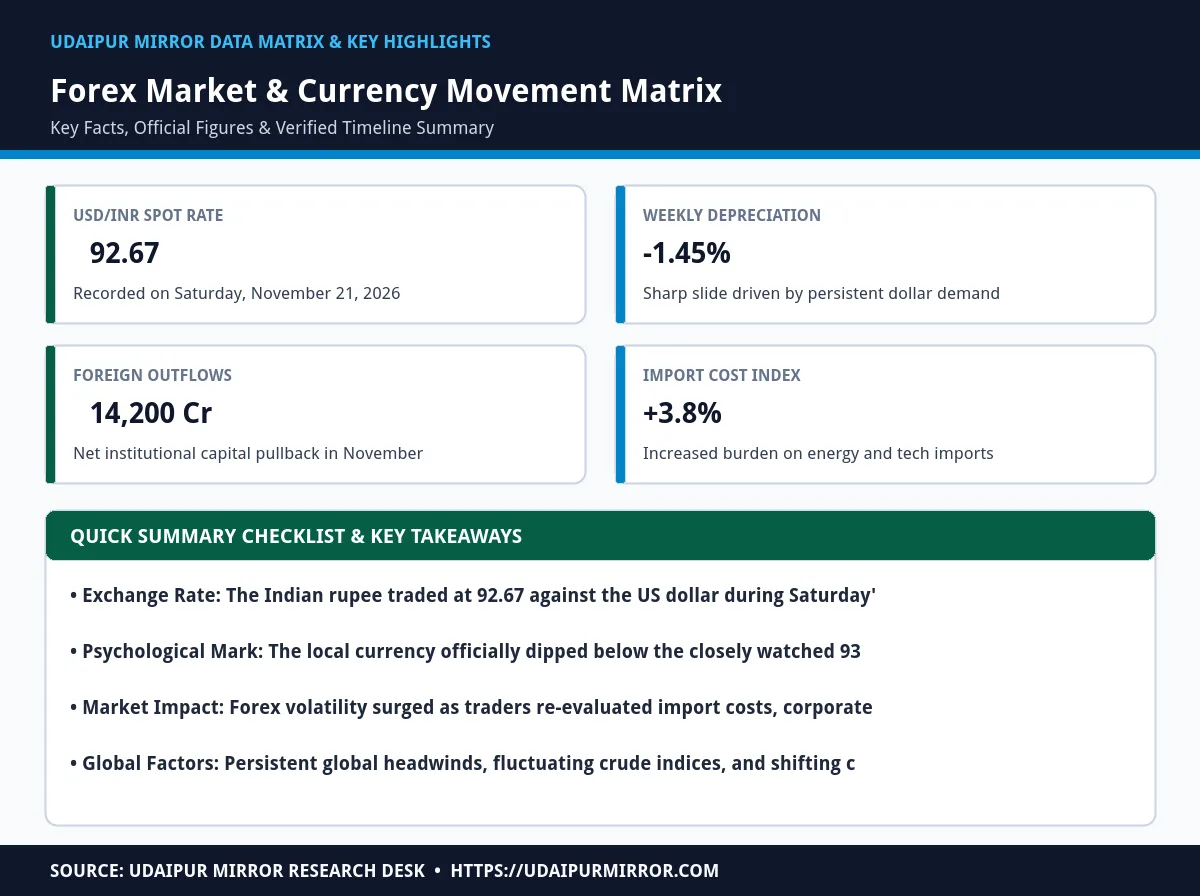
The following financial table outlines the performance of the Indian rupee alongside major macroeconomic indicators, key currency pairs, and underlying commodity movements for the trading week ending November 21, 2026.
| Indicator / Currency | Previous Close | Current Value | Weekly Change (%) | Market Outlook |
|---|---|---|---|---|
| USD/INR Exchange Rate | 91.35 | 92.67 | -1.45% | Bearish for Rupee |
| EUR/INR Cross | 96.80 | 98.12 | -1.36% | Depreciating |
| GBP/INR Cross | 115.40 | 117.25 | -1.60% | Depreciating |
| Crude Oil (Brent $/bbl) | 74.50 | 72.10 | -3.22% | Weakening |
| Gold Spot ($/oz) | 2,640 | 2,590 | -1.89% | Consolidating |
| Silver Spot ($/oz) | 31.20 | 26.20 | -16.02% | Sharp Correction |
A weaker local currency inevitably translates into higher import costs for a net-importing nation like India. With the exchange rate weakening to 92.67 against the US dollar, essential imports—most notably crude petroleum, electronic components, edible oils, and industrial machinery—become significantly more expensive to procure. This imported inflation risk poses a delicate challenge for policymakers striving to maintain price stability without stifling broader economic growth.
Retail consumers may soon feel the pinch across multiple categories, ranging from fuel retail prices to electronics and imported pharmaceutical raw materials. Domestic manufacturers are already reviewing their pricing structures to absorb or pass on the elevated costs. Financial analysts suggest that sustained weakness in the currency could also influence upcoming monetary policy reviews, as central bankers weigh the inflationary impact of a depreciating exchange rate against domestic demand dynamics.
“Imported inflation remains our primary transmission risk; currency depreciation directly filters into consumer price indices over a rolling quarter.” — Macroeconomic Researcher, New Delhi
The currency correction is unfolding alongside significant turbulence in global commodity exchanges. Over the past week, international crude oil prices fell by over 3%, aluminium sank roughly 6%, and silver witnessed a historic tumble exceeding 16%. While a drop in crude prices typically offers relief to India’s current account deficit, the simultaneous collapse in other commodity valuations reflects a broader cooling in global industrial demand and speculative long liquidation.
These cross-asset movements create a complex trading environment where equity indices, bond yields, and currency derivatives react dynamically to international cues. While domestic equities have experienced bouts of resilience driven by domestic retail participation, institutional desks remain cautious. Investors are closely monitoring how central bank interventions and reserve management strategies will shape the trajectory of the exchange rate in the coming weeks. (Also read: Shriram Finance Replaces Trent in BSE Sensex: Check All Stock Additions and Exits Across BSE 100, Sensex 50 and Other Indices).
“Global commodity sell-offs and currency fluctuations are deeply intertwined; treasury desks must evaluate multi-asset risk in real time.” — Chief Investment Officer, Institutional Brokerage
As the market digests the implications of the rupee trading at 92.67, financial advisors are urging caution and discipline among both retail and institutional market participants. Portfolio diversification and hedging against currency risk have emerged as critical priorities. Investors with international exposure or dollar-denominated assets are advised to review their hedging ratios, while equity investors should focus on companies with strong balance sheets, robust pricing power, and minimal foreign debt exposure.
Looking ahead, market participants will keep a close eye on macroeconomic data releases, central bank commentary, and fiscal policy announcements. While volatility is expected to persist in the near term, disciplined asset allocation and adherence to fundamental valuation principles remain the best defense against macroeconomic uncertainty.
“Discipline and robust risk management are paramount when navigating periods of heightened currency volatility and macroeconomic transition.” — Managing Director, Wealth Management Firm
The rupee’s decline to 92.67 was driven by persistent foreign institutional investor capital outflows, high corporate demand for US dollars to service import bills and external borrowings, and shifting global macroeconomic conditions.
A weaker rupee makes imports—such as crude oil, electronics, and industrial raw materials—more expensive. This can lead to higher domestic fuel prices, increased manufacturing costs, and potential inflationary pressures on consumer goods.
While central banks typically monitor and intervene to curb excessive volatility and disorderly market movements, traders closely track reserve adjustments and central bank liquidity operations during periods of sharp currency depreciation.
Financial experts recommend maintaining disciplined asset allocation, focusing on companies with strong pricing power and low foreign debt, and utilizing appropriate currency hedging tools for import-heavy businesses.
Add Udaipur Mirror as a preferred source on Google to see more of our travel guides in your AI overviews.