Office Address
14, Residency Road, Udaipur, Rajasthan 313001
Office Address
14, Residency Road, Udaipur, Rajasthan 313001

BENGALURU: BENGALURU — In a decisive move to fortify critical energy infrastructure against sophisticated digital threats, the kptcl cybersecurity program has been officially rolled out. Announced following intense technical reviews, this comprehensive initiative is engineered to shield high-voltage transmission grids, substation automation systems, and central load dispatch centers from escalating cyberattacks.
⚡ Quick Highlights: KPTCL Launches Cybersecurity Program for Transmission Network
As power grids worldwide become increasingly digitized, automated, and interconnected through cloud platforms and IoT sensors, the attack surface for malicious actors has expanded exponentially. The rollout of the kptcl cybersecurity program marks a vital paradigm shift from reactive defense mechanisms to proactive, predictive security postures. Energy sector analysts have long warned that outdated legacy systems operating SCADA (Supervisory Control and Data Acquisition) architectures remain prime targets for sophisticated cybercriminal syndicates.
Beyond immediate grid protection, power utilities are also exploring emerging technological integrations similar to how Artificial Intelligence Meets Numismatics demonstrates cross-sector digital adoption. However, in the high-stakes domain of power transmission, security failures carry catastrophic physical and economic consequences, making robust encryption and isolated network segments non-negotiable prerequisites.
“Securing our transmission network is no longer just an IT priority; it is a fundamental pillar of national security and public safety.” — KPTCL Infrastructure Security Division
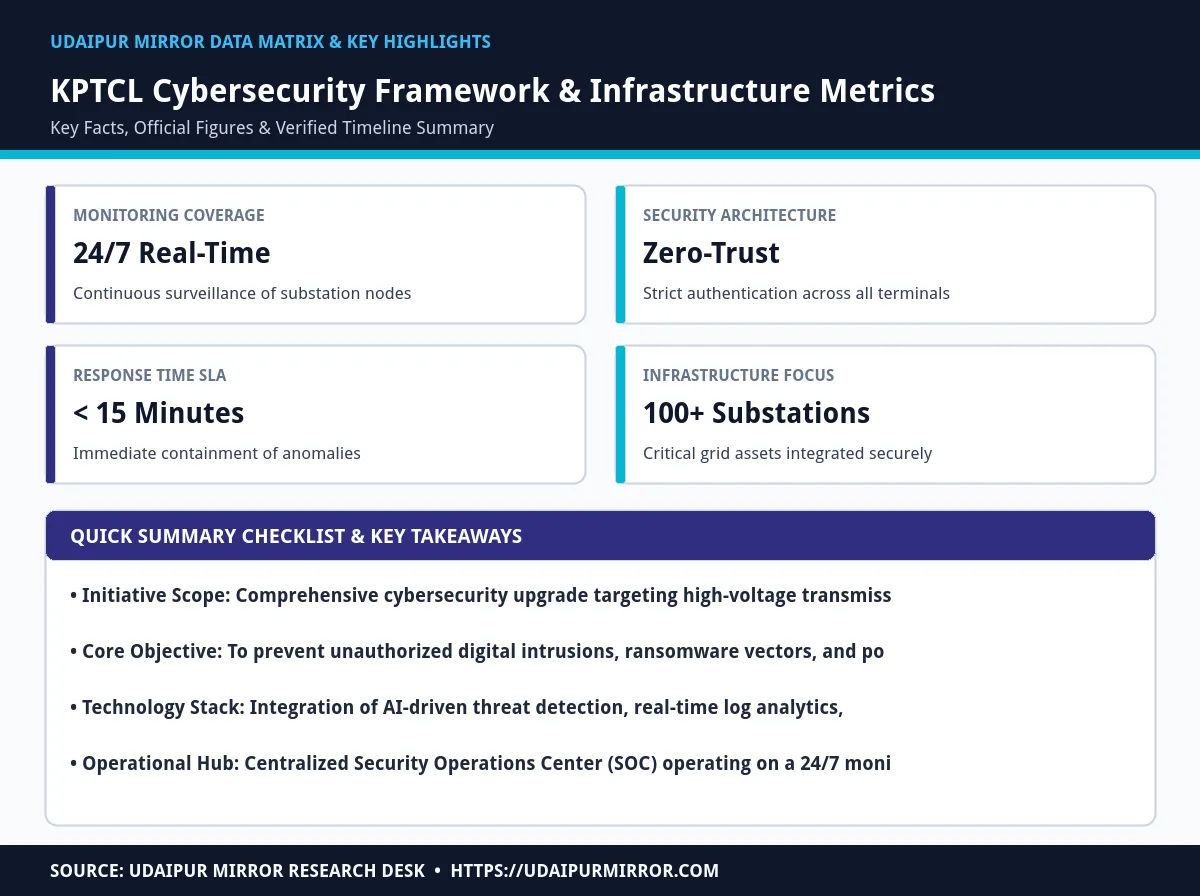
The newly launched cyber defense framework incorporates multiple layers of technological safeguards, operational protocols, and workforce training modules to ensure uninterrupted power transmission across the state.
| Security Layer | Technology Deployed | Target Infrastructure | Operational Status |
|---|---|---|---|
| Perimeter Defense | Next-Gen Firewalls & IDS/IPS | Enterprise IT & SCADA gateways | Fully Deployed |
| Threat Intelligence | AI-Powered SIEM & Analytics | Load Dispatch Centers | Active Monitoring |
| Access Control | Multi-Factor & Zero Trust | Substation Engineering Consoles | Phase-Wise Rollout |
| Data Backup | Encrypted Offline Vaults | Core Grid Databases | Operationalized |
| Incident Response | Automated Playbooks & SOC | Statewide Transmission Nodes | 24/7 Active |
| Staff Training | Simulated Phishing Drills | All Technical Personnel | Ongoing Quarters |
At the heart of the new defense strategy is a dedicated Security Operations Center (SOC) equipped with advanced behavioral analytics. This central hub aggregates logs from thousands of remote terminal units (RTUs) scattered across regional substations. By leveraging machine learning models, the system can instantly flag anomalous traffic patterns—such as unauthorized connection attempts or abnormal data spikes—that typically precede ransomware deployment or infrastructural sabotage.
The emphasis on robust digital security mirrors parallel concerns in other high-value asset markets, much like regulatory warnings issued when Industry Body GJC Alerts BIS Over Gold Adulteration, highlighting how modern sophisticated tampering requires advanced, high-tech counter-measures to preserve systemic integrity.
“Our new SOC gives us unprecedented visibility into network traffic, allowing our engineers to neutralize threats before they impact power delivery.” — Chief Technology Officer, KPTCL
Technology alone cannot prevent breaches; human vigilance remains a critical line of defense. The kptcl cybersecurity program incorporates mandatory, rigorous training modules for all technical personnel, grid operators, and administrative staff. Simulated phishing campaigns, password hygiene workshops, and incident simulation drills are now regular components of employee professional development.
Looking ahead, KPTCL plans to scale its cybersecurity framework further over the next three years, integrating quantum-resistant encryption research and expanding automated threat response capabilities to cover newly commissioned green energy corridors and interstate transmission links. (Also read: Artificial Intelligence Meets Numismatics: PNG to Explore AI at 2027 FUN Convention).
“Building a resilient grid requires empowering our workforce with the knowledge and tools to recognize and report social engineering vectors instantly.” — Director of Human Resources & Training, KPTCL
The primary objective is to protect critical power transmission networks, substation automation systems, and central load dispatch facilities from digital intrusions, ransomware, and state-sponsored cyber threats.
The program utilizes a centralized Security Operations Center (SOC) operating 24/7, equipped with AI-driven threat detection, real-time log analytics, and automated incident response playbooks.
Yes, the program enforces stringent cybersecurity compliance checklists and regular vulnerability audits for all third-party hardware and software suppliers.
Mandatory technical upskilling, simulated phishing drills, and regular cybersecurity awareness workshops are required for all grid engineers, IT staff, and operational personnel.
Add Udaipur Mirror as a preferred source on Google to see more of our travel guides in your AI overviews.