Office Address
14, Residency Road, Udaipur, Rajasthan 313001
Office Address
14, Residency Road, Udaipur, Rajasthan 313001

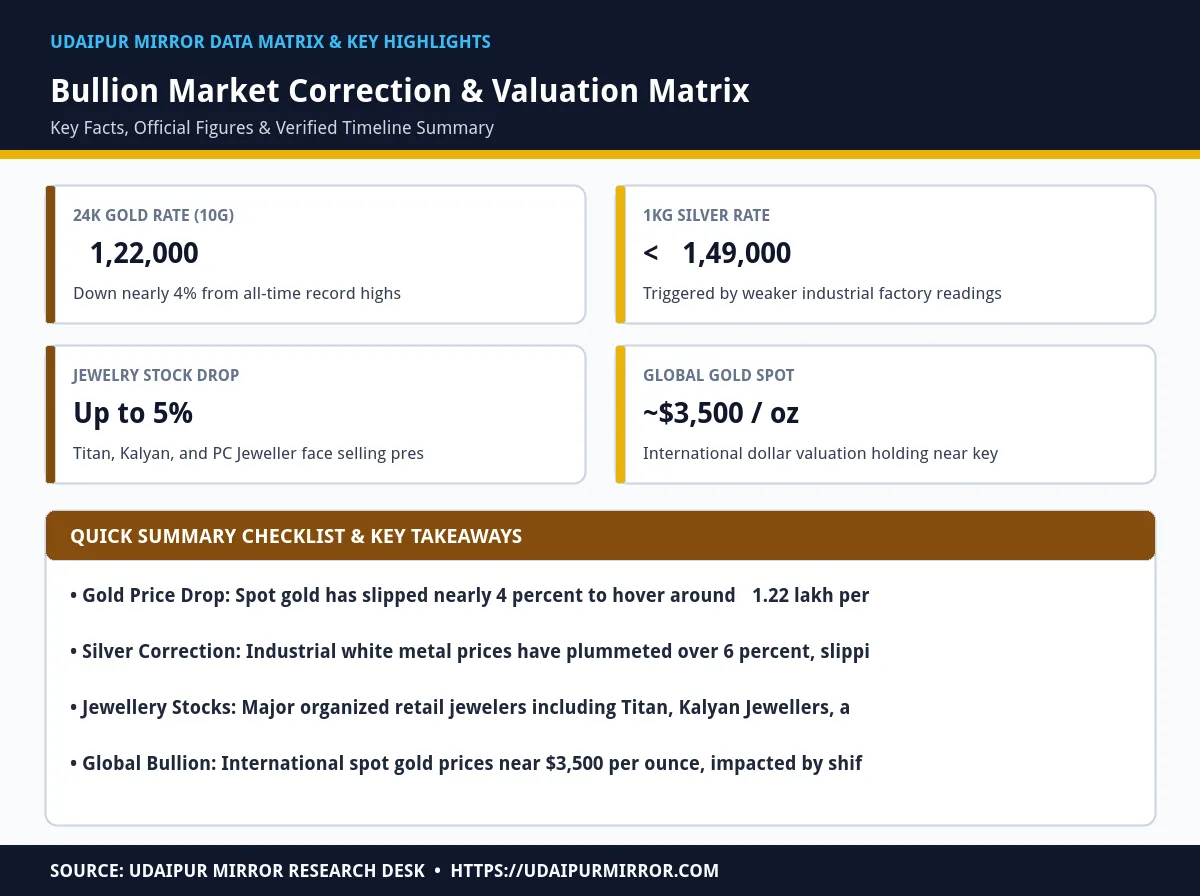
UDAIPUR: UDAIPUR — In the wake of sharp multi-week corrections across domestic and international bullion exchanges, investors and retail buyers are closely tracking the shifting macroeconomic landscape. As spot gold prices drift near ₹1.22 lakh per 10 grams and industrial white metal takes a deeper hit, commodity analysts emphasize that gold price crash risks extend far beyond the immediate asset devaluation. The primary danger facing the market today is not the headline-grabbing correction itself, but the protracted structural stagnation, inventory devaluation for major jewelers, and shifting consumer sentiment that typically follows such high-volatility events.
⚡ Quick Highlights: Gold's Biggest Risk After Price Crash: What Investors Face
When commodity prices plunge sharply—such as gold slipping nearly 4% to test ₹1.22 lakh and silver dropping over 6% below ₹1.49 lakh—public attention is naturally captivated by the immediate loss in asset valuation. However, veteran market analysts and macroeconomic strategists argue that the true vulnerability for investors lies in the structural aftermath of the correction. When panic selling subsides, markets often enter a prolonged phase of consolidation and liquidity contraction, which poses a far greater challenge to retail participants than a swift, temporary dip.
In parallel with domestic bullion shifts, global tech and venture ecosystems are also experiencing capital realignment, much like how digital transformation funding adjusts to macroeconomic pressures. Investors must recognize that post-crash environments breed extreme cautiousness, making it difficult to re-enter positions without careful strategic planning.
“The drop in spot prices is merely the symptom. The disease is the prolonged liquidity freeze and consumer hesitation that paralyzes physical bullion markets for months afterward.” — Senior Commodity Strategist
Retail bullion prices across major commercial hubs in Rajasthan—including Udaipur, Jaipur, Jodhpur, and Kota—reflect the latest MCX corrections. Below is the detailed purity breakdown incorporating standard 3% GST and localized making charges for retail buyers.
| City / Hub | 24K Gold (Per 10g) | 22K Gold (Per 10g) | 18K Gold (Per 10g) | 1 KG Fine Silver |
|---|---|---|---|---|
| Udaipur | ₹1,22,400 | ₹1,12,200 | ₹91,800 | ₹1,48,500 |
| Jaipur | ₹1,22,600 | ₹1,12,400 | ₹91,950 | ₹1,48,800 |
| Jodhpur | ₹1,22,300 | ₹1,12,100 | ₹91,700 | ₹1,48,300 |
| Kota | ₹1,22,500 | ₹1,12,300 | ₹91,900 | ₹1,48,600 |
| MCX Benchmark | ₹1,22,000 | ₹1,11,800 | ₹91,500 | ₹1,48,000 |
The shockwaves of the recent bullion correction are not confined to physical gold bars and silver coins; they have directly impacted corporate equities in the gems and jewellery sector. Prominent listed entities such as Titan Company, Kalyan Jewellers, and PC Jeweller witnessed sharp equity pullbacks of up to 5% as market participants factored in potential inventory write-downs and expected slowdowns in retail footfall during festive and wedding seasons.
Furthermore, shifts in capital allocation mirror trends seen in other asset classes, including initial public offerings where investors scrutinize fundamental valuations just as closely as public equity market indicators. When bullion prices correct aggressively, consumer behavior shifts instantly—buyers delay big-ticket purchases anticipating further drops, while jewelers struggle to balance profit margins against falling replacement costs.
“Retail jewelers are caught between high inventory acquisition costs and hesitant retail buyers demanding immediate price parity with spot market crashes.” — Bullion Retail Association Head
The downward pressure on precious metals is heavily influenced by global macroeconomic metrics, including softening manufacturing indicators and shifting central bank monetary policies. With international gold prices testing support near $3,500 per ounce and industrial silver underperforming due to weaker factory readings globally, the divergence between gold’s safe-haven appeal and industrial silver’s cyclical demand has become starkly pronounced.
As global markets navigate these crosscurrents, commodity experts continue to evaluate whether precious metals will find a definitive bottom before initiating a sustained recovery cycle. Understanding these global interconnections is vital for anyone holding multi-asset portfolios exposed to bullion fluctuations.
“Silver's deep correction reflects manufacturing realities, whereas gold's resilience near $3,500 proves its enduring role as an ultimate hedge against systemic currency debasement.” — Global Macro Economist
Periods of high price volatility often witness unscrupulous retail practices, making adherence to Bureau of Indian Standards (BIS) hallmarking non-negotiable. Consumers purchasing 24 Karat (999 purity) or 22 Karat gold ornaments across Rajasthan must verify the unique 6-digit Hallmark Unique Identification (HUID) code laser-inscribed on every piece.
When calculating the final invoice amount at local jewellers in Udaipur, Jaipur, Jodhpur, or Kota, buyers must account for the standard 3% Goods and Services Tax (GST) applicable across India, alongside variable making charges which typically range from 6% to 15% depending on the intricate artistry of the design. Insisting on an itemized bill separating metal value from making charges ensures absolute transparency and protects buyers from hidden markups.
“Never compromise on BIS hallmarking or itemized invoicing, especially during market corrections when transparency is your best defense against substandard purity.” — Consumer Protection Bureau Advisor
The post-crash phase involves prolonged market consolidation, liquidity freezes, and consumer hesitation. While a price crash happens quickly, the aftermath creates prolonged uncertainty, inventory devaluation for retailers, and psychological fatigue among retail investors.
Spot rates for 24K gold hover around ₹1,22,000 to ₹1,22,600 per 10 grams across major Rajasthan cities like Udaipur, Jaipur, Jodhpur, and Kota, while 22K gold trades between ₹1,11,800 and ₹1,12,400 per 10 grams.
Major listed retail jewellery stocks experienced selling pressure, falling by up to 5% as investors anticipated inventory write-downs and slower retail demand following the sharp correction in spot gold and silver prices.
Buyers must verify the 6-digit BIS HUID hallmark, demand an itemized invoice separating pure metal cost from making charges, and ensure the mandatory 3% GST is correctly applied to the final transaction.
Add Udaipur Mirror as a preferred source on Google to see more of our travel guides in your AI overviews.





[…] the VinFast VF MPV 7: How a Lower Showroom Price Changes Your Car Insurance 40 minutes ago ⚡ Business Gold's Biggest Risk May Not Be a Price Crash: What Happens Afterwards 55 minutes ago … News Udaipur Temples Celebrate Annakut Festival: 21-Gun Salute for Lord Rama, Grand Shringar and […]