Office Address
14, Residency Road, Udaipur, Rajasthan 313001
Office Address
14, Residency Road, Udaipur, Rajasthan 313001

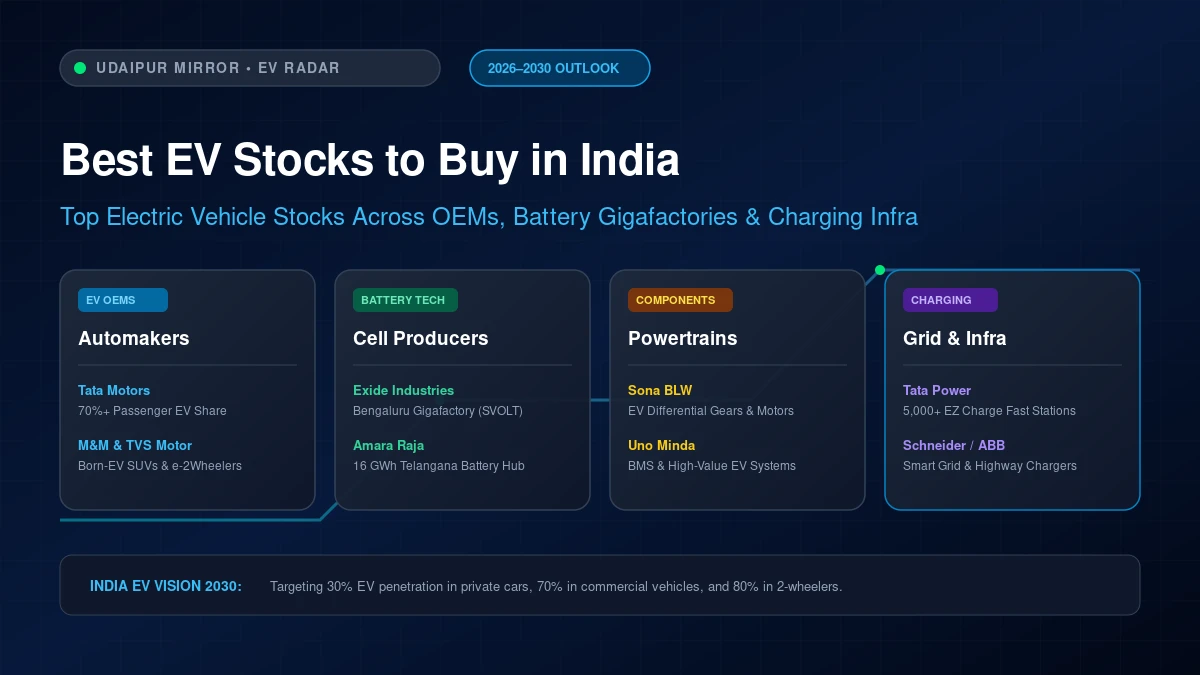
India’s automotive landscape is undergoing a once-in-a-century structural transformation. Propelled by progressive government initiatives under PM E-DRIVE and FAME, tightening emission standards, and rapid parity in total cost of ownership (TCO), the country’s electric mobility market is accelerating rapidly. For long-term investors seeking exponential growth over the 2026–2030 horizon, identifying the best ev stocks to buy in india requires looking beyond car dealerships to examine the entire value chain—from vehicle manufacturers and battery gigafactories to precision component makers and national charging infrastructure networks.
India aims to achieve 30% electric vehicle penetration in private passenger cars, 70% in commercial fleets, and over 80% in two- and three-wheelers by 2030. As consumer adoption expands from metropolitan centers to regional hubs—evidenced by the surge of next-generation electric SUVs arriving in local showrooms—companies with deep localization, proprietary technology, and robust capital structures stand to create immense shareholder wealth. When paired with timeless principles on the best time to invest in Indian market, building a diversified electric mobility basket offers exceptional multi-year compounding potential.
A frequent error made by retail investors is equating the EV sector solely with finished automobile assemblers. In reality, the electric vehicle transition represents a comprehensive industrial ecosystem where profit pools are distributed across four critical verticals:
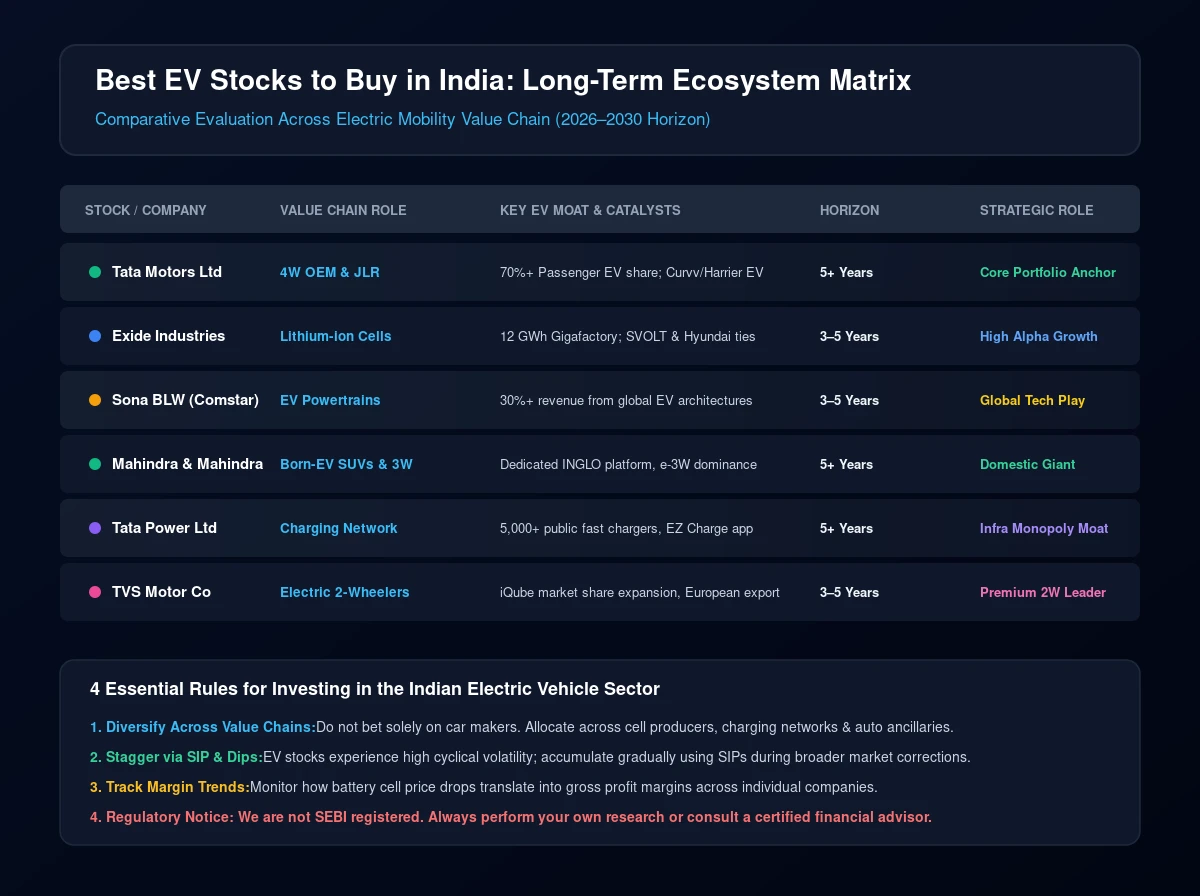
Below is an in-depth analysis of the frontrunners leading India’s electric vehicle revolution:
Tata Motors remains the undisputed bellwether in India’s electric passenger car segment, commanding over 70% market share through its dedicated subsidiary, Tata Passenger Electric Mobility Ltd (TPEML). Powered by top-selling nameplates like the Nexon EV, Punch EV, Tiago EV, and the newly launched Curvv EV, Tata Motors has established an insurmountable distribution and volume lead. Backed by institutional investments from TPG Rise Climate and Jaguar Land Rover’s aggressive electrification pivot, Tata Motors is an indispensable core anchor among the best ev stocks to buy in india.
As India shifts away from importing lithium-ion cells from China, Exide Industries has taken a massive strategic lead. Through its wholly owned subsidiary, Exide Energy Solutions, the company is operationalizing a 12 GWh lithium-ion cell gigafactory in Bengaluru in technical partnership with global battery leader SVOLT. With strategic supply agreements already inked with major domestic automakers—including Hyundai and Kia India—Exide is uniquely positioned to capture massive domestic demand for LFP and NMC chemistry battery packs.
Sona Comstar is one of the rare global pure-play beneficiaries of clean mobility. Over 30% of its consolidated revenues stem directly from electric vehicles, supplying precision differential assemblies, traction motors, and motor controllers to leading global and domestic EV manufacturers. Its technological leadership in high-torque electric drivetrains and expanding patent portfolio provide strong pricing power and high operating margins.
While M&M built its historical reputation on rugged diesel SUVs, its future roadmap is driven by its dedicated ‘INGLO’ born-electric architecture. With models like the BE 6e and XEV 9e entering production and significant capital backing from British International Investment (BII) and Temasek, Mahindra is creating high-margin premium electric platforms. Furthermore, Mahindra holds market leadership in electric three-wheelers (Treo), a segment with near-total electrification in urban logistics.
Vehicle sales cannot scale without an accessible, dependable charging network. Tata Power has emerged as India’s largest EV charging solutions provider under its ‘EZ Charge’ brand, with over 5,000 public and captive fast chargers spanning national highways, commercial malls, and fleet depots, alongside more than 100,000 home chargers installed. Its integrated renewable energy portfolio creates a sustainable, vertically integrated charging monopoly.
In the high-volume two-wheeler domain, TVS Motor has outperformed legacy rivals with its flagship TVS iQube electric scooter, capturing substantial market share alongside startups like Ola Electric and Ather Energy—whose upcoming public market debut is highlighted in the Ather Energy IPO shareholder quota breakdown. With deep investments in European e-bike brands (Norton and Swiss E-Mobility Group), TVS combines premium export realization with robust domestic electrification.
Investing in emerging technological megatrends requires strict emotional and financial discipline. Retail participants should adhere to the following four tactical rules:
The electrification of India’s mobility sector is not a speculative fad; it is an irreversible industrial transformation backed by policy imperatives, technological innovation, and national energy security. By focusing on market leaders with established balance sheets and clear technological moats, retail investors can position their portfolios to participate in India’s clean energy renaissance.
We are not SEBI registered. Udaipur Mirror, its authors, editors, administrators, and contributors are not registered with the Securities and Exchange Board of India (SEBI) as research analysts, investment advisors, portfolio managers, or brokers under SEBI regulations.
All company profiles, financial data points, stock analyses, and sector trends presented in this article are published exclusively for educational, journalistic, and informational purposes. Mention of specific securities or companies does not constitute a buy, sell, or hold recommendation, endorsement, or offer to trade any security or financial instrument. Equity markets involve substantial risk of capital loss. Readers must conduct their own independent due diligence and consult a qualified, SEBI-registered financial planner or investment advisor prior to making any financial investment decisions.
Add Udaipur Mirror as a preferred source on Google to see more of our travel guides in your AI overviews.