Office Address
14, Residency Road, Udaipur, Rajasthan 313001
Office Address
14, Residency Road, Udaipur, Rajasthan 313001

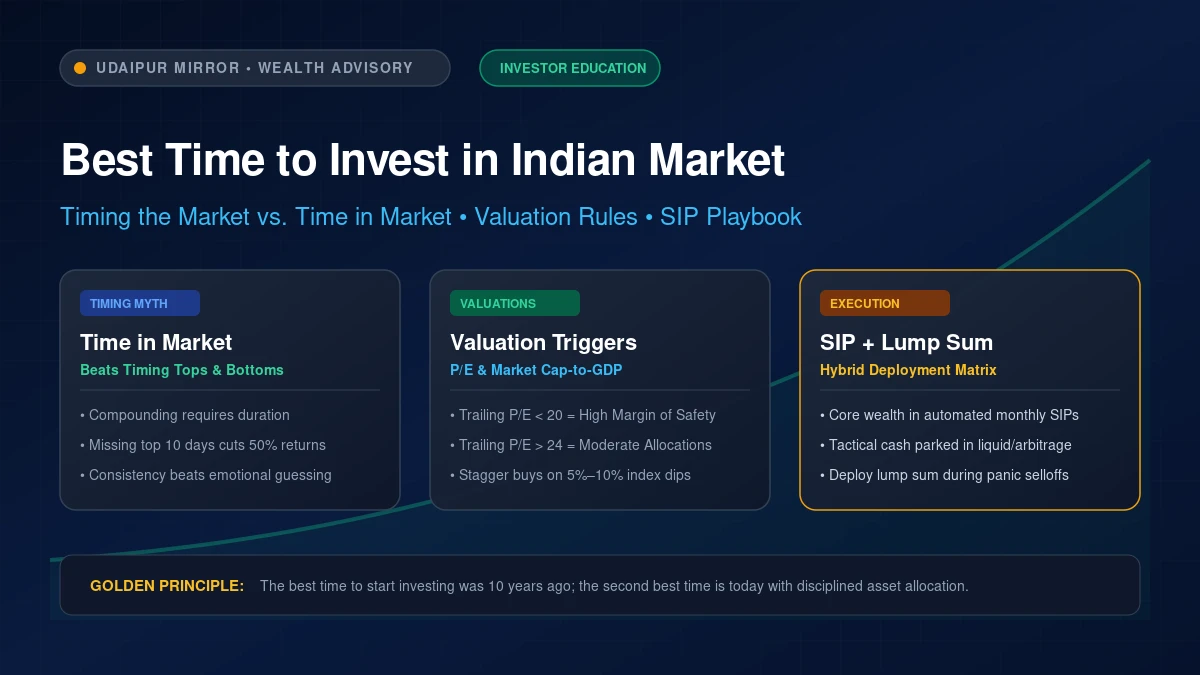
Every retail investor embarking on their wealth creation journey is confronted with a timeless dilemma: when is the best time to invest in indian market? With Dalal Street oscillating through sharp bull runs, abrupt geopolitical corrections, and multi-week consolidation phases, aspiring investors frequently paralyze themselves trying to pinpoint the exact market bottom or waiting for the “perfect” correction to deploy their hard-earned capital.
Historically, market data demonstrates that waiting on the sidelines out of fear often results in higher opportunity costs than investing through interim volatility. While having a tactical Monday stock market plan for retail investors is essential for short-term traders, long-term wealth creators must operate with a completely different mindset. Understanding how to navigate market valuations, structural economic tailwinds, and systematic capital deployment models is the foundation of enduring financial freedom.
The allure of buying at rock-bottom valuations and selling at peak euphoria is strong, but empirical evidence consistently proves that successfully timing macroeconomic turns is nearly impossible for retail participants. A legendary adage on Dalal Street holds that “more money has been lost by investors preparing for corrections or trying to anticipate corrections than has been lost in corrections themselves.”
Historical simulations of the Nifty 50 over the past 25 years reveal an astonishing asymmetry in equity returns:
While attempting to time exact daily swings is counterproductive, tracking macro valuation metrics provides valuable signals regarding when margin of safety is high versus when caution is warranted. Savvy investors evaluate four primary gauges:
The Nifty 50 P/E ratio is the most widely monitored benchmark valuation metric. Historically, a consolidated trailing P/E below 19.0 indicates extreme undervaluation—typically during systemic panic or deep market crashes driven by macro shocks. Conversely, a P/E exceeding 24.0 suggests elevated optimism, where future earnings growth is already heavily priced in.
This metric compares the total market capitalization of all listed Indian equities to the nation’s nominal Gross Domestic Product (GDP). A ratio between 75% and 85% historically points to reasonable valuations for India’s emerging economy, whereas numbers exceeding 115% signify euphoria requiring staggered allocations.
When the Nifty P/B drops below 3.0 or dividend yields rise toward 1.5%, institutional asset managers aggressively deploy dry powder. These levels signify durable long-term entry points for patient capital.
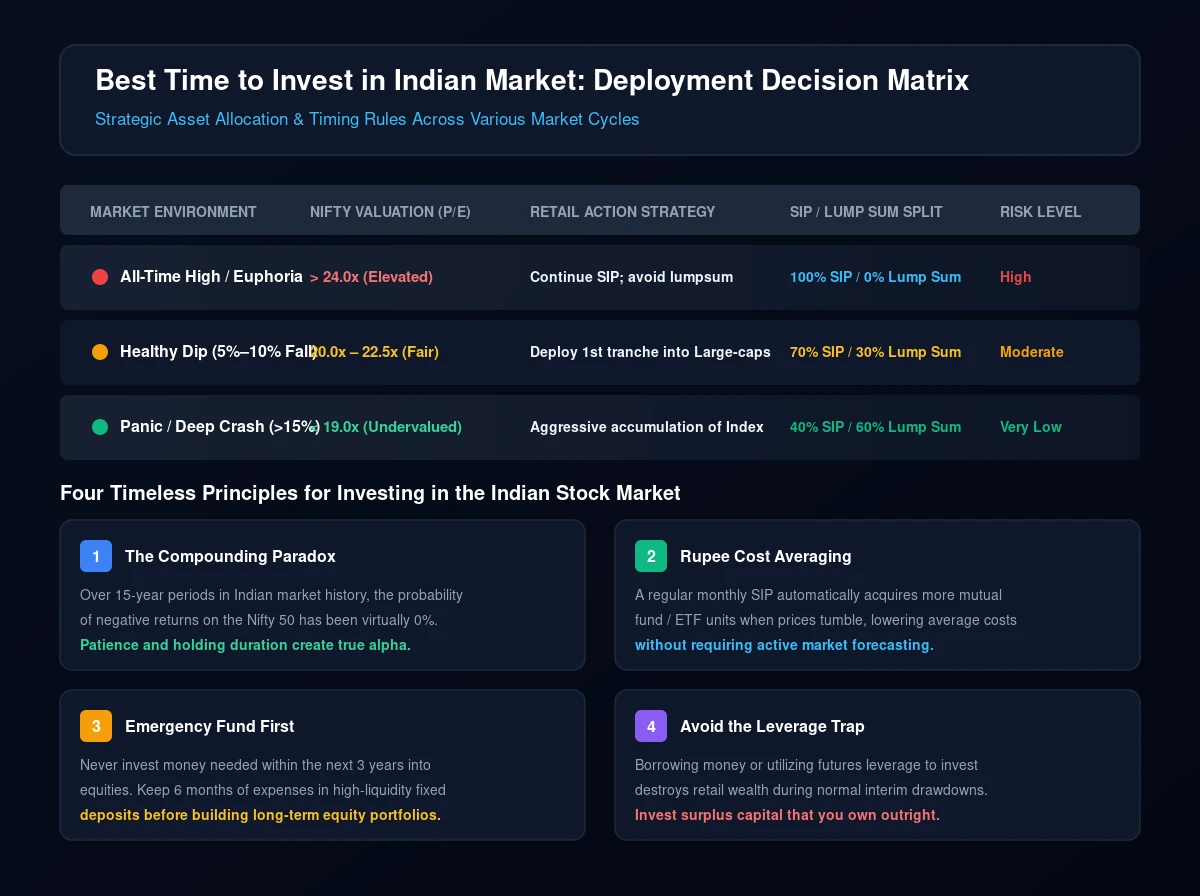
When deciding the best time to invest in indian market, retail investors should not view Systematic Investment Plans (SIP) and lump-sum investments as mutually exclusive. Instead, combining them into a hybrid capital deployment model yields optimal risk-adjusted outcomes:
Beyond technical charts, the long-term rationale for equity investing in India is anchored in powerful secular tailwinds that few global economies match:
As the time-tested investment wisdom states: “The best time to plant a tree was 20 years ago; the second best time is today.” If you possess surplus investable capital, a minimum investment horizon of 5 to 7 years, and a diversified asset allocation strategy, the best time to invest in Indian market is not determined by market forecasts—it begins the day you commit to automated, disciplined investing.
We are not SEBI registered. Udaipur Mirror, its authors, editors, administrators, and contributors are not registered with the Securities and Exchange Board of India (SEBI) as research analysts, investment advisors, portfolio managers, or brokers under SEBI regulations.
All content, valuation metrics, analyses, charts, and concepts shared in this article are published strictly for educational, informational, and journalistic awareness. Nothing on this platform should be construed as financial advice, investment counsel, stock recommendations, or an offer or solicitation to trade any securities, derivatives, mutual funds, or financial instruments. Investments in the securities market are subject to market risks; read all related scheme documents carefully. Readers are strongly urged to conduct their own thorough independent due diligence and seek the counsel of a certified, SEBI-registered financial planner before executing any financial transaction or investment.
Add Udaipur Mirror as a preferred source on Google to see more of our travel guides in your AI overviews.





[…] you have ₹500 or ₹50,000 to invest each month, aligning with the timeless principles on the best time to invest in Indian market and selecting zero-commission direct investment applications ensures every rupee compounds for your […]