Office Address
14, Residency Road, Udaipur, Rajasthan 313001
Office Address
14, Residency Road, Udaipur, Rajasthan 313001

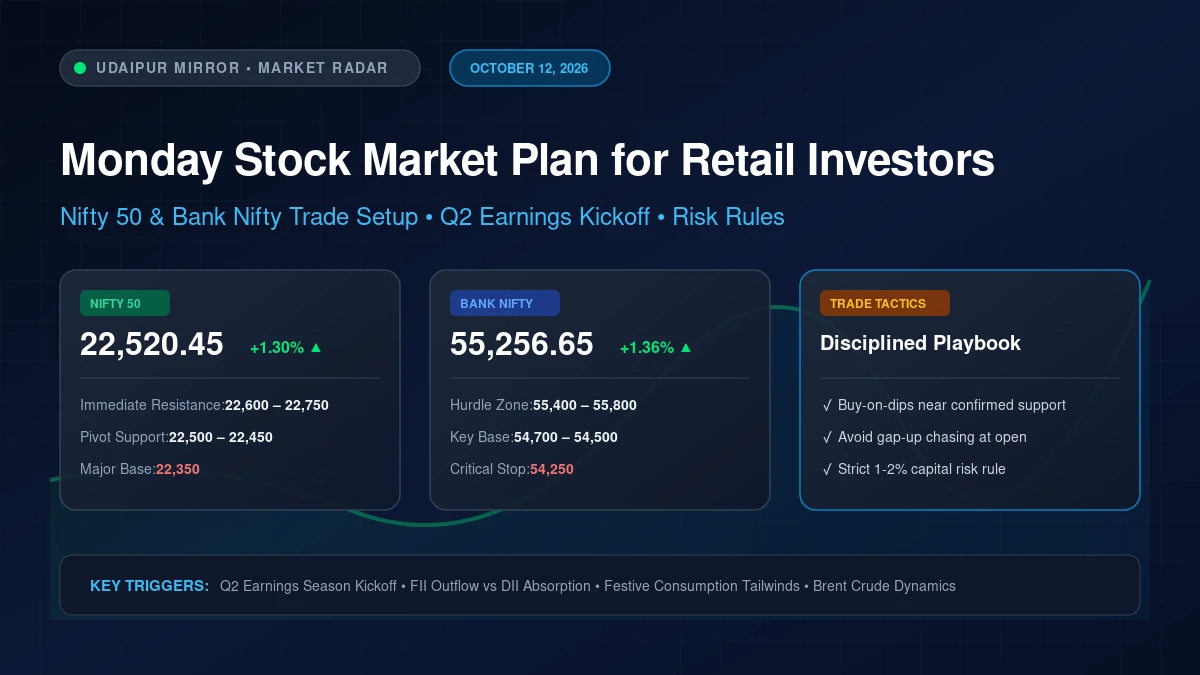
As Dalal Street prepares to resume trading on Monday, October 12, 2026, market participants are dissecting a pivotal shift in momentum. Following an agonizing eight-week losing streak—the longest consecutive weekly decline witnessed in Indian equities in nearly a quarter of a century—benchmark indices staged an aggressive technical rebound on Friday. The Nifty 50 surged 1.30% to settle at 22,520.45, while the Bank Nifty rallied 1.36% to close at 55,256.65. For small and individual market participants navigating elevated volatility, formulating a clear, disciplined monday stock market plan for retail investors is essential to protect capital and seize high-probability setups rather than falling victim to emotional impulses.
While the Friday rally injected much-needed relief across trading desks, institutional flows indicate that the broader structural trend remains cautious. Elevated US 10-year Treasury yields, volatile Brent crude oil benchmarks influenced by geopolitical frictions, and sustained Foreign Institutional Investor (FII) selling continue to present overhead hurdles. Having an actionable understanding of the factors behind the recent market fall allows retail participants to filter out market noise and execute with calculated precision.
The daily chart of the Nifty 50 presents a textbook relief rebound off the oversold multi-week support boundary at 22,250–22,300. Momentum indicators, including the Relative Strength Index (RSI), flashed a notable bullish divergence at lower levels, signaling that downward momentum had exhausted itself in the short term. However, market breadth requires continuous confirmation before traders can declare an enduring trend reversal.
For Monday’s opening session, derivatives data reveals significant Open Interest (OI) buildup that defines the immediate trading corridor:
The banking benchmark demonstrated superior strength on Friday, climbing over 740 points to settle at 55,256.65. Large private-sector lenders alongside select public-sector banking majors led the charge, absorbing selling pressure from foreign portfolios. Ahead of the Q2 FY27 earnings declarations, banking stocks are positioned as the primary catalyst that will dictate the direction of broader indices.
Retail participants monitoring Bank Nifty should note the following critical levels:
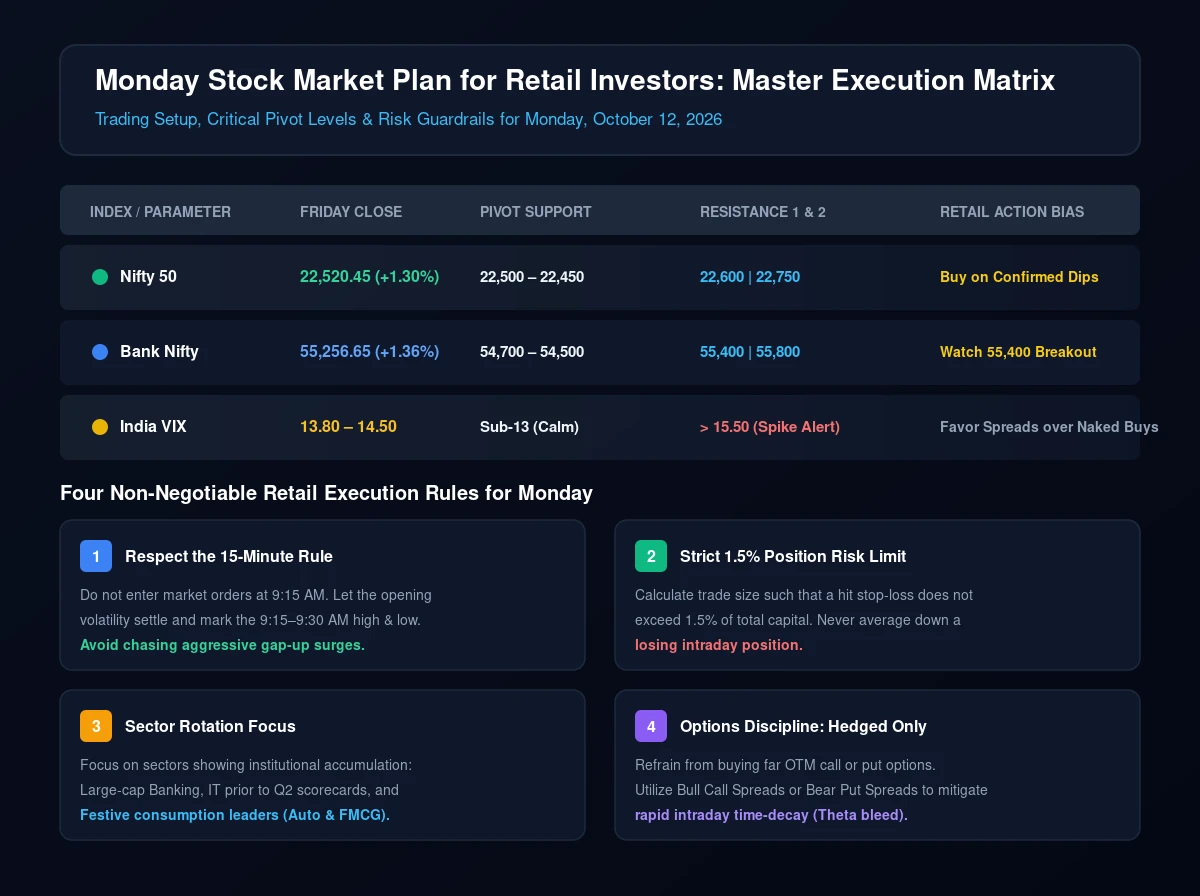
Retail participants frequently underperform institutional funds not due to inadequate technical analysis, but due to lack of trade execution discipline. The following non-negotiable rules form the core framework of an effective monday stock market plan for retail investors:
One of the most common mistakes retail traders make is executing aggressive market orders at 9:15 AM based on pre-market SGX / GIFT Nifty sentiment. If the market opens with an aggressive gap-up, institutional algorithmic desks often offload inventory into retail morning liquidity. Patient traders must allow the opening 15 minutes (9:15 AM to 9:30 AM) to establish the initial balance, trading only breakouts or retests of the defined opening range.
Never allocate capital without a pre-calculated stop-loss order placed directly in the trading system. Individual position sizing should ensure that if a stop-loss is triggered, the financial loss never exceeds 1.5% of total trading equity. Crucially, retail investors must eliminate the urge to “average down” on declining intraday positions.
With India VIX oscillating between 13.80 and 14.50, out-of-the-money (OTM) options suffer rapid Theta decay (time decay) during midday consolidation periods. Retail option traders should favor spread structures—such as Bull Call Spreads or Bear Put Spreads—which cap downside risk, mitigate volatility crush, and drastically improve mathematical expectancy.
Rather than chasing overextended momentum counters, retail capital should track sectors benefiting from real domestic fundamental tailwinds. The ongoing Shardiya Navratri festival is driving robust consumer spending, presenting opportunities in automotive manufacturers—supported by surging retail vehicle registrations—as well as FMCG, durable goods, and private banking franchises.
The trajectory of Indian equities through the upcoming week will be governed by four pivotal macro and corporate catalysts:
In summary, Monday’s session presents tactical opportunities for both short-term swing traders and long-term wealth builders. For disciplined retail investors, the ideal setup involves letting early morning gap volatility settle, respecting the 22,450–22,500 cushion on Nifty, and using staggered limit orders in quality large-caps while strictly protecting trading capital with active stop-losses.
Disclaimer: The analysis and trade setups presented above are intended strictly for educational and informational purposes and do not constitute certified financial or investment advice. Stock and derivatives trading involves substantial risk of financial loss. Retail market participants should perform independent due diligence or consult a SEBI-registered investment advisor prior to initiating financial transactions.
Add Udaipur Mirror as a preferred source on Google to see more of our travel guides in your AI overviews.






[…] in higher opportunity costs than investing through interim volatility. While having a tactical Monday stock market plan for retail investors is essential for short-term traders, long-term wealth creators must operate with a completely […]