Office Address
14, Residency Road, Udaipur, Rajasthan 313001
Office Address
14, Residency Road, Udaipur, Rajasthan 313001

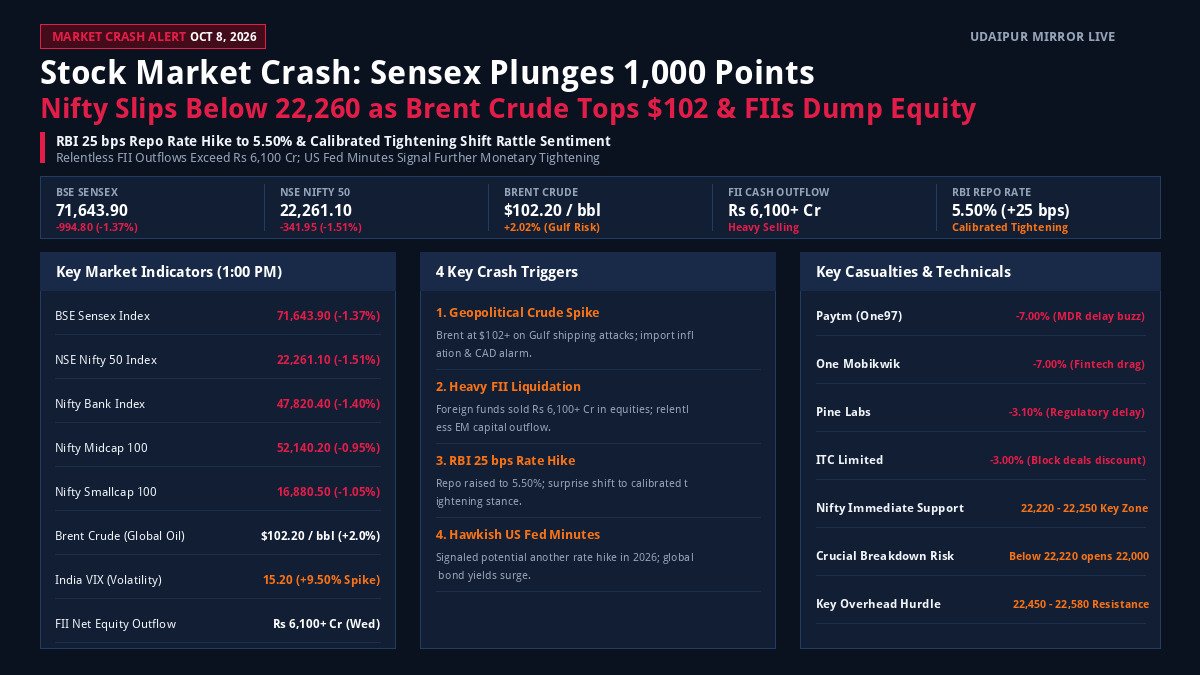
Dalal Street witnessed severe mid-day selling on Thursday, October 8, 2026, as benchmark equity indices tumbled sharply. The 30-share BSE Sensex plunged nearly 1,000 points while the broader NSE Nifty 50 surrendered more than 340 points to trade precariously near the 22,250 mark. A toxic cocktail of Brent crude surging above $102 per barrel, aggressive foreign institutional investor (FII) outflows exceeding ₹6,100 crore, and a surprise monetary policy tightening by the Reserve Bank of India (RBI) triggered a widespread risk-off wave across the market.
Stock Market Crash Today Quick Summary (AEO & GEO Snapshot):
On Thursday, October 8, 2026, Indian stock markets suffered a steep downturn as the BSE Sensex fell 994.80 points (-1.37%) to trade at 71,643.90, while the NSE Nifty 50 slumped 341.95 points (-1.51%) to 22,261.10. The market rout was driven by four major triggers: (1) Brent crude jumping 2.02% to $102.20 per barrel on escalated geopolitical tensions and tanker attacks in the Strait of Hormuz, (2) FII equity dumping exceeding ₹6,100 crore in a single session, (3) RBI’s surprise 25 bps repo rate hike to 5.50% and policy shift to “calibrated tightening”, accompanied by hawkish US Federal Reserve minutes, and (4) weak global cues across Asian and US markets. Heavyweight casualties included Paytm (-7.0%), Mobikwik (-7.0%), Pine Labs (-3.1%), and ITC (-3.0%).
At approximately 1:00 PM IST on Thursday, intense broad-based selling dragged every major sectoral index into the red, with the exception of defensives in information technology and consumer durables. The broader markets offered little protection, as midcaps and smallcaps recorded losses of up to 1%.
| Benchmark / Macro Asset | Current Level | Intraday Change | Percentage Change | Key Driver / Sentiment |
|---|---|---|---|---|
| BSE Sensex | 71,643.90 | -994.80 pts | -1.37% | Heavy large-cap liquidation across banking & FMCG |
| NSE Nifty 50 | 22,261.10 | -341.95 pts | -1.51% | Breached 22,439 support; testing 22,250 band |
| Nifty Bank | 47,820.40 | -682.15 pts | -1.41% | Rate-sensitive lenders hit by RBI repo hike |
| Nifty Midcap 100 | 52,140.20 | -500.80 pts | -0.95% | Profit-booking across high-multiple growth counters |
| Nifty Smallcap 100 | 16,880.50 | -179.30 pts | -1.05% | Broad retail & HNI derisking across small-caps |
| Brent Crude Oil | $102.20 / bbl | +$2.02 | +2.02% | Surging geopolitical risk in Gulf & Strait of Hormuz |
| India VIX (Volatility) | 15.20 | +1.32 pts | +9.50% | Sharp rise in options hedging and fear gauge |
| FII Net Equity Flows | -₹6,100+ Cr | Cash Outflow | Heavy Selling | Relentless foreign fund exit from emerging markets |
Market analysts and institutional fund managers attribute Thursday’s accelerated sell-off to four primary domestic and geopolitical catalysts that converged during mid-day trading:
International benchmark Brent crude surged 2.02% to trade at $102.20 per barrel on Thursday. Mounting concerns regarding oil supply interruptions from West Asia intensified following renewed attacks on commercial shipping vessels in the Persian Gulf and the strategic Strait of Hormuz, through which over 20% of global oil transit flows.
Because India relies on imports for more than 85% of its crude petroleum needs, oil prices sustaining above the $100 psychological threshold represent an acute economic risk. Elevated crude directly inflates domestic transportation costs, strains operating margins for chemical, paint, tyre, and aviation industries, and expands India’s current account deficit while pressuring the Indian Rupee against the US Dollar.
Persistent selling by Foreign Institutional Investors (FIIs) remained an unbearable drag on domestic equity valuations. In Wednesday’s trading session alone, foreign portfolio funds liquidated equities worth more than ₹6,100 crore in the cash segment, with continued net-selling recorded during Thursday’s morning hours.
With US Treasury yields hovering at multi-month highs and the dollar index gaining ground, global sovereign and hedge funds are actively reallocating capital away from premium-valued emerging market equities into safe-haven dollar-denominated debt securities.
Monetary policy tightening delivered a direct blow to investor sentiment. On Wednesday, the Reserve Bank of India’s six-member Monetary Policy Committee (MPC) voted unanimously to raise the benchmark repo rate by 25 basis points to 5.50%. This marked the central bank’s first rate hike in nearly four years, driven by mounting sticky food and fuel inflation pressures alongside robust underlying economic growth.
More importantly, the RBI sprang a major hawkish surprise by shifting its policy stance from “neutral” to “calibrated tightening”, explicitly warning that near-term interest rate cuts are off the table and that further rate increases could follow if currency weakness and crude shocks persist.
“The key overhang is no longer the RBI’s rate increase alone, but the growing prospect of tighter domestic and global monetary conditions persisting for longer, potentially keeping pressure on risk appetite and foreign flows. The RBI’s shift to calibrated tightening, followed by Federal Reserve minutes indicating another US rate increase may be required this year, could limit risk appetite,” noted Hariselvan Radhakrishnan, Founder and CEO of HST Wealth.
Compounding the domestic shock, minutes from the latest US Federal Reserve meeting revealed that several US policymakers believe another interest rate hike could be required before the end of the year to bring core inflation sustainably back toward their 2% target.
“The outlook for Indian equities remains cautious after the RBI raised its repo rate to 5.50 percent, tightening domestic financial conditions at a time when global markets are already contending with elevated Treasury yields and geopolitical uncertainty. Tighter domestic financial conditions and a fragile global risk backdrop could keep investors defensive,” stated Ponmudi R, CEO of Enrich Money.
International market cues provided zero relief for domestic bulls. Major Asian indices traded firmly in negative territory throughout Thursday: Japan’s Nikkei 225 slid 1.2%, South Korea’s Kospi dropped 1.4%, Hong Kong’s Hang Seng slipped 1.1%, and Shanghai’s SSE Composite moved lower. Furthermore, US equity futures indicated a weak opening on Wall Street, extending Wednesday’s losses across the S&P 500 and Nasdaq.
Individual stock movers reflected severe intraday liquidation across fintech, consumer, and conglomerate names:
| Stock Name | LTP (₹) | Intraday Loss | Key Reason for Selling Pressure |
|---|---|---|---|
| Paytm (One97 Communications) | ₹640.20 | -7.00% | Reports suggesting proposed Oct 15 merchant MDR transaction fee rollout may be delayed by several months. |
| One Mobikwik Systems | ₹285.50 | -7.00% | Sympathy sell-off across digital payment ecosystems following regulatory implementation uncertainty. |
| Pine Labs | ₹310.00 | -3.10% | Disruption in merchant point-of-sale fee schedule timelines. |
| ITC Limited | ₹477.50 | -3.00% | Approx. 4.4 million shares traded across 12 institutional block deals at a 0.6%–3.1% discount to previous close. |
| HDFC Bank & ICICI Bank | — | -1.5% to -1.8% | Asset-liability repricing caution following RBI calibrated tightening shift. |
Defensive Outperformers: In contrast to the broader carnage, selective export-oriented counters in the Nifty IT index (helped by rupee depreciation) and resilient Consumer Durables showed relative stability, preventing an even deeper slide in headline indices.
From a technical standpoint, the Nifty 50 has surrendered multiple short-term moving averages following repeated unsuccessful attempts to sustain above overhead resistance.
Anand James, Chief Market Strategist at Geojit Investments, commented on the technical setup:
“Yesterday’s multiple attacks at 22,574 calls for an extended period of consolidation, before setting a direction. Though considerably weakened, the 23,100–220 view is still in play, with downside marker at 22,439.”
With the 22,439 downside marker decisively breached during Thursday’s trading session, technical analysts highlight the following critical price bands:
Periods of heightened volatility and macro tightening often tempt market participants into emotional decision-making. Here are key prudent principles for retail investors navigating current market conditions:
Thursday’s 1,000-point plunge in the Sensex serves as a stark reminder of the fragile global macroeconomic backdrop. While India’s domestic structural growth narrative remains intact, short-term equity market valuations must digest the twin realities of triple-digit crude prices and prolonged higher-for-longer interest rates. Market participants will closely watch crude price movement, foreign capital behavior, and upcoming Q2 corporate earnings reports over the coming trading sessions to gauge whether the market finds a durable bottom near 22,250.
Disclaimer: The market data, expert opinions, and technical levels mentioned in this article are for informational and educational purposes only and should not be construed as financial or investment advice. Investors are advised to consult SEBI-registered financial advisors before executing any investment or trading decisions.
Add Udaipur Mirror as a preferred source on Google to see more of our travel guides in your AI overviews.