Office Address
14, Residency Road, Udaipur, Rajasthan 313001
Office Address
14, Residency Road, Udaipur, Rajasthan 313001

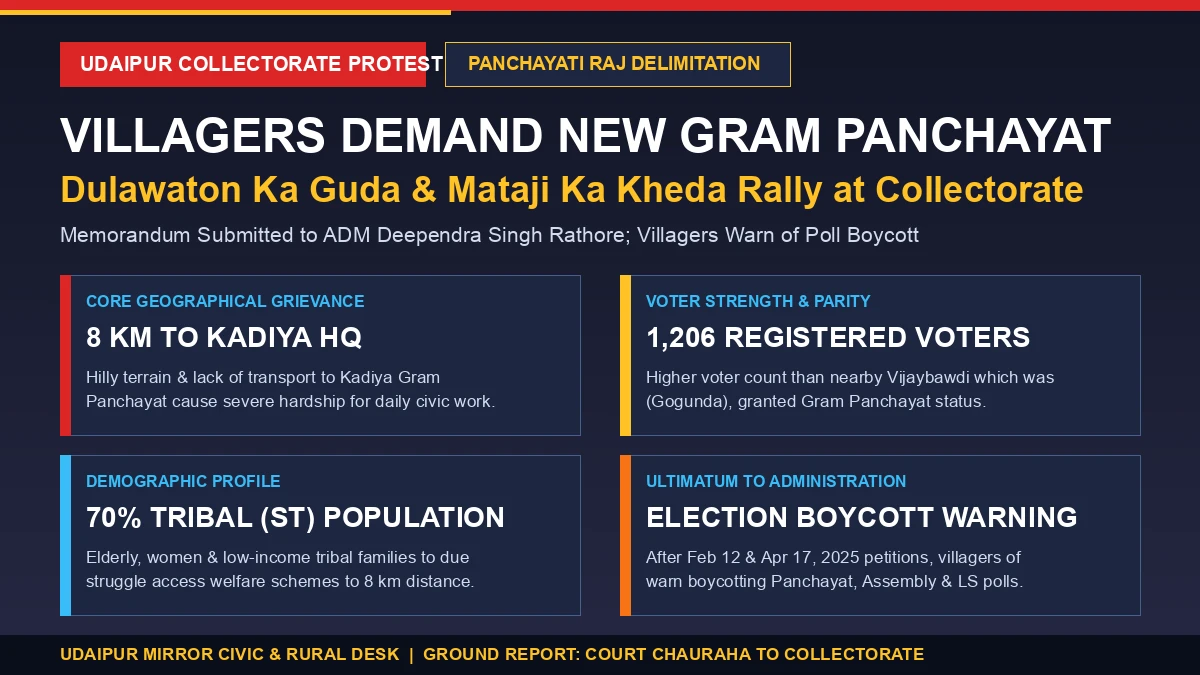
UDAIPUR: Scores of residents from two neighboring revenue villages—Dulawaton Ka Guda and Mataji Ka Kheda—marched from Court Chauraha to the Udaipur District Collectorate on Monday evening, staging an emphatic demonstration demanding the immediate creation of a separate Gram Panchayat. Raising slogans outside the Collectorate gates before meeting senior district officials, the protesting villagers handed over a formal memorandum addressed to the Chief Minister of Rajasthan through Additional District Magistrate (Administration) Deependra Singh Rathore. Frustrated by months of unfulfilled assurances despite repeated official representations in February and April 2025, residents issued a stern ultimatum warning that both villages will boycott voting in upcoming Panchayati Raj, Legislative Assembly (Vidhan Sabha), and Lok Sabha elections unless their demand for a new Gram Panchayat is notified.
The protest gathered momentum late Monday afternoon as men, elders, youth, and community representatives from Dulawaton Ka Guda and Mataji Ka Kheda assembled near Court Chauraha in Udaipur city. Carrying copies of their previous representations and revenue maps, the villagers marched toward the District Collectorate while raising slogans calling for administrative justice and decentralized grassroots governance.
Speaking outside the Collectorate premises, village representatives emphasized that their agitation is not politically motivated, but born out of daily administrative hardship. According to the delegation, residents have patiently followed every procedural norm during the state’s Panchayat delimitation and reorganization exercises over the past year, yet their legitimate proposal was overlooked while smaller habitations in neighboring blocks received Gram Panchayat status.
At the heart of the villagers’ grievance is the geographical layout of their current administrative unit, Kadiya Gram Panchayat. Residents explained to district officials that the Kadiya Panchayat headquarters is situated approximately 8 kilometers away from Dulawaton Ka Guda and Mataji Ka Kheda.
Unlike plains areas connected by frequent state highways or rural bus routes, the belt linking Dulawaton Ka Guda and Mataji Ka Kheda to Kadiya cuts through undulating Aravalli hilly terrain (पहाड़ी क्षेत्र) with minimal public transportation options:
In their written representation to the district administration, villagers highlighted a critical socio-economic metric: approximately 70 percent of the total population across Dulawaton Ka Guda and Mataji Ka Kheda belongs to the Scheduled Tribe (ST) community, alongside other economically vulnerable rural households.
Under the spirit of Rajasthan’s Panchayati Raj system and tribal sub-plan governance norms, administrative units in hilly and tribal-majority belts are meant to be geographically compact so that last-mile welfare delivery reaches every doorstep. Instead, villagers noted that the 8 km distance to Kadiya headquarters disproportionately hurts three groups:
Beyond geography and demographics, the delegation presented concrete electoral roll figures to demonstrate that Dulawaton Ka Guda and Mataji Ka Kheda comfortably fulfill the population and voter criteria for a standalone Gram Panchayat.
According to the official voter data cited in the memorandum, the combined area of Dulawaton Ka Guda and Mataji Ka Kheda has 1,206 registered voters. Drawing a direct comparison with neighboring rural blocks, the villagers pointed out that in the adjacent Gogunda Panchayat Samiti jurisdiction, Vijaybawdi (विजयबावड़ी) village was accorded full Gram Panchayat status despite having fewer registered voters than 1,206.
Villagers argued that when a nearby habitation with a smaller electorate in the same geographical belt qualifies for an independent Gram Panchayat, denying the same status to Dulawaton Ka Guda and Mataji Ka Kheda—which together represent 1,206 voters and a 70% tribal population—amounts to administrative disparity.
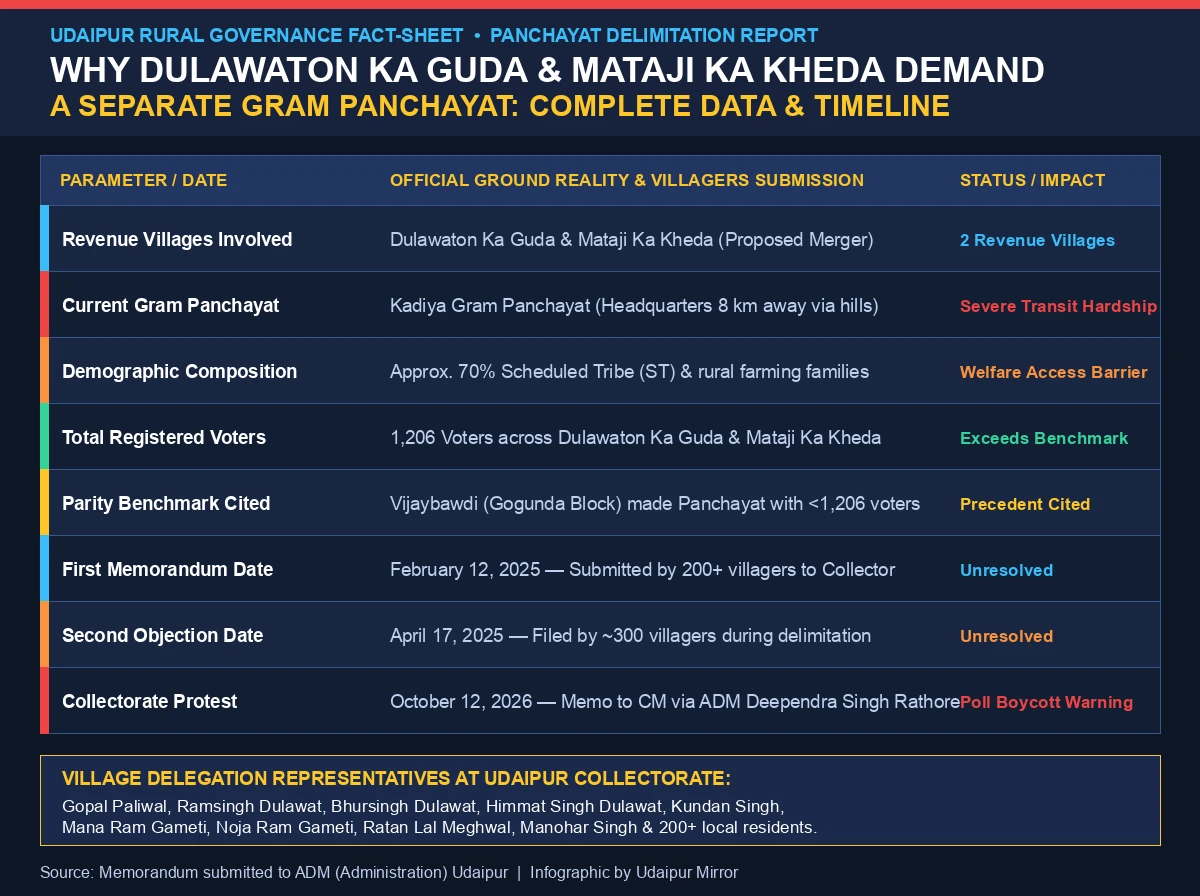
Monday’s Collectorate protest was the culmination of an eight-month-long administrative effort by residents of both villages. As detailed by the protestors, they had approached the authorities twice in 2025 with hundreds of signatures:
| Parameter / Milestone | Details Submitted by Villagers | Administrative Impact / Status |
|---|---|---|
| Revenue Villages Proposed | Dulawaton Ka Guda & Mataji Ka Kheda | Proposed merger into 1 new Gram Panchayat |
| Current Gram Panchayat | Kadiya Gram Panchayat | Headquarters is ~8 km away via hilly terrain |
| Demographic Profile | Approx. 70% Scheduled Tribe (ST) population | High dependence on doorstep government welfare |
| Combined Voter Strength | 1,206 Registered Voters | Meets rural & tribal belt electoral viability |
| Comparative Precedent | Vijaybawdi (Gogunda Panchayat Samiti) | Granted Panchayat status with fewer than 1,206 voters |
| 1st Representation | February 12, 2025 (200+ signatories) | Submitted to District Collector, Udaipur |
| 2nd Representation / Objection | April 17, 2025 (~300 signatories) | Filed during delimitation objection window |
| Latest Collectorate Action | October 12, 2026 (Memo to CM via ADM Admin) | Warning of Panchayat, Assembly & LS poll boycott |
Following the slogan-shouting outside the Collectorate, a representative delegation of villagers met ADM (Administration) Deependra Singh Rathore in his chamber and handed over a comprehensive memorandum addressed to the Chief Minister of Rajasthan.
In the memorandum, the villagers made it clear that their patience has been exhausted after waiting since February 2025. They stated unequivocally that if the state government and district administration fail to notify a separate Gram Panchayat comprising Dulawaton Ka Guda and Mataji Ka Kheda, the 1,206 voters of both revenue villages will collectively boycott voting in all forthcoming elections—including the Panchayati Raj polls, Rajasthan Legislative Assembly elections, and Lok Sabha elections.
The demonstration and submission of the memorandum to ADM Deependra Singh Rathore saw broad participation across all communities of Dulawaton Ka Guda and Mataji Ka Kheda. Prominent villagers and community elders present during the representation included:
District officials received the memorandum and assured the delegation that their representation and demographic comparison would be forwarded to the state Panchayati Raj Department and higher authorities for review.
Residents of Dulawaton Ka Guda and Mataji Ka Kheda protested at the Udaipur District Collectorate on Monday evening to demand the formation of a new, independent Gram Panchayat by merging their two revenue villages, which are currently attached to Kadiya Gram Panchayat nearly 8 kilometers away.
The headquarters of Kadiya Gram Panchayat is about 8 km away through hilly terrain with no adequate public transport. Because nearly 70% of the local population belongs to the Scheduled Tribe (ST) community, senior citizens, women, and economically weaker families face severe difficulty traveling to Kadiya to avail government welfare schemes and routine Panchayat certificates.
According to the memorandum submitted to the administration, the two revenue villages have a combined electorate of 1,206 registered voters. Villagers pointed out that Vijaybawdi in the nearby Gogunda Panchayat Samiti was granted Gram Panchayat status despite having fewer than 1,206 voters.
More than 200 villagers first submitted a memorandum to the Udaipur District Collector on February 12, 2025. Subsequently, around 300 villagers registered formal objections on April 17, 2025, before staging their latest demonstration on October 12, 2026.
The villagers submitted a memorandum addressed to the Chief Minister through ADM (Administration) Deependra Singh Rathore, warning that if a new Gram Panchayat is not created, they will boycott voting in upcoming Panchayati Raj, Assembly, and Lok Sabha elections.
Add Udaipur Mirror as a preferred source on Google to see more of our travel guides in your AI overviews.