Office Address
14, Residency Road, Udaipur, Rajasthan 313001
Office Address
14, Residency Road, Udaipur, Rajasthan 313001

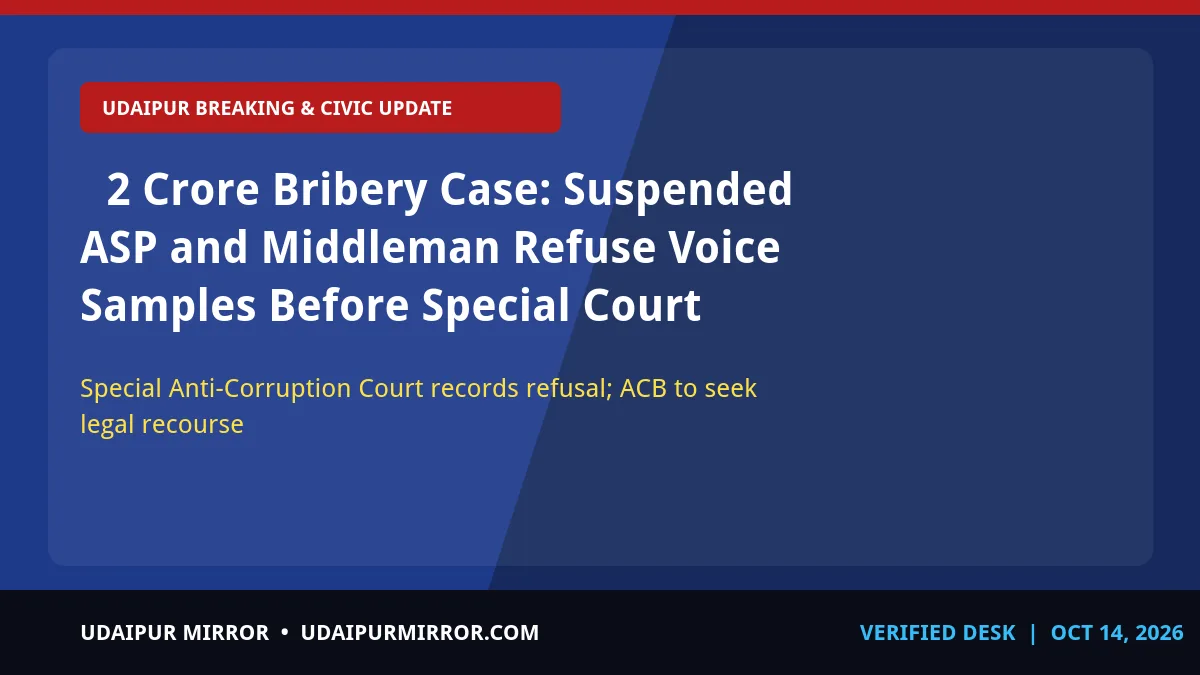
JAIPUR / UDAIPUR: In an escalating legal confrontation surrounding Rajasthan’s sensational high-level corruption probe, the suspended police officer and his civilian accomplice accused in the 2 crore bribery case asp investigation formally refused to give their voice samples before the Special Anti-Corruption Bureau (ACB) Court on Tuesday. The refusal stalls a crucial forensic match against intercepted audio transcripts, prompting anti-graft prosecutors to petition the magistrate to draw an adverse inference against both accused under constitutional and statutory evidentiary doctrines.
⚡ Quick Highlights: ₹2 Cr Bribery Case: ASP Refuses Voice Sample in Court
The Special Anti-Corruption Court witnessed intense procedural sparring when the suspended Additional Superintendent of Police (ASP) and his civilian co-accused were produced pursuant to an ACB application seeking voice spectrography samples. Forensic analysis of these samples was intended to corroborate multiple wiretapped phone conversations and covert sting recordings recovered during the verification stage.
Appearing before the presiding judge, defense counsels entered a formal statement on behalf of both individuals stating their categorical refusal to provide voice recordings. The defense asserted that compelling an accused person to provide speech samples violates their right against self-incrimination guaranteed under Article 20(3) of the Constitution of India.
State prosecutors countered that established jurisprudence by the Supreme Court of India grants judicial magistrates the power to direct accused persons to furnish voice samples for forensic examination without violating self-incrimination clauses, as a voice sample constitutes physical identification rather than testimonial testimony. (Also read: Udaipur Power Cut Alert for Oct 14: 5-Hour Electricity Shutdown in Hathipole, Ghantaghar & Hospital Zones [Full Area List]).
“The act of refusal to furnish voice specimens inside an open court will be presented as a material factor. We are formally requesting the bench to record adverse inference under relevant legal provisions.” — Senior Special Public Prosecutor, Anti-Corruption Bureau
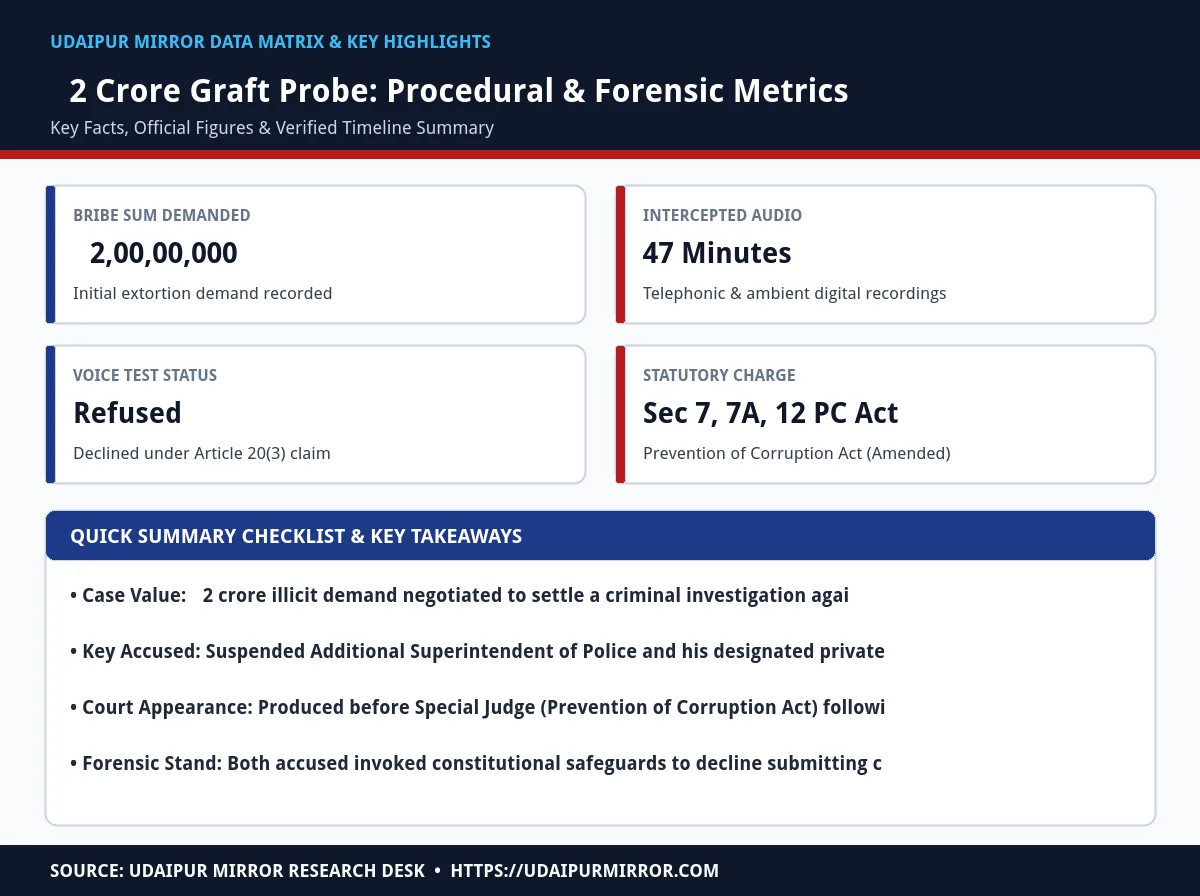
The Special Investigation Unit of the Anti-Corruption Bureau has methodically tracked money trails, digital chatter, and surveillance logs in the extortion investigation. Below is the chronological breakdown of primary procedural milestones recorded in the official case dossier.
| Date & Stage | Investigation Agency | Procedural Action | Current Legal Status |
|---|---|---|---|
| August 2026 (Initial Complaint) | ACB Headquarters | Verification of ₹2 crore settlement extortion | FIR registered under PC Act |
| September 2026 (Digital Intercept) | ACB Technical Wing | Recorded voice calls between ASP & middleman | Transcripts submitted to FSL |
| Early October 2026 (Arrests) | ACB Operations Unit | Detention and custodial interrogation | Remanded to judicial custody |
| October 13, 2026 (FSL Production) | Special ACB Court | Voice spectrography specimen order sought | Accused entered formal refusal |
| October 14, 2026 (Adverse Plea) | Special Public Prosecutor | Plea under Sec 114 Indian Evidence Act | Bench scheduled detailed arguments |
According to the chargesheet draft and preliminary FIR lodged by the Anti-Corruption Bureau, the suspended ASP had allegedly leveraged his regulatory and investigative position to demand ₹2 crore from a prominent infrastructure contractor facing a regional criminal complaint. The private intermediary functioned as a buffer, conducting back-channel discussions at discreet hospitality venues.
Surveillance data revealed that the middleman met the complainant multiple times across luxury corridor venues along national highways connecting Udaipur, Nathdwara, and Rajsamand. Local observers tracking regional governance noted how administrative lapses often coincide with broader civic developments across southern Rajasthan. For example, civic operations often demand complete administrative vigilance, much like when scheduled infrastructure maintenance causes local disruptions, such as the Udaipur Power Cut Alert for Oct 14: 5-Hour Electricity Shutdown in Hathipole, Ghantaghar & Hospital Zones [Full Area List].
“The paper trail and cellular tower locations put the accused ASP and the liaison agent in direct contact immediately preceding and following every negotiation call.” — Investigating Officer, Special Investigation Wing
Under Indian criminal jurisprudence, an accused’s refusal to undergo voice spectrography does not automatically collapse an anti-corruption case. Legal experts point out that following the landmark Supreme Court verdict in Ritesh Sinha vs. State of Uttar Pradesh, judicial magistrates have explicit authority to direct suspects to provide voice samples for the purpose of investigation.
When an accused exercises an absolute refusal despite judicial sanction, trial courts are empowered under Section 114 (Presumption of facts) of the Indian Evidence Act (and its equivalent under the Bharatiya Sakshya Adhiniyam) to draw an adverse inference. This presumption allows the bench to infer that had the sample been provided, the spectrographic frequency analysis would have matched the intercepted incriminating recordings. (Also read: City Express by Marriott Debuts in India with 56-Room Udaipur Nathdwara Highway Property).
“A refusal at this critical juncture is a calculated procedural gambit, but it hands the prosecution a potent tool in the form of judicial adverse inference during final arguments.” — Senior High Court Advocate specializing in PC Act litigation
The high-profile bribery probe has reverberated through Rajasthan’s administrative and police hierarchy, prompting the Department of Personnel and the State Home Ministry to sanction comprehensive audits of sensitive inquiries handled by the suspended ASP during his tenure. District monitoring committees across southern Rajasthan and Mewar divisions have instituted tighter scrutiny over officer-intermediary nexus networks.
Amid major political and administrative transitions in the region—including the heightened scrutiny surrounding the Udaipur Panchayat Election 2026: BJP Releases Zila Parishad Candidate List; Former MLAs, MLA’s Daughter Fielded [Complete 47 Wards]—the state government has issued zero-tolerance directives to the Anti-Corruption Bureau to prevent political interference in judicial corruption proceedings.
“Institutional transparency is paramount. No uniformed officer or associate found subverting the justice system for monetary gain will receive departmental leniency.” — Senior Secretariat Official, Department of Personnel, Rajasthan
The case involves a suspended Additional Superintendent of Police and an alleged middleman accused of demanding and attempting to extort ₹2 crore from a private firm to resolve an ongoing police complaint.
The accused cited fundamental rights under Article 20(3) of the Indian Constitution, arguing that furnishing speech specimens amounts to forced self-incrimination, declining the ACB’s formal request before the Special Judge.
Yes. The prosecution will request the court to draw an adverse inference under Section 114 of the Evidence Act. In addition, digital logs, call detail records, cell tower locations, and witness statements can corroborate the charges.
The Special Anti-Corruption Court will formally record the refusal, adjudicate the prosecution’s adverse inference application, and proceed with framing of charges under Sections 7 and 12 of the Prevention of Corruption Act.
Add Udaipur Mirror as a preferred source on Google to see more of our travel guides in your AI overviews.