Office Address
14, Residency Road, Udaipur, Rajasthan 313001
Office Address
14, Residency Road, Udaipur, Rajasthan 313001

JAIPUR: In an aggressive statewide push to enforce healthcare accountability and stem seasonal outbreaks, the rajasthan health department orders comprehensive field monitoring protocols, expedited claim settlements for empanelled private and public hospitals, and intensive vector-control drives across all 33 health administrative zones.
⚡ Quick Highlights: Rajasthan Health Orders: Monitoring, Fast Payouts
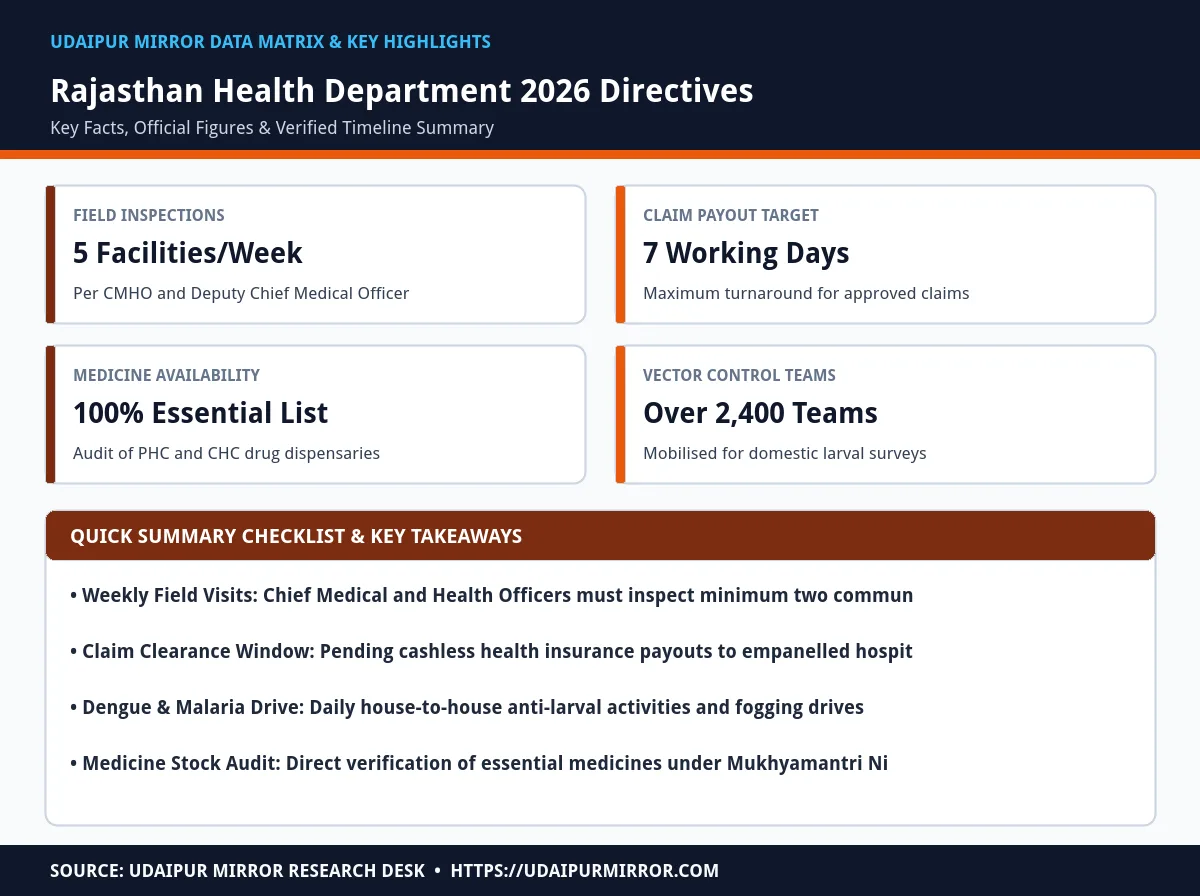
Following reports of inconsistent doctor attendance and sporadic medicine shortages in tribal and peripheral rural blocks, Additional Chief Secretary (Medical and Health) Shubhra Singh issued a sweeping notification mandating that all Chief Medical and Health Officers (CMHOs), Block Chief Medical Officers (BCMOs), and departmental program managers exit administrative headquarters to conduct extensive physical audits. Each administrative physician must inspect a minimum of five public healthcare facilities weekly, with surprise checks directed at primary health centres (PHCs), community health centres (CHCs), and sub-centres.
These ground checks focus on verifying geo-tagged biometric attendance systems, reviewing patient casualty registrations, and examining cold-chain integrity for seasonal immunization and anti-rabies vaccines. Officials found skipping designated field rounds without explicit prior sanction will face immediate disciplinary inquiries and adverse entries in their Annual Confidential Reports (ACRs).
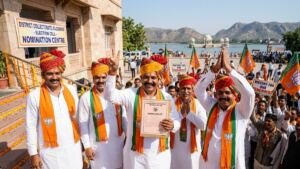
While local district bodies navigate election code logistics amidst political processes such as the Udaipur Panchayat Election 2026: Scrutiny of 750 Nomination Papers Today; 720 Candidates in Fray Across Zila Parishad & 10 Samitis, state authorities emphasized that essential public healthcare field operations remain completely insulated from political activities.
“Administrative presence cannot remain confined to air-conditioned secretariats while peripheral health posts experience staff absenteeism. Every CMHO is personally accountable for the functionality of primary health machinery in their jurisdiction.” — Senior Directorate Official, Medical, Health & Family Welfare Department, Rajasthan
The Medical and Health Department has set binding weekly monitoring quotas, rapid-response timelines, and inspection thresholds for district-level administrative teams across key Rajasthan divisions to ensure zero lapses in clinical delivery.
| Division / District | Mandatory Weekly Inspections | Claim Dispute Resolution | Vector Surveillance Teams | Reporting Mechanism |
|---|---|---|---|---|
| Jaipur (Urban & Rural) | 12 CHCs / 18 PHCs | Within 5 Business Days | 420 Rapid Action Squads | Real-Time e-Aushadhi & Portal |
| Udaipur & Mewar Belt | 10 CHCs / 15 PHCs | Within 7 Business Days | 280 Anti-Larval Teams | Weekly District Taskforce Sync |
| Jodhpur & Marwar Zone | 10 CHCs / 14 PHCs | Within 7 Business Days | 260 Fogging & Larval Units | Bi-Weekly DM Review Docket |
| Kota & Hadoti Belt | 8 CHCs / 12 PHCs | Within 6 Business Days | 210 Surveillance Squads | Integrated Health Dashboard |
| Bikaner & North Sector | 8 CHCs / 11 PHCs | Within 7 Business Days | 190 Dedicated Units | Daily Vector Incident Index |
| Ajmer & Central Sector | 9 CHCs / 13 PHCs | Within 6 Business Days | 230 Field Inspection Teams | State Health Directorate Sync |
A central pillar of the newly issued directives is the rapid decongestion of unpaid claims lodged by private empanelled healthcare providers under the state’s universal health insurance ecosystem (Ayushman Bharat – Mukhyamantri Ayushman Arogya Yojana). Over recent months, private medical associations raised concerns regarding bureaucratic verification delays, which threatened to disrupt cashless hospitalization services for economically weaker families.
Under the revised protocol, state nodal verification officers and Third-Party Administrators (TPAs) must process queries and sanction verified claims within a maximum window of seven working days. The department has established a designated fast-track grievance desk at Swasthya Bhawan in Jaipur to settle disputed bills and minimize claim rejection rates.
State vigilance mechanisms have simultaneously been instructed to ensure these accelerated financial clearances remain immune to kickbacks or irregularities, mirroring ongoing crackdowns in other administrative domains such as the ₹2 Crore Bribery Case: Suspended ASP and Middleman Refuse Voice Samples Before Special Court. Clear automated trail logs will be audited weekly by internal finance inspectors.
“No empanelled hospital can deny cashless admission to an eligible citizen under the pretext of settlement backlogs. We have streamlined the verification pipeline to ensure transparent, automated, and prompt disbursals.” — Executive Directive, State Health Assurance Agency (SHAA), Jaipur
With transitional post-monsoon weather creating favorable conditions for vector breeding, the Rajasthan health department ordered heightened surveillance to suppress the transmission of dengue, malaria, chikungunya, and scrub typhus. Municipal bodies, Panchayati Raj institutions, and health teams have been ordered to act in unison across high-burden clusters.
District surveillance units have mobilized over 2,400 field teams for door-to-door larval surveys. Under the ‘Dry Day’ protocol enforced every Sunday, communities are urged to empty domestic coolers, overhead cisterns, and discarded containers. Healthcare workers are conducting targeted Temephos application in stagnant water bodies, coupled with Pyrethrum fogging in localities recording elevated fever indices. (Also read: Rajsamand Panchayat Election 2026: BJP Releases Zila Parishad Candidate List for 28 Wards; Ward 10 Kept On Hold [Full Ward-Wise Table]).
“Early diagnostic intervention is our foremost shield against dengue hemorrhagic escalations. Testing facilities across district hospitals are stocked with sufficient NS1 antigen and IgM ELISA test kits.” — Dr. Ravi Sharma, State Epidemiologist, Integrated Disease Surveillance Programme (IDSP)
The health department has also targeted operational friction inside the Rajasthan Medical Services Corporation Limited (RMSCL) supply chain. Reports of intermittent shortages of basic antipyretics, antibiotics, and hypertension medicines prompted a state-level instruction holding district drug store warehouse managers directly responsible for maintaining buffer inventories.
Through the digital e-Aushadhi portal, drug inventory levels will be tracked dynamically. If any public health facility falls below a 15-day reserve of essential medicines, local institutional heads are authorized to execute local purchases to prevent patients from spending out-of-pocket at commercial retail counters.
“The state's free medicine scheme is non-negotiable. Bypassing state formularies to force patients toward retail chemist shops will result in immediate termination of contractual staff and severe departmental action against regular officers.” — Managing Director, Rajasthan Medical Services Corporation Limited
Recognizing that public health drives falter without civic coordination, District Collectors across all districts have been designated as executive commanders for the health campaign. Weekly reviews will harmonize sanitation drives conducted by municipal corporations with vector surveys run by health workers.
District magistrates have also been tasked with assessing oxygen generation plant readiness, electricity backup lines in rural hospitals, and ambulance response response times under the 108 and 104 emergency networks, ensuring rural populations receive uninterrupted emergency transit.
“Healthcare management requires inter-departmental precision between sanitation, public works, and clinical personnel. District administrations will lead ground monitoring to resolve bottlenecks immediately.” — State Health Secretariat Joint Communiqué, Jaipur
The Rajasthan health department ordered Chief Medical and Health Officers (CMHOs) and Block Chief Medical Officers (BCMOs) to conduct mandatory weekly field inspections of at least five healthcare centres (two CHCs and three PHCs), audit doctor biometric attendance, inspect drug availability, and monitor hygiene standards.
The department set a mandatory seven-working-day clearance timeline for pending and newly submitted cashless health insurance claims by empanelled private and public hospitals under state health insurance schemes, backed by a fast-track dispute desk at Swasthya Bhawan in Jaipur.
Measures include deploying over 2,400 field teams for door-to-door larval surveys, conducting Pyrethrum fogging, enforcing weekly Sunday ‘Dry Day’ protocols in urban and rural wards, maintaining ELISA diagnostic kit stocks, and operating dedicated fever outpatient clinics.
Under the Mukhyamantri Nishulk Dava Yojana guidelines, if prescribed medicines are out of stock in the facility dispensary, hospital in-charges are authorized to make immediate local purchases using decentralized institutional funds. Patients can also report shortages via the state health helpline 181.
Add Udaipur Mirror as a preferred source on Google to see more of our travel guides in your AI overviews.


[…] Justice Joseph highlighted that unlike statutory regulatory authorities, the Election Commission of India (ECI) carries the sacred mandate of mediating political power itself. Consequently, even an appearance of institutional complacency poisons voter faith. He insisted that reinforcing election commission integrity safeguards cannot be delayed, specifically demanding statutory firewalls against executive encroachment. (Also read: Rajasthan Health Department Orders Tighter Field Monitoring, Faster Chiranjeevi-Maa Payouts and Vect…). […]