Office Address
14, Residency Road, Udaipur, Rajasthan 313001
Office Address
14, Residency Road, Udaipur, Rajasthan 313001

NEW DELHI: A democracy is fundamentally poisoned at its very source whenever the credibility, institutional insulation, and constitutional independence of the poll panel fall into suspicion, former Supreme Court jurist Justice Kurian Joseph warned during an address on national governance. Emphasizing the urgent necessity of robust election commission integrity safeguards, the retired judge observed that public trust in the ballot box serves as the foundational pillar of the Republic, rendering any perceived administrative capitulation or systemic bias fatal to representative democracy.
⚡ Quick Highlights: EC Integrity Safeguards: Justice Kurian Joseph Warns
Addressing legal luminaries, constitutional scholars, and civil society delegates at a seminar examining democratic integrity, Justice Kurian Joseph underscored that free, fair, and unquestioned elections are not mere ceremonial events but the very circulatory lifeblood of sovereign governance. He noted that if citizens begin to harbor reasonable apprehensions that the election machinery acts in deferential coordination with the executive branch, democratic legitimacy collapses completely.
Justice Joseph highlighted that unlike statutory regulatory authorities, the Election Commission of India (ECI) carries the sacred mandate of mediating political power itself. Consequently, even an appearance of institutional complacency poisons voter faith. He insisted that reinforcing election commission integrity safeguards cannot be delayed, specifically demanding statutory firewalls against executive encroachment. (Also read: Rajasthan Health Department Orders Tighter Field Monitoring, Faster Chiranjeevi-Maa Payouts and Vector Disease Control).
“If the integrity of the Election Commission cannot be trusted implicitly by every citizen, the entire democratic enterprise is poisoned at the source. The umpire cannot be perceived as batting for the ruling side.” — Justice Kurian Joseph, Former Supreme Court Judge
The framework governing appointments and functional autonomy at Nirvachan Sadan has traversed several judicial, parliamentary, and administrative iterations over the past three decades:
| Era / Landmark | Selection Mechanism | Key Safeguards / Mechanism | Constitutional Status |
|---|---|---|---|
| Pre-1991 System | Sole Executive Discretion | Appointments made directly on PM and Cabinet advice | Single-member commission until 1989 |
| 1991 Multi-Member Act | Sole Executive Discretion | Equal status granted to CEC and two ECs under Article 324 | Three-member statutory body |
| Dinesh Goswami Panel (1990) | Proposed Collegium | Recommended consultation with CJI and Leader of Opposition | Parliamentary recommendation unadopted |
| SC Ruling (March 2023) | 3-Member Collegium | Prime Minister, Chief Justice of India, and Leader of Opposition | Judicial stopgap pending legislative act |
| Parliamentary Act (Dec 2023) | Executive-Led Panel | Prime Minister, Union Cabinet Minister, and Leader of Opposition | Current operational statutory mechanism |
| Proposed 2026 Safeguards | Equated Removal & Cooling-Off | Removal parity for ECs with CEC; strict ban on subsequent posts | Proposed constitutional amendments |
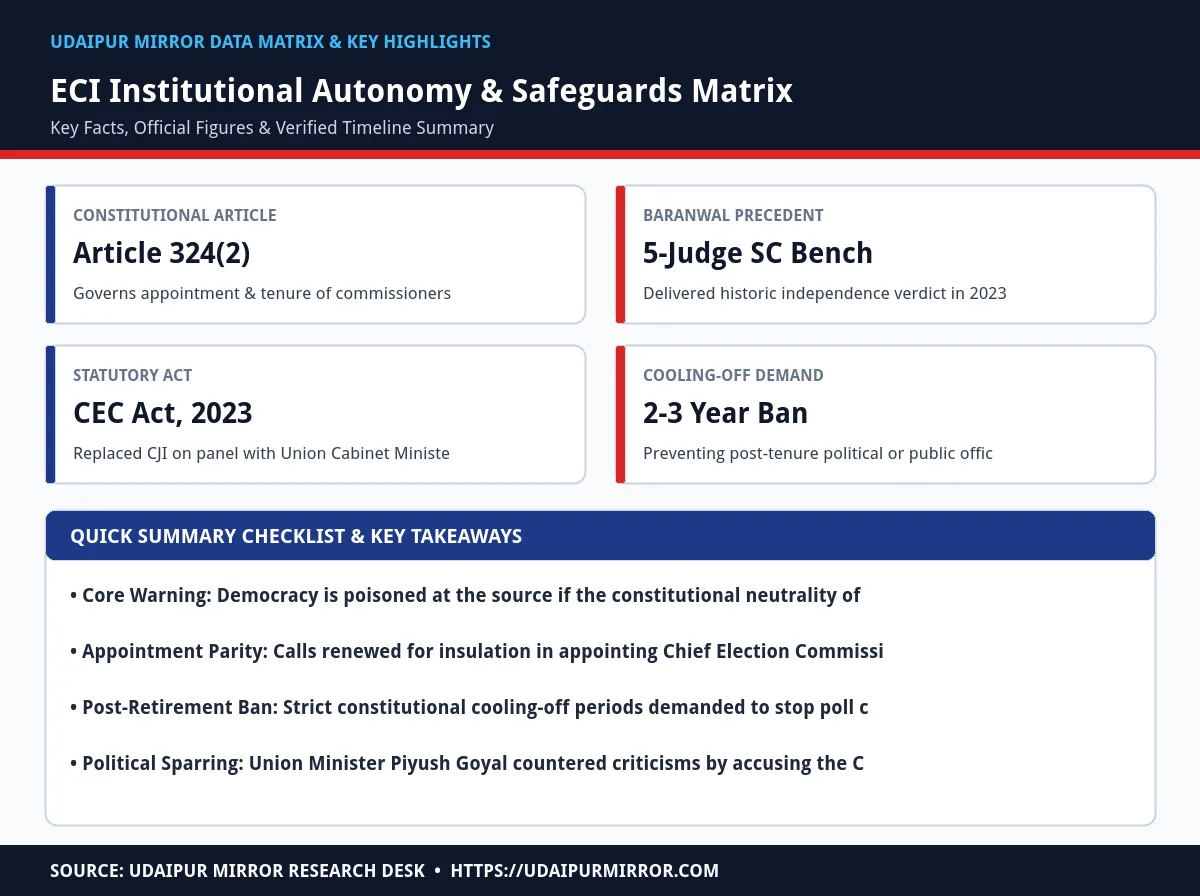
The central fulcrum of Justice Joseph’s discourse focused on the contentious appointment architecture established under recent legislation. In March 2023, a five-judge Constitution Bench of the Supreme Court headed by Justice K.M. Joseph had instituted a balanced selection committee consisting of the Prime Minister, the Chief Justice of India, and the Leader of the Opposition. However, Parliament subsequent passed the Chief Election Commissioner and other Election Commissioners (Appointment, Conditions of Service and Term of Office) Act, which replaced the CJI with a nominated Union Cabinet Minister.
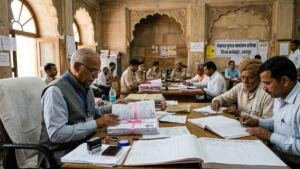
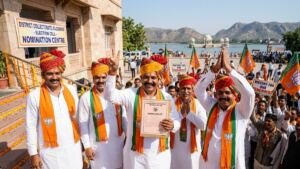
Justice Kurian Joseph pointed out that a committee where the executive command retains a permanent 2:1 majority fails the test of perceived detachment. Constitutional insulation demands that the appointing authority reflects an unassailable equilibrium across state organs. Similar structural concerns regarding local-level governance neutrality often surface when administrative machinery supervises regional democratic processes, as demonstrated during the ongoing Udaipur Panchayat Election 2026: Scrutiny of 750 Nomination Papers Today; 720 Candidates in Fray Across Zila Parishad & 10 Samitis.
Another focal dimension raised by legal reform advocates is the practice of retired poll commissioners accepting governorships, parliamentary candidacies, or high-level tribunal appointments. Justice Joseph argued that the prospect of post-retirement sinecures creates psychological vulnerabilities during an official’s active tenure, subtly incentivizing favorable treatment toward the executive of the day.
The critique ignited sharp counter-arguments from the ruling establishment. Senior BJP leader and Union Minister Piyush Goyal swiftly retorted, asserting that the current government had codified transparent rules, whereas previous regimes had repeatedly compromised the independence of the EC by rewarding former commissioners with ministerial posts and Rajya Sabha nominations. Goyal cited historical precedents where top election watchdogs entered party politics immediately after relinquishing office. (Also read: Udaipur Panchayat Election 2026: Scrutiny of 750 Nomination Papers Today; 720 Candidates in Fray Across Zila Parishad & 10 Samitis).
“Those raising questions today must look in the mirror. It was the Congress culture that rewarded former Chief Election Commissioners with party tickets and Cabinet berths.” — Piyush Goyal, Union Minister
The integrity of electoral bodies extends beyond national Lok Sabha elections into state assemblies and regional governance bodies. When federal watchdogs face credibility debates, local state election commissions and district returning officers face similar public pressure for impartial administration. Clean procedures remain imperative whether resolving ward-level party controversies, such as those cataloged in the Rajsamand Panchayat Election 2026: BJP Releases Zila Parishad Candidate List for 28 Wards; Ward 10 Kept On Hold [Full Ward-Wise Table], or adjudicating high-stakes national infractions.
Legal scholars maintain that systemic safeguards must be established through constitutional amendments rather than ad-hoc statutory orders. Expanding Article 324 to establish an autonomous permanent secretariat for the Election Commission, funded directly through the Consolidated Fund of India, represents a vital structural reform awaiting legislative consensus.
Justice Kurian Joseph stated that democracy is poisoned at its very source if the integrity, independence, and neutrality of the Election Commission cannot be trusted implicitly by the electorate.
Critics argue that replacing the Chief Justice of India with a Union Cabinet Minister on the selection panel gives the central executive an automatic 2:1 majority, undermining non-partisan appointments.
Key proposals include a mandatory 3-year cooling-off period before commissioners can accept post-retirement roles, equal constitutional removal protections for all commissioners, and a direct independent budget.
Piyush Goyal defended the government’s statutory framework, alleging that historical Congress regimes undermined the commission’s independence by rewarding former poll officials with Cabinet berths and party nominations.
Add Udaipur Mirror as a preferred source on Google to see more of our travel guides in your AI overviews.