Office Address
14, Residency Road, Udaipur, Rajasthan 313001
Office Address
14, Residency Road, Udaipur, Rajasthan 313001

NEW YORK/MUMBAI: Global financial markets were sent into a tailspin on Wednesday as the nasdaq falls on fed rate hike bets following a surprisingly resilient inflation report from the US Labor Department. The September Consumer Price Index (CPI) exceeded economist forecasts, effectively shattering hopes for a dovish pivot and forcing traders to recalibrate their expectations for the Federal Reserve’s final meetings of 2026. The tech-heavy index led the decline, shedding nearly 2% as high-growth companies—highly sensitive to interest rate fluctuations—bore the brunt of the selling pressure.
⚡ Quick Highlights: Nasdaq Falls 2% on Fed Rate Hike Bets | Udaipur Mirror
The primary driver behind the current market volatility is the September CPI print, which showed that core inflation remains stubbornly above the Federal Reserve’s 2% target. This ‘hot’ data has effectively neutralized the narrative of a soft landing, suggesting that the central bank may need to keep rates ‘higher for longer’ or even implement additional hikes before the year concludes.
As the nasdaq falls on fed rate hike bets, investors are rotating out of speculative growth stocks. While some domestic sectors in India have shown resilience, such as the recent trend where the Nifty IT Soars 4% as TCS, Infosys and Coforge Spark 2,000-Point Rally: Key Catalysts Behind Tech Surge, the global sentiment is now shifting toward a defensive posture.
“The inflation numbers were a wake-up call for those expecting an early pivot. The Fed is now backed into a corner where they must prioritize price stability over market liquidity.” — Marcus Vane, Chief Strategist at Global Capital Markets
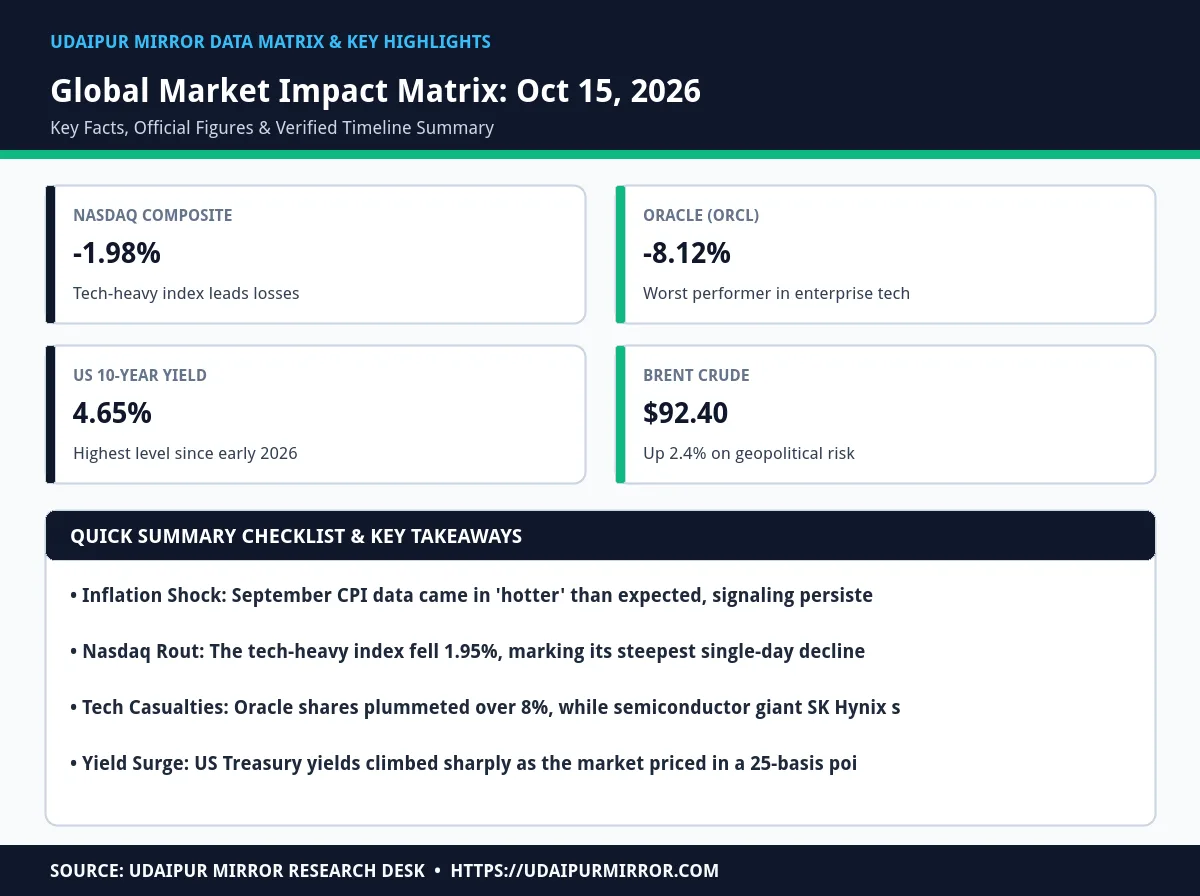
The following table outlines the closing figures for major indices and commodities following the release of the September CPI data, highlighting the broad-based nature of the market correction.
| Asset Class | Closing Value | Daily Change | Impact Level |
|---|---|---|---|
| Nasdaq Composite | 17,842.50 | -1.98% | High |
| S&P 500 | 5,620.10 | -1.25% | Moderate |
| Dow Jones | 41,950.30 | -0.85% | Low |
| Brent Crude Oil | $92.40/bbl | +2.40% | High |
| US Dollar Index | 106.85 | +0.75% | Moderate |
| SK Hynix (KRX) | 182,400 KRW | -6.10% | High |
| Oracle Corp | $152.10 | -8.05% | Critical |
The technology sector, particularly companies with high price-to-earnings ratios, saw a massive sell-off. Oracle Corporation witnessed a staggering drop of over 8% following disappointing guidance and the broader macro-economic headwinds. Similarly, the semiconductor industry faced a rout, with SK Hynix slipping more than 6% as concerns over global demand and rising capital costs intensified.
This global tech correction serves as a stark reminder of the sensitivity of the sector to interest rate cycles. Even as local primary markets see activity, such as when the Vaibhav Vyapaar IPO Closes with 0.38x Subscription: Check Allotment Date, GMP Trends, and Listing Timelines, the overarching shadow of US monetary policy continues to dictate the direction of institutional capital flows.
Adding fuel to the fire, Brent crude oil prices surged past the $92 mark. The escalation of tensions in the Middle East has introduced a significant risk premium to energy markets. For a major oil importer like India, this dual blow of a stronger dollar and rising crude prices poses a significant challenge to the fiscal deficit and domestic inflation management.
The surge in oil prices often leads to a ‘risk-off’ sentiment where investors flee emerging markets in favor of the US Dollar and Treasuries. This flight to safety is evident in the bond market, where the 10-year Treasury yield reached levels not seen since the start of the year, further depressing the present value of future corporate earnings. (Also read: Vaibhav Vyapaar IPO Closes with 0.38x Subscription: Check Allotment Date, GMP Trends, and Listing Timelines).
For Indian investors, the Nasdaq’s fall is a double-edged sword. While the domestic IT sector has recently enjoyed a rally, the global slowdown in tech spending—driven by higher US interest rates—could eventually dampen the demand for Indian outsourcing services. Furthermore, the strengthening US Dollar makes imports more expensive, potentially leading to imported inflation.
The broader geopolitical landscape also plays a role. Recent shifts in US policy, such as the US Green Card Programme Suspension Hits Indian IT Giants; Anupam Mittal Foresees Tech Talent Surge in India, already have the industry on edge. A prolonged period of high interest rates in the US could further accelerate the repatriation of capital from Dalal Street back to Wall Street.
“Indian markets cannot remain decoupled from the US for long. If the Nasdaq continues to bleed, we will see a spillover effect on the Nifty and Sensex by the end of the week.” — Rohan Mehta, Senior Analyst at Mewar Securities
As we approach the final quarter of 2026, all eyes remain on the Federal Open Market Committee (FOMC). The ‘hot’ CPI data has effectively taken a rate cut off the table for the remainder of the year. Instead, the debate has shifted to whether the Fed will hike once or twice more before January 2027.
Investors are advised to maintain a diversified portfolio, focusing on value stocks and sectors with strong pricing power that can withstand inflationary pressures. The volatility in the Nasdaq is likely to persist until there is a clear sign that inflation has been tamed without triggering a deep recession.
The Nasdaq fell primarily due to the release of ‘hot’ US CPI data, which showed higher-than-expected inflation. This led to increased bets that the Federal Reserve will raise interest rates again, which negatively impacts high-growth tech stocks.
High US inflation leads to higher US interest rates, which strengthens the US Dollar. This often results in Foreign Portfolio Investors (FPIs) pulling money out of emerging markets like India to invest in safer US assets, putting downward pressure on the Nifty and Sensex.
Oracle saw a significant drop of over 8%, and SK Hynix fell by more than 6%. Most major US tech firms, including the ‘Magnificent Seven,’ experienced declines as investors revalued growth prospects against higher borrowing costs.
Following the September CPI beat, market probability for a 25-basis point hike in November has surged to over 70%. The Fed’s decision will depend on subsequent labor market data and final inflation readings.
Add Udaipur Mirror as a preferred source on Google to see more of our travel guides in your AI overviews.





[…] against traditional legacy imports. Even as global macro signals remain cautious after the Nasdaq Slumps 2% as Hot US Inflation Data Ignites Federal Reserve Rate Hike Fears, domestic high-conviction defense electronics continue to command premium multiples from […]