Office Address
14, Residency Road, Udaipur, Rajasthan 313001
Office Address
14, Residency Road, Udaipur, Rajasthan 313001

BENGALURU: In an unexpected regulatory upheaval affecting cross-border technology services, the United States Department of Labor has halted employer-sponsored permanent residency filings for premier Indian IT services conglomerates, precipitating a structural debate over the us green card programme suspension. The decision directly impacts top tier service providers—including Tata Consultancy Services (TCS), Infosys, Wipro, and HCLTech—prompting immediate assessments across human capital desks and enterprise technology corridors worldwide.
⚡ Quick Highlights: US Green Card Programme Suspension: IT Giants & Impact
The formal notification freezing Program Electronic Review Management (PERM) applications—an indispensable preliminary phase in employment-based immigrant visa pathways—has targeted major outsourcing enterprises. Regulators cite compliance reviews and domestic labor market protections, creating immediate friction for mid-tier technology professionals stationed in the United States on existing non-immigrant H-1B instruments.
Industry analysts emphasize that while the move reflects ongoing protectionist undercurrents in Washington, the enterprise landscape differs vastly from earlier cycles. Rather than crippling IT execution capabilities, the restriction primarily affects long-term immigration aspirations rather than current contractual software delivery or cloud migrations. (Also read: Fusion CX IPO Opens for Subscription: ₹702 Cr Issue, 12% GMP, Ashish Kacholia & Kotak Life Lead ₹315 Cr Anchor Book [Apply or Avoid?]).
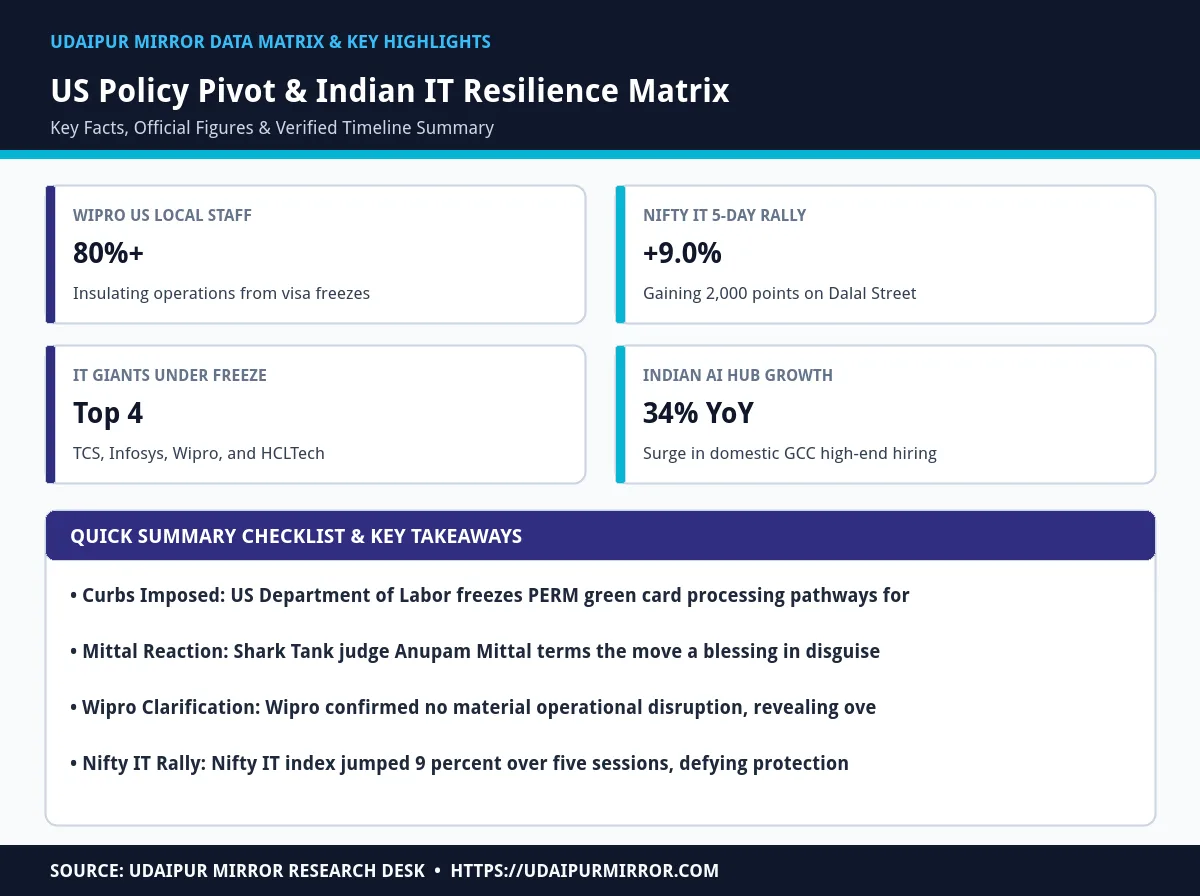
“This is a massive blessing in disguise for India. The very talent that built trillion-dollar enterprise stacks abroad will now build generational deep-tech platforms right here at home.” — Anupam Mittal, Founder & CEO, People Group
The operational pivot executed by tier-1 Indian technology vendors over the last decade has significantly reduced direct exposure to unilateral visa curbs. The table below outlines localized staffing ratios, revenue distribution, and immediate management stances following the suspension directive.
| Company Name | US Revenue Share (%) | Local US Workforce Ratio | PERM Green Card Exposure | Official Corporate Stance |
|---|---|---|---|---|
| Tata Consultancy Services (TCS) | 49.5% | 72% | Moderate (<2% total headcount) | Diversified global delivery model ensures contract continuity |
| Infosys Limited | 58.2% | 74% | Moderate (Under review) | Onshore innovation hubs anchor client digital transformations |
| Wipro Limited | 54.8% | 80%+ | Minimal / Negligible | No material operational or financial impact reported |
| HCLTech | 63.0% | 71% | Low to Moderate | Engineering R&D delivery distributed across 54 countries |
| LTIMindtree | 56.4% | 68% | Low | Focus remains on localized delivery centers in North America |
Prominent angel investor and Shark Tank India judge Anupam Mittal publicly framed the restrictions not as a setback, but as an unprecedented tailwind for India’s burgeoning startup and enterprise artificial intelligence ecosystem. According to Mittal, systemic friction in Western immigration pipelines will naturally redirect seasoned enterprise architects, data scientists, and engineering directors back to metropolitan tech hubs like Bengaluru, Hyderabad, and Pune.
Over the past four quarters, India has recorded a dramatic expansion in Global Capability Centers (GCCs), with multinational firms directly establishing high-value engineering centers on Indian soil. As tech valuations normalize and venture capital allocates heavily toward sovereign AI and domestic infrastructure, the retention of top-tier engineering talent is anticipated to accelerate product maturity across Indian software-as-a-service (SaaS) and deep tech domains.
“When the world closes administrative doors to high-caliber engineers, developing economies that offer rapid scale and digital adoption become the natural beneficiaries.” — Venture Ecosystem Briefing Note
In an effort to quell panic among corporate stakeholders, Wipro issued a decisive clarification indicating that the green card freeze carries no material business impact. The Bengaluru-headquartered technology exporter disclosed that more than 80 percent of its workforce stationed in the United States comprises American citizens, permanent residents, or locally authorized personnel.
Similar operational transitions have been mirrored across peers. TCS and Infosys have established major regional delivery and innovation hubs in Texas, North Carolina, Indiana, and Rhode Island, deliberately pruning their historical dependence on guest-worker pipelines. As industrial capital shifts toward domestic supply chains and manufacturing, as highlighted during the Fusion CX IPO subscription and valuation assessment, domestic digital enterprise transformation remains resilient against cross-border bureaucratic adjustments.
Contrary to conventional expectations that immigration crackdowns would trigger sell-offs in technology shares, the Nifty IT index logged an extraordinary 9 percent advance over five consecutive trading sessions, gaining nearly 2,000 points. Heavyweights including Infosys, Tata Consultancy Services, and HCLTech rallied up to 11 percent in intra-week trading, propelled by upbeat quarterly earnings commentary and substantial enterprise AI engagement rollouts.
Market strategists attribute this counterintuitive resilience to broader macroeconomic fundamentals. American corporate IT expenditure has rebounded, with enterprises funneling capital into generative AI proofs-of-concept, ERP modernization, and hybrid cloud architecture. Much like retail and institutional participation expanding rapidly in primary markets—seen recently in the HD Fire Protect IPO day 1 subscription surge—investors view the IT sector’s underlying multi-year earnings visibility as far superior to transient administrative visa headwinds.
The enduring consequence of the us green card programme suspension centers on whether the domestic technology ecosystem possesses adequate depth to productively integrate thousands of mid-to-senior software specialists. Industry leaders maintain that the convergence of domestic digital public infrastructure (DPI), booming sovereign AI clusters, and semiconductor investments creates unprecedented domestic opportunities.
Rather than seeking prolonged residency overseas under restrictive administrative contingencies, engineers are increasingly choosing domestic enterprise leadership roles. With competitive compensation packages, wealth generation via stock options, and the chance to architect scalable consumer and enterprise technologies, India’s tech corridor stands poised to turn international policy friction into sovereign industrial leverage.
The US Department of Labor has halted the processing of PERM labor certifications—the foundational stage required for employment-based permanent residency (green cards)—specifically targeting major foreign technology service providers including TCS, Infosys, Wipro, and HCLTech.
No. The suspension does not cancel valid H-1B visas, L-1 intra-company transfers, or operational contracts. Furthermore, over 70 to 80 percent of on-site professionals at firms like Wipro and Infosys are already locally hired US citizens or permanent residents.
Markets rallied because tier-1 Indian IT companies derive the majority of digital and AI revenue from localized onshore teams and offshore engineering centers. Strong contract wins, enterprise cloud demand, and robust margin guidance outweighed administrative visa concerns.
Anupam Mittal characterized the move as a major catalyst for reverse brain drain, emphasizing that administrative barriers in the US will compel experienced senior tech talent to return to India and accelerate domestic AI, startup, and enterprise engineering innovation.
Add Udaipur Mirror as a preferred source on Google to see more of our travel guides in your AI overviews.