Office Address
14, Residency Road, Udaipur, Rajasthan 313001
Office Address
14, Residency Road, Udaipur, Rajasthan 313001


NEW DELHI: NEW DELHI — In a major step toward fostering early financial literacy among Indian students, the National Council of Educational Research and Training (NCERT) has officially updated its school curriculum. The newly revised academic frameworks incorporate comprehensive chapters on ncert class 9 personal finance, aiming to equip young minds with practical money management skills before they step into higher education.
⚡ Quick Highlights: NCERT Class 9 Personal Finance & Entrepreneurship Chapters Added
For decades, formal education systems across India focused heavily on theoretical sciences, languages, and traditional humanities, often leaving practical money management to trial and error in adulthood. Recognizing this critical gap, academic experts and policymakers have long advocated for foundational economic literacy. By introducing structured lessons on wealth creation, young citizens can now understand how inflation erodes idle savings and why early investing through instruments like systematic investment plans changes financial trajectories.
As retail participation in capital markets surges across households, educators emphasize that financial literacy is no longer an optional skill reserved for commerce graduates. It is an essential survival tool in an increasingly digital and credit-driven economy. For adults looking to diversify their portfolios while children learn the basics, exploring advanced options such as Mirae Asset Platinum Hybrid Long Short Fund Direct Growth highlights how modern investment strategies continue to evolve in tandem with regulatory updates.
“Teaching children about money, compounding, and financial discipline early in life builds a resilient generation capable of navigating complex economic environments.” — Curriculum Development Committee Member
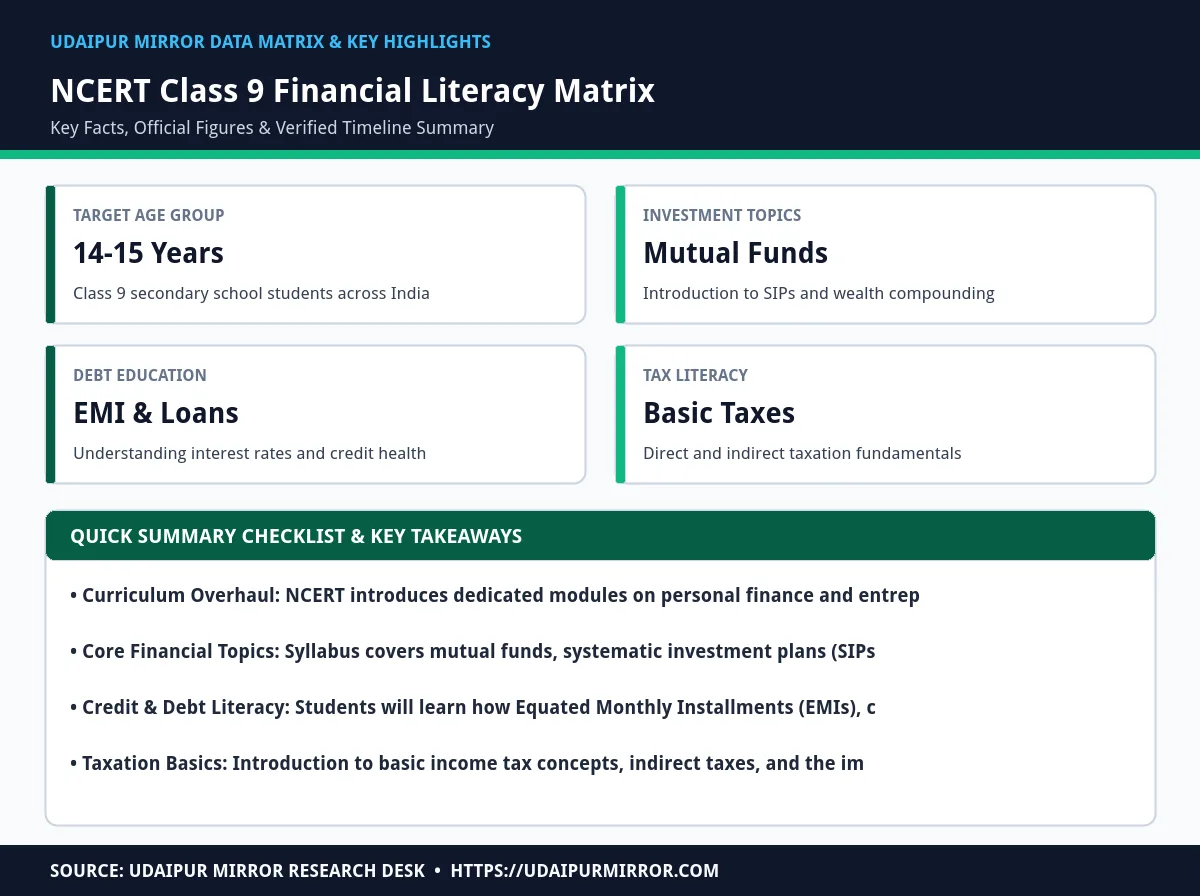
A comparative look at how financial education has evolved from traditional commerce electives to mandatory practical life skills in the modern Indian school curriculum.
| Education Phase | Traditional Curriculum | New NCERT 2026 Framework | Target Audience |
|---|---|---|---|
| Middle School | Basic arithmetic and simple/compound interest formulas. | Budgeting, pocket money management, and digital payments. | Class 6 to 8 |
| Secondary School | Purely theoretical economics and bookkeeping principles. | Mutual funds, SIPs, EMIs, and ncert class 9 personal finance. | Class 9 |
| Senior Secondary | Optional Accountancy and Business Studies electives. | Tax filing basics, green bonds, and entrepreneurship incubation. | Class 11 & 12 |
| Practical Focus | Exam-oriented definitions with little real-world application. | Case studies on retail investing, risk management, and debt traps. | All Streams |
The newly integrated chapters break down complex financial terminologies into digestible, age-appropriate concepts. Instead of daunting mathematical models, students will explore real-world scenarios such as planning for higher education, understanding monthly household budgets, and decoding bank statements. The curriculum demystifies mutual funds by explaining equity, debt, and hybrid fund categories using relatable analogies.
Furthermore, the modules on credit and borrowing shed light on the mechanics behind Equated Monthly Installments (EMIs). Students will learn how high-interest consumer debt can derail financial goals, contrasting sharply with productive loans taken for asset creation or education. This pragmatic approach ensures that students appreciate the true cost of borrowing before they ever apply for a credit card or personal loan in their adult lives.
“When students understand how an EMI impacts their monthly cash flow, they make much wiser borrowing choices later in life.” — Senior Educational Researcher
Beyond personal finance, the updated textbooks place heavy emphasis on entrepreneurship and startup culture. India’s burgeoning startup ecosystem requires a continuous influx of innovative thinkers who understand problem-solving, market validation, and risk mitigation. The curriculum encourages students to identify local community challenges and brainstorm scalable business solutions, transforming passive job seekers into proactive job creators.
In tandem with broader national developments, such as the implementation of Rajasthan Government Welfare Schemes 2026 which support grassroots entrepreneurship and solar adoption, these academic updates ensure that students remain connected with the economic realities and developmental goals of the country. By combining financial acumen with entrepreneurial grit, the updated syllabus prepares adolescents for the dynamic modern workforce.
“Entrepreneurship is not just about starting a company; it is about cultivating a mindset of resourcefulness, resilience, and value creation.” — Venture Education Expert
Rolling out a specialized curriculum requires robust preparation, particularly in subjects traditionally perceived as daunting by educators outside the commerce stream. To ensure seamless execution, educational boards have initiated comprehensive teacher training workshops. These sessions familiarize school faculty with activity-based learning modules, board games simulating stock markets, and interactive digital quizzes designed to make financial literacy engaging for teenagers.
Parents and parent-teacher associations have overwhelmingly welcomed the move, noting that financial literacy taught at school bridges the generational knowledge gap often found in Indian households regarding formal investing and tax planning.
“Our teachers are undergoing specialized orientation programs to ensure that financial concepts are taught through practical activities rather than rote memorization.” — State Education Board Director
The new curriculum covers mutual funds, systematic investment plans (SIPs), compounding, EMIs, credit scores, basic taxation, and entrepreneurship fundamentals.
NCERT introduced these chapters to equip students with essential life skills early, fostering financial literacy, smart borrowing habits, and wealth management before adulthood.
Yes, the updated chapters are integrated directly into the standard secondary school curriculum for schools affiliated with the board starting in the 2026 academic session.
Educational boards are conducting specialized faculty training workshops, activity-based learning modules, and orientation sessions to help teachers explain financial concepts simply.
Add Udaipur Mirror as a preferred source on Google to see more of our travel guides in your AI overviews.