Office Address
14, Residency Road, Udaipur, Rajasthan 313001
Office Address
14, Residency Road, Udaipur, Rajasthan 313001

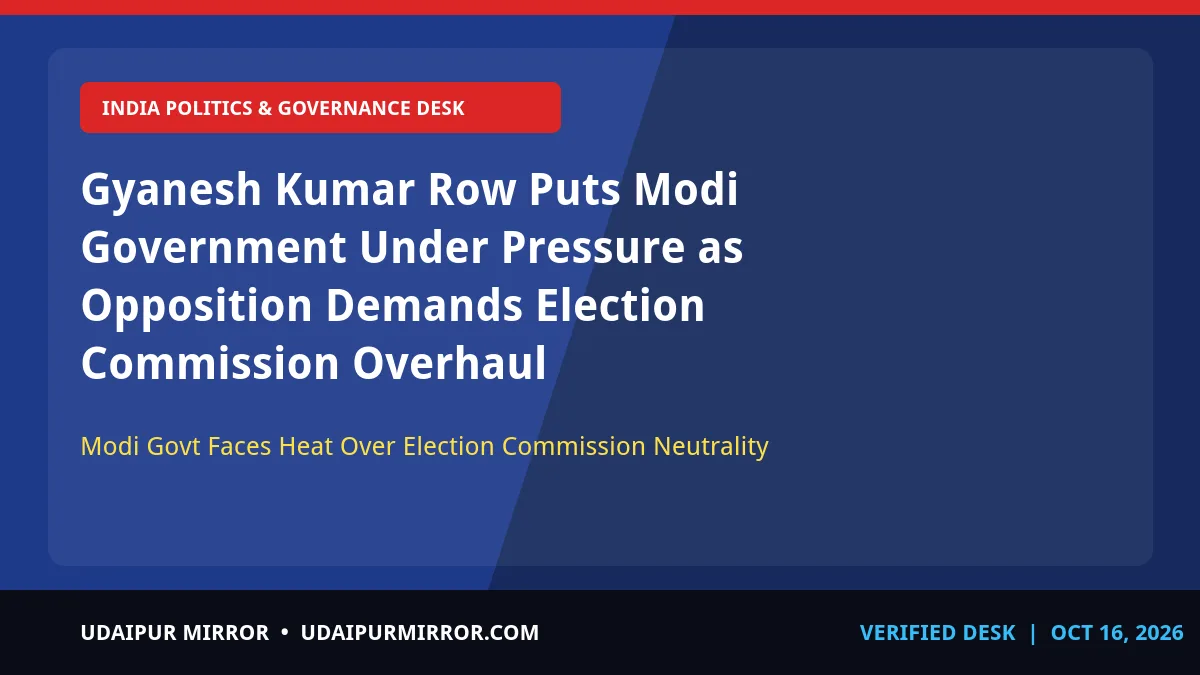
NEW DELHI: The gyanesh kumar election commission row has escalated into a major political and constitutional standoff in the national capital, intensifying parliamentary friction and putting the Narendra Modi-led Union government under sustained administrative pressure. Across national party headquarters and judicial corridors on Friday, political formations demanded comprehensive accountability over recent institutional procedures, questioning selection parameters and operational decisions overseen by the Election Commission of India (ECI).
⚡ Quick Highlights: Gyanesh Kumar Row: Modi Govt Faces Election Body Heat
The controversy surrounding Election Commissioner Gyanesh Kumar touches on constitutional autonomy, an issue that has simmered since Parliament altered the appointments framework. Critics allege that current institutional workflows prioritize executive consensus over consultative checks, a dynamic that came to the forefront following detailed analytical exposés published earlier this week.
Opposition spokespersons have seized on bureaucratic interventions during state-level roll reorganizations, citing them as symptomatic of deeper structural deficits. While national debates focus on central oversight, sub-national governance machinery faces similar scrutiny, as demonstrated during the Udaipur Zila Parishad Elections 2026: 126 Candidates in Fray Across 47 Wards as Dangi Dynasty Clash and BAP Heat Up Polls, where regional political groups have repeatedly questioned grassroots administrative fairness.
“An independent election authority must not only be fair in its constitutional duty, it must also visibly maintain distance from executive political objectives.” — Senior Supreme Court Advocate & Constitutional Jurist
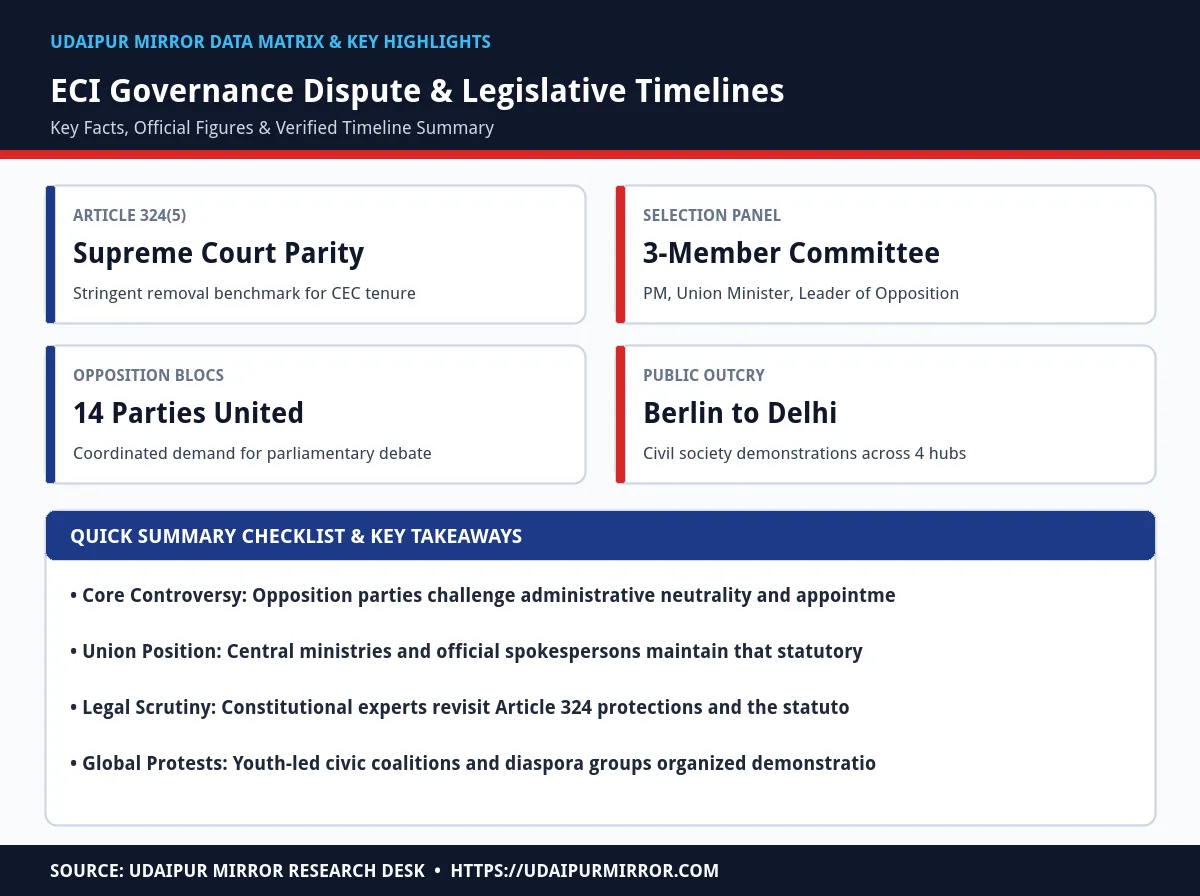
The timeline below details key milestones leading up to the current friction surrounding ECI appointments, procedural objections raised by civil society, and legislative challenges documented through October 2026.
| Date / Phase | Administrative Action | Institutional Stakeholder | Political & Legal Status |
|---|---|---|---|
| December 2023 | Passage of CEC & EC Appointment Act | Parliament of India | Excluded CJI from 3-member panel |
| March 2024 | Appointment of Gyanesh Kumar & Sukhbir Sandhu | Search & Selection Committee | Opposition registers dissent note |
| June 2024 | General Election Certification Completed | Election Commission of India | Scrutiny on multi-phase scheduling |
| August 2026 | Revision of State Electoral Rolls | ECI Secretariat | Regional parties allege selective roll purges |
| Early Oct 2026 | Diaspora & Student Memorandum Filed | Civil Society / Berlin Demonstrators | Public interest petitions lodged in SC |
| 15-16 Oct 2026 | Frontline Report on Executive Influence | National Media & Opposition | Opposition issues joint censure notice |
In response to calls from fringe political outfits and civil coalitions for decisive executive intervention, constitutional scholars have pointed to the rigid legal frameworks governing the constitutional commission. Under Article 324(5) of the Constitution of India, the Chief Election Commissioner cannot be removed from office except in like manner and on like grounds as a Judge of the Supreme Court, requiring a two-thirds majority in both houses of Parliament.
However, the position regarding other Election Commissioners involves a nuanced constitutional balance: they can be removed by the President solely upon the explicit recommendation of the CEC. This procedural safeguard makes external political pressure ineffective without institutional concurrence, solidifying judicial precedent around constitutional insulation.
“The deliberate insulation of election commissioners under Article 324 was designed to prevent volatile political storms from arbitrarily destabilizing institutional continuity.” — Former ECI Legal Advisor
The controversy has also found unexpected resonance beyond India’s borders. Civic youth initiatives, including unconventional satirical movements like the Cockroach Janta Party alongside overseas student coalitions, held rallies outside the Indian Embassy in Berlin on Thursday, demanding institutional transparency and independent electoral auditing.
These demonstrations highlight how diaspora groups are increasingly engaged with domestic institutional affairs. Commentators note that while external demonstrations carry limited legal leverage inside domestic courts, they intensify reputational challenges for the government on global platforms. (Also read: Rajasthan Weather Alert: Rain & Hailstorms Lash Jaipur, Ganganagar & 7 Districts; Mercury Drops Up to 5°C as Western Disturbance Strikes).
“Institutional confidence is a global metric; ensuring complete transparency in democratic institutions is essential to India's democratic prestige.” — International Policy Analyst, Global Affairs Forum
Pushing back firmly against the allegations, senior Union ministers and the Press Information Bureau (PIB) issued rebuttals, categorizing the campaign as a coordinated effort to undermine public faith in constitutional bodies. Official statements stressed that all current commissioners were inducted through legislative frameworks enacted by Parliament following open debate.
Government spokespersons emphasized that policy delivery and governance initiatives proceed unhindered by partisan friction. Administrative performance remains the Centre’s core defense, contrasting ongoing institutional debates with practical infrastructure challenges, such as when Gehlot Flags Critical Water Gap in Rajasthan as Jal Jeevan Mission Deadline Slips Beyond 2026 to highlight the divide between administrative implementation and political rhetoric.
“The constitutional credibility of the Election Commission of India is self-evident. Attempts to drag statutory appointments into partisan politics undermine our democratic ethos.” — Official Press Statement, Ministry of Law and Justice
With several state assembly elections scheduled over the next twelve months, the ongoing clash is expected to shape campaign narratives. For the ruling National Democratic Alliance, deflecting procedural accusations while keeping the spotlight on structural development remains priority number one. Conversely, for the united opposition, questioning commission parity provides a unified rallying platform across both national and regional landscapes.
As political party secretariats prepare their legal and parliamentary countermoves, the Gyanesh Kumar controversy underscores the fragility of institutional consensus in an increasingly polarized political climate.
“Democracy thrives on public confidence. Whether inside the House or in the public sphere, accountability remains non-negotiable.” — Opposition Floor Leader, Lok Sabha
The controversy centers on opposition allegations regarding institutional impartiality, appointment protocols under the 2023 Chief Election Commissioner Act, and administrative decisions concerning electoral rolls and scheduling oversight.
Under the Chief Election Commissioner and other Election Commissioners Act, 2023, appointments are made by the President of India on the recommendation of a three-member Selection Committee consisting of the Prime Minister, a designated Union Cabinet Minister, and the Leader of the Opposition (or leader of the largest opposition party in Lok Sabha).
Under Article 324(5) of the Constitution, the Chief Election Commissioner can only be removed through an impeachment-like process requiring a special two-thirds majority in Parliament. Other Election Commissioners cannot be removed except on the formal recommendation of the Chief Election Commissioner.
The Modi government, through the Press Information Bureau and Union Ministers, has firmly defended the ECI’s independence, stating that appointments followed statutory procedures passed by Parliament and that the commission’s constitutional integrity remains untarnished.
Add Udaipur Mirror as a preferred source on Google to see more of our travel guides in your AI overviews.


[…] The escalating tension over public accountability and institutional oversight mirrors broader political friction currently shaping national discourse, as detailed in our investigative analysis on the Gyanesh Kumar Row Puts Modi Government Under Pressure as Opposition Demands Election Commission Over…. […]