Office Address
14, Residency Road, Udaipur, Rajasthan 313001
Office Address
14, Residency Road, Udaipur, Rajasthan 313001

JAIPUR: The ambitious goal of providing functional household tap connections (FHTC) to every rural home in the state has hit a major roadblock. Senior leader Ashok Gehlot has officially highlighted the growing jal jeevan mission rajasthan water gap, noting that the state is likely to miss its revised 2026 completion targets. Despite significant financial outlays and central support, the logistical complexities of Rajasthan’s desert topography and the slow pace of infrastructure development in remote blocks have left millions of households still waiting for reliable potable water access.
⚡ Quick Highlights: Rajasthan Jal Jeevan Mission: Gehlot Flags Water Gap Issues
The jal jeevan mission rajasthan water gap has become a focal point of political and administrative debate as the state enters the final quarter of 2026. While the mission aimed to provide 100% coverage by 2024, the deadline was pushed to 2026, and now looks set to extend into 2027. The primary reason cited by officials is the sheer scale of the infrastructure required to reach ‘Dhanis’—small, scattered settlements in the Thar Desert.
Furthermore, the sustainability of water sources is under scrutiny. Many villages that were initially marked as ‘covered’ are now reporting dry taps due to receding groundwater levels. This seasonal stress is often exacerbated by extreme weather patterns. For instance, the recent Rajasthan Weather Alert involving hailstorms and unseasonal rain has temporarily replenished some local catchments, but long-term storage solutions remain inadequate.
“The gap between policy and pipes is widening. We cannot claim success until the last household in the most remote block of Jaisalmer has a running tap.” — Ashok Gehlot, Former Chief Minister
The following table outlines the current status of Functional Household Tap Connections (FHTC) across key districts in Rajasthan, highlighting the significant disparity between urban-adjacent areas and the arid western blocks.
| District Name | Total Rural Households | FHTC Provided | Coverage (%) | Remaining Gap |
|---|---|---|---|---|
| Udaipur | 5,42,109 | 3,84,200 | 70.87% | 1,57,909 |
| Jaipur | 6,12,440 | 5,02,110 | 81.98% | 1,10,330 |
| Jodhpur | 4,88,210 | 3,22,150 | 65.98% | 1,66,060 |
| Bikaner | 3,15,400 | 2,10,500 | 66.74% | 1,04,900 |
| Ajmer | 3,95,200 | 3,12,400 | 79.04% | 82,800 |
| Kota | 2,88,150 | 2,45,000 | 85.02% | 43,150 |
The impact of the water crisis is not uniform across the state. In the southern regions, the progress is relatively better, yet the administrative focus is often diverted by local political cycles. For example, the ongoing Udaipur Zila Parishad Elections 2026 have seen water supply become a primary campaign issue, with candidates promising to expedite JJM works to win over rural voters.
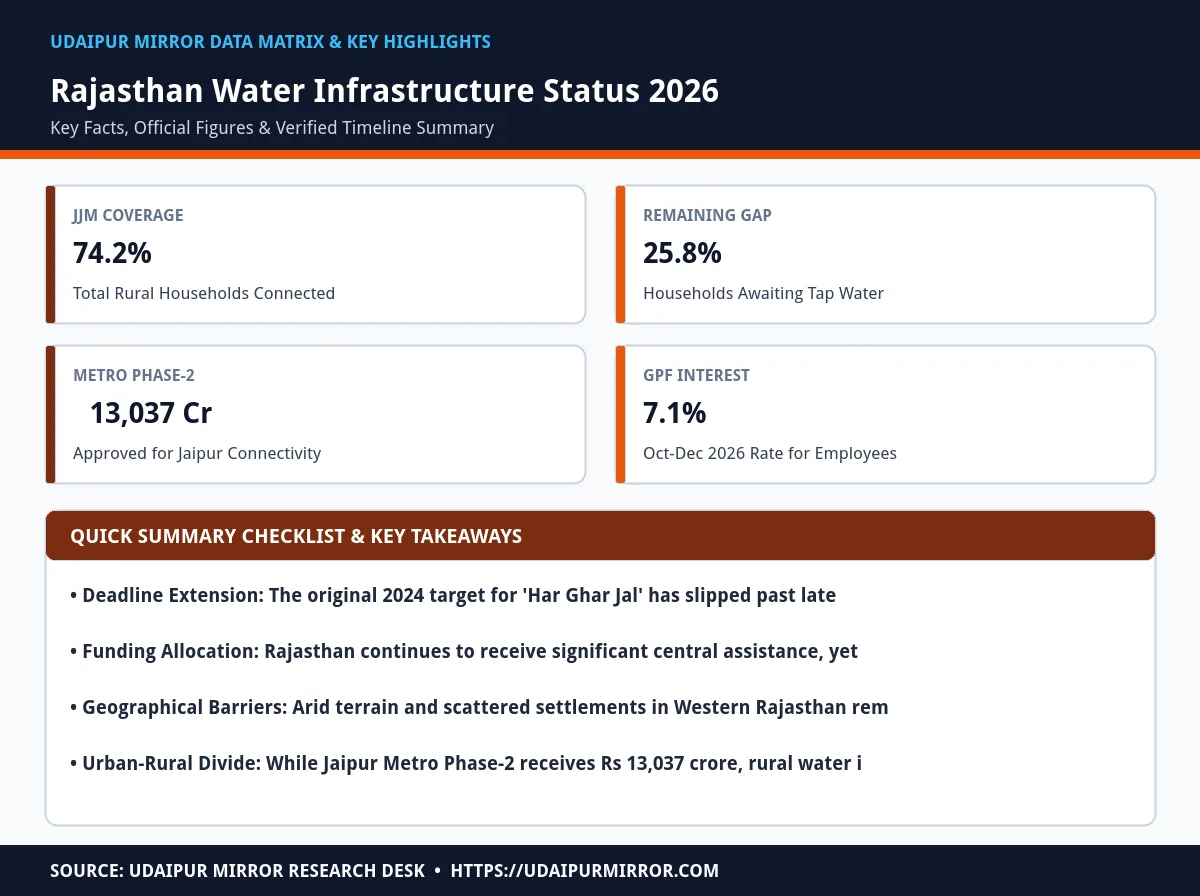
In contrast, the industrial corridors of the state are seeing a different kind of pressure. As industrial growth gains momentum, the demand for water from the manufacturing sector is competing with the needs of local communities. The state government’s recent focus on urban connectivity, evidenced by the Rs 13,037 crore Jaipur Metro Phase-2 approval, has led some critics to argue that rural water infrastructure is being sidelined in favor of high-profile urban projects.
To maintain administrative morale and fiscal stability, the Rajasthan government has set the interest rate on General Provident Fund (GPF) and Contributory Provident Fund (CPF) at 7.1% for the October-December 2026 quarter. While this provides some relief to state employees, the larger question remains about the allocation of state funds toward the jal jeevan mission rajasthan water gap.
The cabinet recently honored PM Modi for 25 years of public service, a move that underscores the political alignment between the state and center. However, this alignment must translate into faster clearances for forest land and railway crossings, which currently hold up hundreds of kilometers of water pipelines across the state’s eastern and northern districts. (Also read: Udaipur Zila Parishad Elections 2026: 126 Candidates in Fray Across 47 Wards as Dangi Dynasty Clash and BAP Heat Up Polls).
For residents of Rajasthan, tracking the progress of water connectivity in their specific locality is essential. The Jal Jeevan Mission provides a transparent digital dashboard for real-time monitoring. Here is how you can check the status of your village:
Bridging the jal jeevan mission rajasthan water gap requires more than just laying pipes; it requires a holistic approach to water management. The state is now looking toward surface water sources, such as the Indira Gandhi Canal and the Eastern Rajasthan Canal Project (ERCP), to provide a more permanent solution than depleting borewells.
As we move toward 2027, the focus must shift to ‘Grey Water Management’ and ‘Source Strengthening.’ Without these, the taps installed today may run dry tomorrow. The integration of solar-powered pumping stations is also being trialed in districts like Barmer and Jaisalmer to reduce the operational costs for Gram Panchayats, ensuring the long-term viability of the mission.
While the national deadline was 2024, Rajasthan’s revised target for 100% rural tap connectivity is now late 2026 to mid-2027, depending on the district’s progress.
The primary reasons include the state’s vast and difficult desert geography, scattered settlements (Dhanis), and a high dependency on declining groundwater sources.
Residents can use the Rajasthan Sampark helpline (181) or the JJM mobile app to report issues regarding water quality or non-functional infrastructure.
No, they are separate. However, both represent the state’s massive infrastructure push. The Metro Phase-2 focuses on urban mobility, while JJM focuses on rural water security.
Add Udaipur Mirror as a preferred source on Google to see more of our travel guides in your AI overviews.



[…] capacity is timely. While the city faces infrastructure challenges, as noted in recent reports on Gehlot Flags Critical Water Gap in Rajasthan as Jal Jeevan Mission Deadline Slips Beyond 2026, the aviation sector remains a bright spot for economic […]