Office Address
14, Residency Road, Udaipur, Rajasthan 313001
Office Address
14, Residency Road, Udaipur, Rajasthan 313001

McGregor, Texas: Billionaire Tesla CEO Elon Musk has unveiled unprecedented flight-adjacent footage of the tesla next gen roadster spacex thruster collaboration, showing the electric supercar driving inverted, lifting into the air, and touching down smoothly at SpaceX testing grounds in Texas.
⚡ Quick Highlights: Tesla Next-Gen Roadster Flips Mid-Air With SpaceX Thrusters
The dramatic demonstration, shared by Elon Musk across social platform X, captured the sports car driving inverted beneath an overhead structural gantry before utilizing short, pulsed bursts from its cold gas thrusters to disconnect from the surface and perform a controlled aerial rotation. Musk accompanied the video with the declaration: ‘Turns out the future does have flying cars,’ followed by a laconic, ‘Well, it worked.’
The technological breakthrough relies on a dual-mechanism architecture. High-rpm electric suction fans evacuate air beneath the chassis, pulling the car onto surfaces with thousands of pounds of simulated downforce. Simultaneously, an array of miniature cold-gas thrusters—fed by ultra-high-pressure composite overwrapped pressure vessels (COPV) adapted directly from Falcon 9 second-stage guidance systems—deliver directional thrust vectors capable of counteracting gravity for brief intervals.
While this represents the bleeding edge of global hypercar innovation, electric vehicle architecture is progressing across all vehicle tiers worldwide. In the mainstream EV transition, see our analysis on how Honda 0 Alpha Electric SUV India Debut: Affordable EV SUV Launch Details and Range Confirmed highlights the expansion of daily passenger electrification.
“Turns out the future does have flying cars. Well, it worked.” — Elon Musk, CEO of Tesla & SpaceX
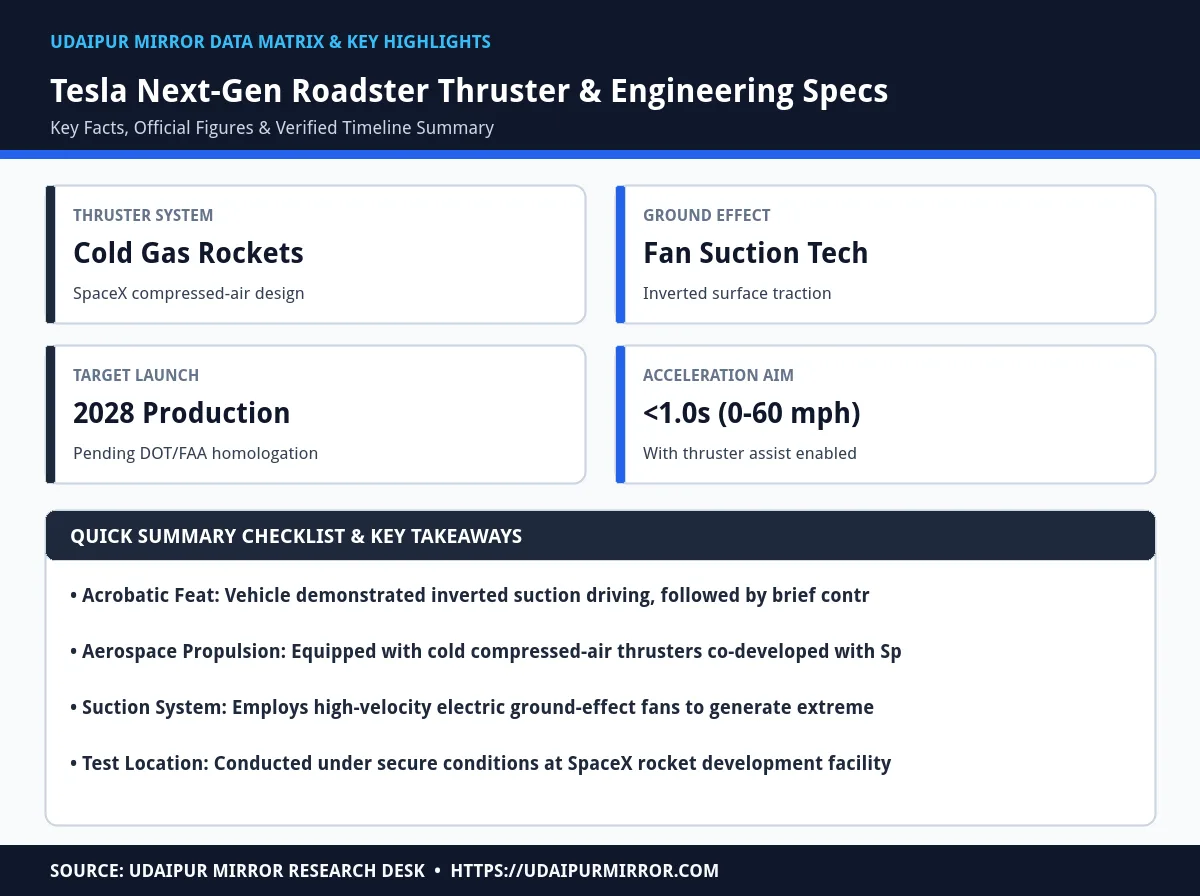
A detailed side-by-side technical evaluation of the demonstrated next-generation Roadster capabilities against road safety and commercial certification standards.
| Component / Capability | Demonstrated Technology | SpaceX Engineering Role | Commercial & Regulatory Status |
|---|---|---|---|
| Mid-Air Propulsion | Cold gas compressed-air nozzles | Falcon 9 attitude thruster adaptation | Awaiting Federal Aviation (FAA) clearance |
| Inverted Driving | Active electric fan suction downforce | Aerospace boundary layer suction | Restricted to closed-circuit testing tracks |
| Chassis Structural Rigidity | Carbon composite monocoque | High-stress rocket material alloys | Meets high-speed impact collision standards |
| Energy Storage & Pressure Vessels | Composite overwrapped pressure vessels (COPV) | Spacecraft pneumatic helium/air tanks | Department of Transportation (DOT) vessel review |
| Target Production Year | Commercial rollout slated for 2028 | Joint manufacturing integration | Prototype phase with active engineering trials |
Driving upside down has long been a theoretical milestone discussed by Formula 1 designers, who have asserted that modern aerodynamic wings generate downforce exceeding vehicle curb weight at speeds above 150 mph. However, Tesla approach removes the necessity for extreme forward velocity by employing powered fan suction similar to Gordon Murray famed Brabham BT46B ‘fan car’ and the McMurtry Spéirling hillclimb racer.
By sealing the skirt around the underside of the vehicle and actively evacuating low-pressure air, the Roadster creates instantaneous ground-effect suction regardless of speed. This enables the car to maintain continuous tire adhesion even when oriented upside down along specialized inverted tracks.
Despite the viral enthusiasm generated by the McGregor test, automotive industry analysts and legal experts caution that substantial regulatory hurdles stand between prototype demonstrations and consumer deliveries. In the United States, motor vehicles intended for public highways must conform to Federal Motor Vehicle Safety Standards (FMVSS) administered by the National Highway Traffic Safety Administration (NHTSA).
High-pressure pneumatic thrusters capable of discharging compressed air at thousands of pounds per square inch introduce unprecedented hazards for surrounding motorists, pedestrians, and cyclists. Furthermore, any vehicle operating in sustained airborne trajectories risks falling under Federal Aviation Administration (FAA) jurisdiction, necessitating pilot licensing and airworthiness certifications that conventional passenger cars are unequipped to fulfill.
Global automakers are closely monitoring these advanced performance frontiers while scaling domestic manufacturing infrastructure, as detailed in our comprehensive report on India’s EV Revolution: How Electric Vehicles and Local Manufacturing are Reshaping the Automotive Landscape.
“Deploying rocket-assist thrusters on production street-legal vehicles creates unprecedented safety, liability, and noise compliance dilemmas for regulatory bodies worldwide.” — Automotive Regulatory Consultant
First unveiled as a concept in 2017, the second-generation Tesla Roadster has experienced multiple developmental postponements as Tesla prioritized high-volume manufacturing of the Model Y, Semi truck, and Cybertruck. Musk has reaffirmed that Tesla is currently targeting 2028 for series production, with the base non-thruster model arriving alongside the optional SpaceX Package.
Prospective reservation holders, who deposited between $50,000 and $250,000 nearly a decade ago, will be watching closely to see whether the mid-air acrobatic features will be restricted to track-only software modes or geo-fenced private facilities, separating experimental aviation from everyday electric grand touring.
No, the Roadster cannot sustain conventional cross-country flight. It utilizes brief compressed-air thruster pulses for short, controlled hops and acrobatic maneuvers rather than sustained winged flight.
The vehicle uses high-velocity electric vacuum fans to evacuate air from beneath its sealed chassis, generating thousands of pounds of negative pressure downforce that adheres the tires to an inverted ceiling.
The SpaceX package replaces the rear passenger seats with cold gas thrusters and composite air pressure vessels, providing rocket-assist acceleration and aerial maneuverability.
Tesla is currently targeting 2028 for series production, though commercial road approval for its thruster-assisted capabilities remains subject to regulatory review.
Add Udaipur Mirror as a preferred source on Google to see more of our travel guides in your AI overviews.