Office Address
14, Residency Road, Udaipur, Rajasthan 313001
Office Address
14, Residency Road, Udaipur, Rajasthan 313001

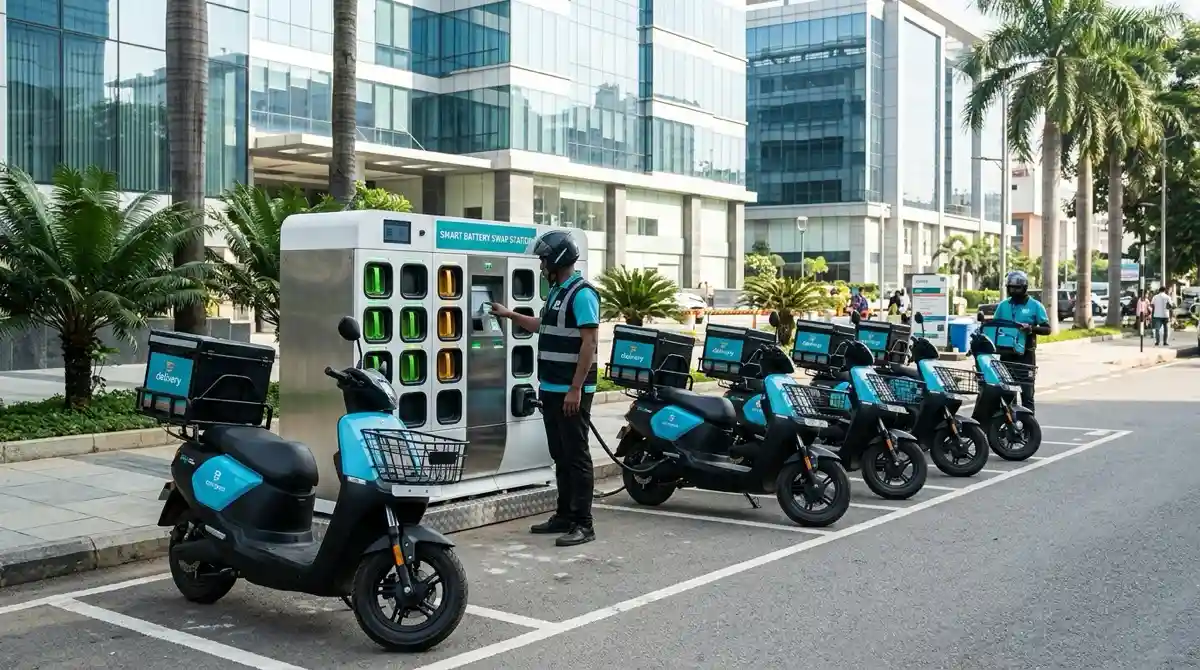
India’s automotive sector is undergoing a historic transformation, driven by accelerating electric vehicle (EV) adoption, massive capital investments in local component manufacturing, and strategic export hubs designed to serve international markets.
The growth story of electric mobility in India is no longer confined to two-wheelers and commercial delivery fleets. Passenger EV adoption is breaching new milestones as battery costs stabilize and domestic charging infrastructure expands across Tier-1 and Tier-2 cities. Following major industry alignments—such as the recent global manufacturing partnership between Tata Motors and Stellantis—India is rapidly transitioning from a domestic-only consumer market into a powerhouse for global automotive exports.
India’s geographical advantage, coupled with skilled engineering talent, has positioned automotive plants in Pune, Chennai, and Manesar as strategic export hubs. Global automakers are increasingly utilizing Indian facilities not just to meet domestic demand, but to engineer and manufacture vehicles tailored for emerging markets across Africa, Latin America, and Southeast Asia.
This manufacturing pivot helps mitigate supply chain vulnerabilities while optimizing production costs. With stricter emission norms and global carbon border adjustments coming into play, legacy players are accelerating their green-transition roadmaps to stay competitive.
EV adoption in India is driven by falling battery costs, expanding public charging networks, government subsidies (such as PM E-Drive and PLI schemes), and high-frequency commercial use cases in last-mile logistics.
Local manufacturing of battery cells, power electronics, and vehicle architectures reduces import reliance, lowers vehicle acquisition costs, and positions India as a major global automotive export hub.
Yes, legacy automakers are investing heavily in dedicated EV platforms and strategic joint ventures to transition their product lineups away from traditional internal combustion engines.
Disclaimer: This article is for informational and business analysis purposes only and does not constitute financial or investment advice. All market trends and data are based on industry reports and public disclosures.
Add Udaipur Mirror as a preferred source on Google to see more of our travel guides in your AI overviews.