Office Address
14, Residency Road, Udaipur, Rajasthan 313001
Office Address
14, Residency Road, Udaipur, Rajasthan 313001


NEW DELHI: NEW DELHI — As technological adoption accelerates across South Asia, industry leaders convened this week to discuss how artificial intelligence transforming retail industry frameworks is redefining modern commerce. The ongoing discourse at the Great India Retail Summit has underscored that predictive analytics, autonomous logistics, and hyper-personalized customer engagement are no longer futuristic concepts but essential operational pillars for enterprise survival. Market analysts reviewing these developments often compare this structural shift to the broader financial tailwinds seen during recent market milestones, such as the historic capital inflows highlighted in reports like the Diwali Rally Delivers Best Market Performance in Six Years market analysis.
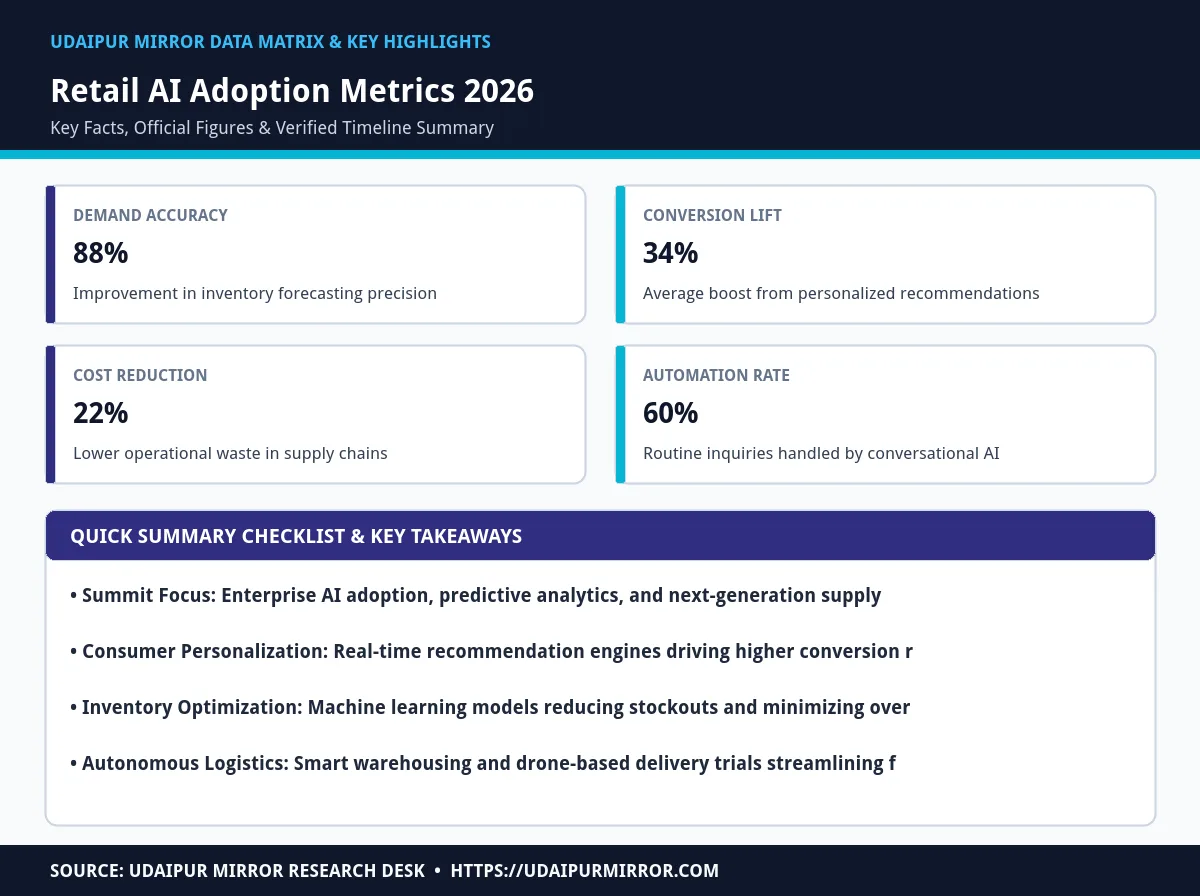
⚡ Quick Highlights: AI Transforming Retail Industry: Great India Retail Summit Insights
The integration of advanced machine learning architectures has revolutionized how brands interact with shoppers. At the Great India Retail Summit, industry executives emphasized that static e-commerce storefronts are rapidly being replaced by dynamic, conversational interfaces capable of understanding nuanced user intent in real time. By leveraging large language models, retailers can curate bespoke product discovery journeys that mimic the attentiveness of an elite in-store personal shopper, thereby drastically reducing cart abandonment rates.
Furthermore, this digital evolution runs parallel to broader market transformations happening across the technology and financial ecosystems. As venture capital firms look toward high-growth tech enterprises—similar to trends observed during major public offerings and market liquidity expansions like the Razorpay IPO: ₹6,000 Crore Mega Issue analysis—retail-tech startups are securing unprecedented funding rounds to scale their proprietary artificial intelligence engines.
“Artificial intelligence is no longer just a peripheral tool for marketing departments; it forms the core operational nervous system of modern omnichannel retail enterprises.” — Retail Technology Strategist, Great India Retail Summit
A detailed breakdown illustrating how legacy retail operational models compare against modern AI-infused workflows across core business functions.
| Operational Domain | Traditional Retail Approach | AI-Powered Retail Model | Efficiency Gain | Implementation Priority |
|---|---|---|---|---|
| Demand Forecasting | Historical sales sheets & gut feel | Machine learning predictive analytics | 35% higher accuracy | High |
| Customer Support | Manual call centers & long queues | Generative AI conversational agents | 70% faster resolution | Critical |
| Inventory Management | Periodic manual stock audits | IoT sensors & real-time tracking | 40% less stock loss | High |
| Marketing Campaigns | Broad demographic broadsheets | Hyper-personalized dynamic feeds | 3x engagement rate | Moderate |
| Supply Chain Routing | Fixed static delivery routes | Dynamic GPS machine learning routing | 25% fuel savings | Medium |
| Pricing Strategy | Fixed seasonal markdown schedules | Dynamic real-time algorithmic pricing | 18% margin growth | High |
Beyond the storefront, the backend implications of machine learning are equally profound. Traditional supply chains plagued by sudden demand spikes and logistical bottlenecks are finding robust solutions in autonomous forecasting platforms. Retailers are deploying neural networks to analyze weather patterns, local events, and macroeconomic indicators simultaneously, ensuring warehouses maintain optimal stock levels without tying up excessive working capital.
These advancements align with national goals of sustainable infrastructure development and energy efficiency. Just as India continues to champion green initiatives in other sectors—highlighted in reports covering the India Reaffirms Commitment to Global Solar Cooperation updates—smart retail distribution centers are increasingly turning to renewable energy grids to power their automated sorting facilities and robotic fulfillment bays.
“Predictive supply chain frameworks protect profit margins against unpredictable global shocks while minimizing carbon footprints through optimized routing.” — Supply Chain Automation Lead
Despite the immense upside, scaling artificial intelligence across legacy retail frameworks presents notable hurdles. Enterprise leaders at the summit pointed out that data silos, fragmented IT infrastructure, and legacy Point of Sale (POS) systems often hinder seamless integration. Bridging these gaps requires substantial upfront capital expenditure and a cultural shift toward data-driven decision-making across all organizational tiers.
Moreover, as retail platforms collect deeper consumer behavioral data, regulatory compliance regarding data privacy and cybersecurity becomes paramount. Enterprises must invest heavily in robust encryption and ethical AI governance models to maintain consumer trust and protect sensitive financial transactions against increasingly sophisticated digital threats. (Also read: Razorpay IPO: ₹6,000 Crore Mega Issue, Billion Target Valuation, Reverse Flip & Dalal Street Listing Analysis).
“Trust is the ultimate currency in digital retail. As we deploy smarter algorithms, safeguarding consumer data integrity must remain our foremost priority.” — Chief Information Security Officer, Retail Sector
The summit primarily focused on how artificial intelligence is transforming the retail industry through predictive analytics, supply chain automation, and hyper-personalized consumer experiences.
AI improves inventory management by using machine learning models to analyze historical sales, seasonal trends, and real-time demand signals, significantly reducing stockouts and holding costs.
Generative AI models power conversational shopping assistants, virtual try-on tools, and automated customer support agents that handle routine inquiries and curate personalized recommendations.
Key challenges include integrating AI with legacy IT infrastructure, overcoming data silos, ensuring strict consumer data privacy, and managing the initial capital expenditure.
Add Udaipur Mirror as a preferred source on Google to see more of our travel guides in your AI overviews.