Office Address
14, Residency Road, Udaipur, Rajasthan 313001
Office Address
14, Residency Road, Udaipur, Rajasthan 313001


NEW DELHI: NEW DELHI — Demonstrating unwavering resolve toward clean energy expansion and sustainable development, India has officially reaffirmed its dedication to global solar cooperation during high-level international deliberations held this week. The diplomatic and policy push underscores the nation’s pivotal role in steering worldwide decarbonization efforts, aligning domestic manufacturing capacities with multilateral climate action goals to ensure energy security across developing economies.
⚡ Quick Highlights: India Reaffirms Commitment to Global Solar Cooperation in 2026
As global energy demands surge, policymakers and industry leaders have increasingly emphasized that unilateral efforts are insufficient to combat climate change. India’s recent diplomatic assertions at international energy forums highlight the necessity of shared technology, open supply chains, and harmonized regulatory standards. By fostering international dialogue, the nation seeks to bridge technological divides and assist emerging economies in harnessing abundant solar irradiation.
This collaborative philosophy extends to administrative and technical cooperation, ensuring that regulatory frameworks, such as those governing state DISCOMs and net metering, draw from international best practices. For candidates tracking administrative processes or economic analysts reviewing market trends like RSSB Conductor document verification updates, staying informed on macroeconomic shifts remains crucial for overall development planning.
“Solar energy is no longer an alternative choice; it is the cornerstone of global energy security and sustainable economic cooperation.” — Renewable Energy Policy Delegate
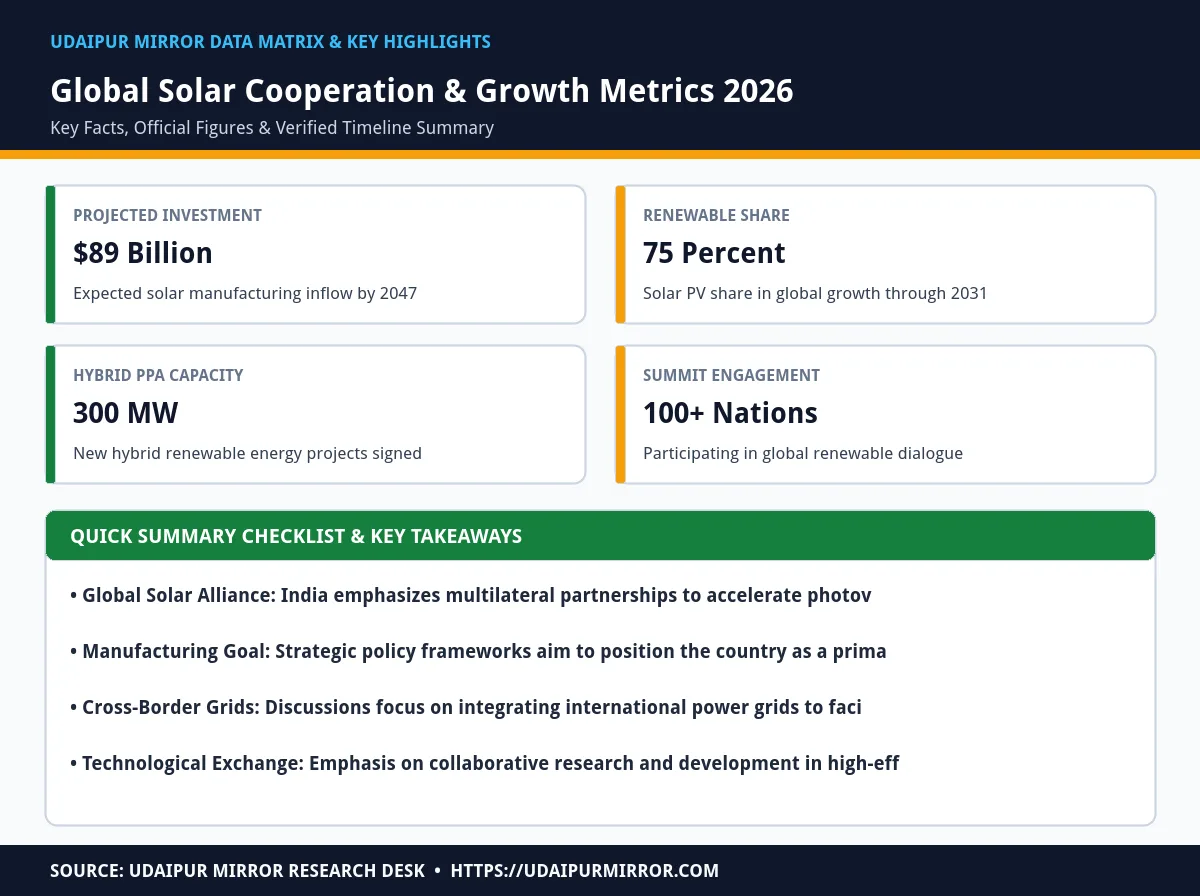
The following matrix outlines key strategic markers, projected capital inflows, and international milestones shaping the future of global solar cooperation and renewable capacity expansion through 2030 and beyond.
| Strategic Metric | Current Status (2026) | Projected Milestone | Primary Impact |
|---|---|---|---|
| Solar PV Contribution | Driving majority of renewable additions | 75% of global renewable growth by 2031 | Rapid grid decarbonization |
| Manufacturing Capital | Scaling domestic and foreign inflow | $89 Billion expected by 2047 | Supply chain self-reliance |
| Hybrid Energy PPAs | Active signing across developers | GW-scale integration by 2028 | Grid stability and peak power |
| International Alliances | Active multilateral diplomacy | Expanded One Sun One World Grid | Cross-border clean energy trade |
| Rooftop Subsidies | Millions of active household connections | Universal urban adoption | Empowering domestic consumers |
Economic projections indicate that international cooperation will unlock unprecedented financial inflows into clean technology. Industry projections suggest that India could attract up to $89 billion in solar manufacturing investments by 2047. This massive capital allocation will transform domestic production lines, enabling the mass manufacture of high-efficiency n-type and bifacial solar modules that meet rigorous international quality benchmarks.
Financial analysts keeping an eye on broader commodity markets, including those tracking silver price forecasts and inflation trends, note that precious metals play an indispensable role in photovoltaic paste and electrical contact manufacturing, linking global commodity movements directly to the solar industrial boom.
“Financial commitment from global institutional investors proves that India's solar manufacturing ecosystem offers robust long-term value.” — Clean Tech Investment Analyst
Recent reports from the International Energy Agency (IEA) indicate that solar photovoltaic systems will drive approximately 75 percent of all renewable energy growth through 2031. This explosive trajectory is propelled by plunging technology costs, enhanced conversion efficiencies, and widespread adoption of rooftop solar programs. Nations that actively align their national policies with this global wave are positioned to reap substantial economic and environmental dividends.
Furthermore, domestic initiatives such as the PM Surya Ghar Muft Bijli Yojana are seamlessly integrated with these broader international goals, empowering households to generate their own clean electricity while reducing aggregate grid strain. State utilities across Rajasthan and other regions continue to streamline digital application portals to handle the surging volume of consumer registrations. (Also read: Rajasthan Computer Anudeshak Basic Result & Document Verification 2026: Merit List, SSO Scrutiny Form & Complete DV Checklist | राजस्थान कंप्यूटर अनुदेशक).
“The speed at which solar PV is scaling globally outpaces all previous forecasts, making it the definitive leader of the future energy mix.” — Energy Market Researcher
To address the inherent intermittency of solar power, energy developers are increasingly turning toward hybrid renewable energy configurations. Recent power purchase agreements (PPAs), such as Essar’s commitment to a 300 MW hybrid project, demonstrate the industry’s shift toward combining solar and wind generation backed by battery energy storage systems (BESS). These integrated assets ensure steady, reliable power delivery even during peak demand hours.
State-level participation in national renewable summits further reinforces regional commitment. Rajasthan, with its vast solar parks in Bhadla and the Thar desert, continues to serve as the epicenter of India’s utility-scale solar revolution, attracting top-tier global developers and engineering firms.
“Hybrid renewable models coupled with storage represent the holy grail of grid management, solving the intermittent nature of solar generation.” — Renewable Energy Infrastructure Director
The primary focus centered on strengthening multilateral partnerships, sharing advanced clean energy technologies, aligning regulatory frameworks, and securing cross-border investments to accelerate photovoltaic adoption.
Industry analyses project that India could attract up to $89 billion in solar manufacturing investments by 2047, boosting domestic ingot, wafer, cell, and module production.
According to IEA reports, solar photovoltaic systems are expected to drive approximately 75 percent of all renewable energy growth globally through 2031.
Hybrid projects combine solar and wind generation with energy storage systems to overcome intermittency, delivering steady and reliable power to electrical grids.
Add Udaipur Mirror as a preferred source on Google to see more of our travel guides in your AI overviews.