Office Address
14, Residency Road, Udaipur, Rajasthan 313001
Office Address
14, Residency Road, Udaipur, Rajasthan 313001

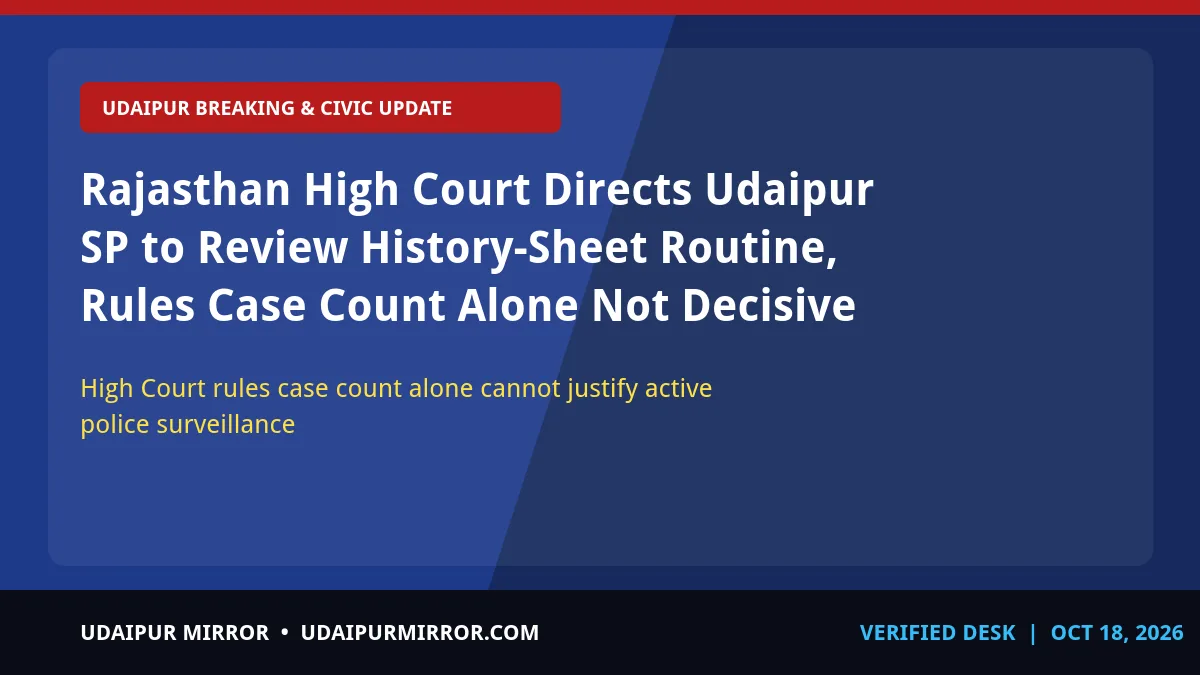
UDAIPUR: In a pivotal legal directive safeguarding personal liberty against routine police surveillance, the Rajasthan High Court has ordered the Superintendent of Police (SP) in Udaipur to conduct a comprehensive udaipur sp history sheet review. The Jodhpur Bench of the High Court observed that the mere existence or high count of past criminal cases cannot serve as the sole decisive ground for opening or continuing a history-sheet against an individual. The ruling emphasizes that police authorities must evaluate present conduct, active threat perception, and actual criminal involvement rather than mechanically applying police regulations.
⚡ Quick Highlights: Udaipur SP History Sheet Review: HC Directs Fresh Audit
The Jodhpur Bench of the Rajasthan High Court issued the landmark order while hearing a criminal writ petition filed by a local resident challenging the continuation of his name in the history-sheet maintained at a local police station in Udaipur. The petitioner submitted that despite being acquitted or having resolved multiple old cases years ago, police personnel continued to visit his home routinely, subjecting his family to harassment and public scrutiny.
The Single Bench observed that maintaining a history-sheet is a severe administrative measure that directly impacts a citizen’s reputation and freedom of movement. The court noted that police stations frequently open and extend history-sheets purely based on the cumulative tally of First Information Reports (FIRs) filed over a person’s lifetime, without examining whether those cases resulted in convictions or whether the person remains actively involved in criminal operations today.
While judicial scrutiny over local law enforcement actions remains high—similar to recent stringent judicial rulings where the Balaji Hospital Director Sentenced to 2 Years Imprisonment in Dual Cheque Bounce Cases by Udaipur Court underscored strict adherence to legal standards—the High Court emphasized that police surveillance must strictly balance public safety with fundamental human rights.
“The number of criminal cases registered against an individual cannot be treated as a mathematical formula to label someone a history-sheeter indefinitely. Police must demonstrate present habitual criminality.” — Rajasthan High Court Bench, Jodhpur
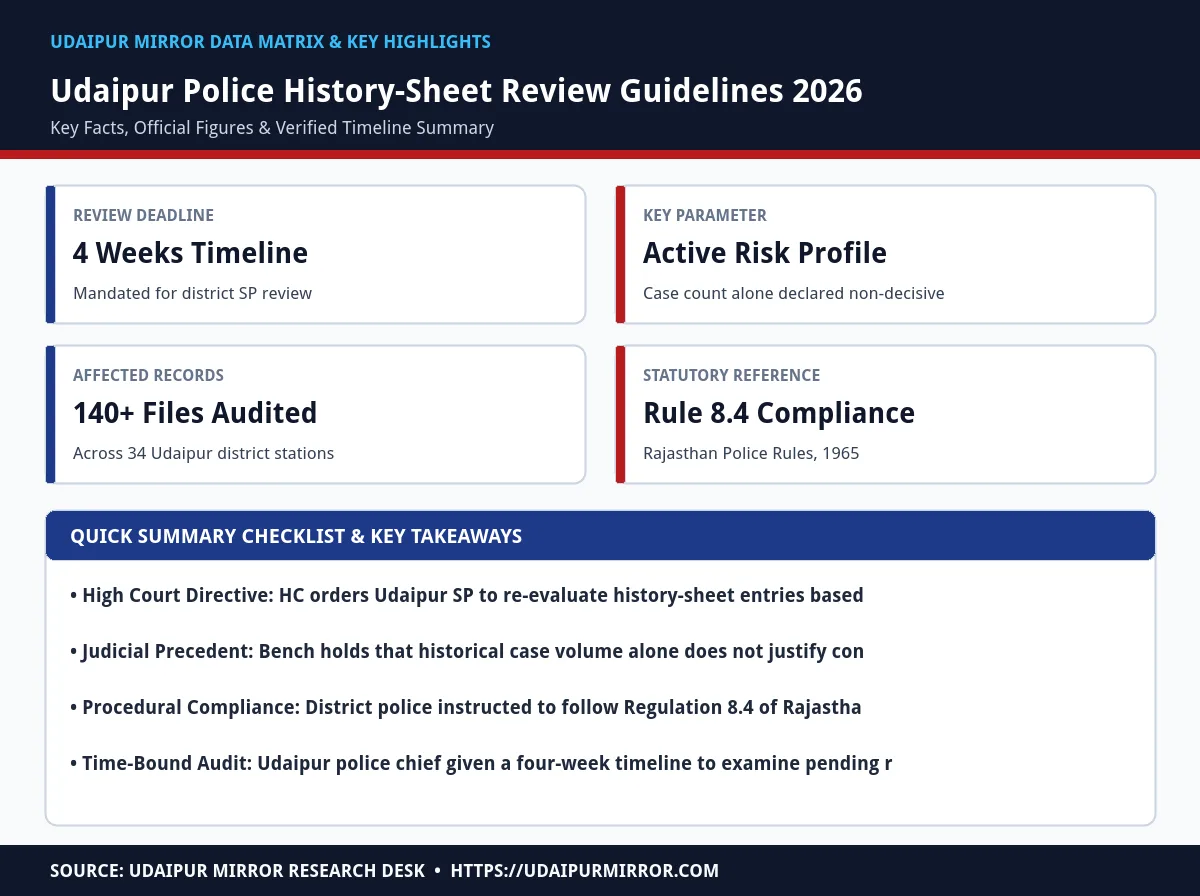
The district police administration has initiated a phase-wise review schedule across Udaipur’s major police circles to comply with the High Court’s directions. Below is the operational framework and file distribution for the upcoming four-week audit.
| Police Circle | Total History Sheets | Active Surveillance | Under HC Review | Mandatory Audit Status |
|---|---|---|---|---|
| Udaipur City Circle (Girwa) | 42 Files | 28 Active | 12 Cases | Scheduled for Week 1 |
| Pratap Nagar & Sukher | 31 Files | 19 Active | 8 Cases | Scheduled for Week 2 |
| Hiran Magri & Goverdhan Vilas | 27 Files | 15 Active | 6 Cases | Scheduled for Week 2 |
| Mavli & Vallabhnagar | 22 Files | 11 Active | 5 Cases | Scheduled for Week 3 |
| Jhadol & Gogunda Block | 18 Files | 9 Active | 4 Cases | Scheduled for Week 4 |
Under Chapter 8 of the Rajasthan Police Rules, 1965, police history-sheets (Class A and Class B) are intended for habitual offenders or persons whose activities pose a clear and present threat to public peace. Rule 8.4 explicitly governs the opening and retention of history-sheets. However, the High Court pointed out that police officials frequently overlook the requirement of establishing ‘habitual nature’ through objective and contemporary evidence.
The court held that if an individual has been acquitted in past cases, or if disputes were civil or personal in nature and have long been settled, those FIRs lose their weight when justifying ongoing surveillance. The High Court ordered that the Superintendent of Police must personally examine whether there is any fresh material or intelligence suggesting that the person continues to lead a life of crime before confirming the retention of a history-sheet.
Following the High Court order, the Udaipur SP office is organizing a dedicated cell to review all history-sheets currently maintained across the district’s 34 police stations, including urban units like Surajpole, Hathipole, Ambamata, and Sukher, as well as rural blocks in Salumber, Gogunda, and Kherwara.
Station House Officers (SHOs) have been instructed to compile updated character reports, pending trial statuses, and recent conduct records for every individual listed in their station register No. 10. Furthermore, as the district police modernize their operations—such as how Rajasthan Police Launches Money Restoration Module in Udaipur: How Cyber Fraud Victims Can Recover Frozen Funds Without Court Orders to streamline procedural administrative tasks—the SP review process will integrate digital verification tools to ensure transparent record maintenance.
Legal experts in Udaipur have welcomed the High Court’s directive, citing constitutional protections under Article 21 of the Constitution of India, which guarantees the right to life, personal liberty, and privacy. Senior advocates at the Udaipur District Bar Association noted that uncalibrated police surveillance, including nocturnal visits and compulsory station call-ins, severely impairs an individual’s dignity and livelihood opportunities.
The High Court reiterated the principle established in Supreme Court precedents, holding that executive action which intrudes upon personal privacy must satisfy the test of reasonableness and proportionality. If an individual has maintained a clean record for years following past litigation, forcing them to remain under the shadow of a history-sheet violates constitutional norms.
“Surveillance must be proportionate and targeted. Turning a temporary criminal record into a permanent mark of suspicion violates fundamental rights guaranteed under Article 21.” — Senior Counsel, Udaipur District Bar Association
The High Court has set a strict four-week deadline for the Udaipur SP to consider representations filed by individuals seeking the removal of their names from police history-sheets. Citizens who believe their inclusion is arbitrary or based solely on old, closed cases can submit detailed applications to the district police chief’s office.
To ensure a smooth and organized review process, the district administration has outlined clear criteria for documentation required when submitting petitions for history-sheet closure.
The Rajasthan High Court ruled that the number of criminal cases alone is not decisive for opening or continuing a police history-sheet. The court directed the Udaipur SP to conduct a comprehensive review focused on current conduct and active threat levels.
History-sheets in Rajasthan are governed by Regulation 8.4 of the Rajasthan Police Rules, 1965, which requires objective evidence that an individual is a habitual offender active in criminal enterprise.
No, the High Court clarified that cases resulting in acquittals, discharges, or settlements cannot be mechanically counted to justify ongoing police surveillance or history-sheet continuation.
Affected citizens can submit a formal written representation to the Udaipur SP office along with certified copies of court acquittal orders and proof of current lawful occupation. The SP is mandated to dispose of such petitions within four weeks.
Add Udaipur Mirror as a preferred source on Google to see more of our travel guides in your AI overviews.