Office Address
14, Residency Road, Udaipur, Rajasthan 313001
Office Address
14, Residency Road, Udaipur, Rajasthan 313001

BEIJING / HONG KONG: NEW DELHI — Equity benchmarks across mainland China and Hong Kong moved lower in early Tuesday trading as china and hong kong stocks slip under the weight of an extended sell-off in major technology counters. The downturn in Asian indices follows a mixed global macroeconomic backdrop where investors are carefully weighing shifting monetary policy expectations from major central banks. While Wall Street registered gains overnight and the Nikkei surged, regional sentiment in Greater China remained subdued due to ongoing regulatory pressures and profit-booking in high-flying software and hardware developers. This regional pressure mirrors recent domestic IT sector fluctuations, comparable to how Infosys, TCS, and Coforge shares plunge as Anthropic IPO filing triggers global IT sell-off, demonstrating interconnected vulnerabilities across global technology supply chains.
⚡ Quick Highlights: China and Hong Kong Stocks Slip as Tech Shares Extend Losses
The primary catalyst behind Tuesday’s market retreat in East Asia was a sharp correction in major technology platforms, semiconductor manufacturers, and digital entertainment providers listed in Hong Kong and Shanghai. Market analysts note that investors are recalibrating valuations following a period of regulatory scrutiny and fluctuating earnings forecasts. As institutional funds rotate out of growth-heavy tech portfolios, broader indexes have struggled to maintain positive momentum despite supportive measures from monetary authorities.
Furthermore, macroeconomic headwinds and changing trade dynamics have forced foreign portfolio investors to adopt a cautious stance. While macroeconomic fundamentals in select sectors remain resilient, the outsized influence of technology stocks on benchmark valuations means that any sustained weakness in software or hardware firms immediately ripples across the wider economic landscape. This structural sensitivity is comparable to broader macroeconomic metrics, much like tracking national fiscal health indicators outlined in reviews of Debt on Indian Government: Complete Breakdown of Public Debt, Debt-to-GDP Ratio & Sustainability.
“Asian technology shares are facing a dual challenge of high valuations and evolving regulatory frameworks, prompting a necessary recalibration among institutional investors.” — Senior Asia-Pacific Strategist, Global Wealth Management
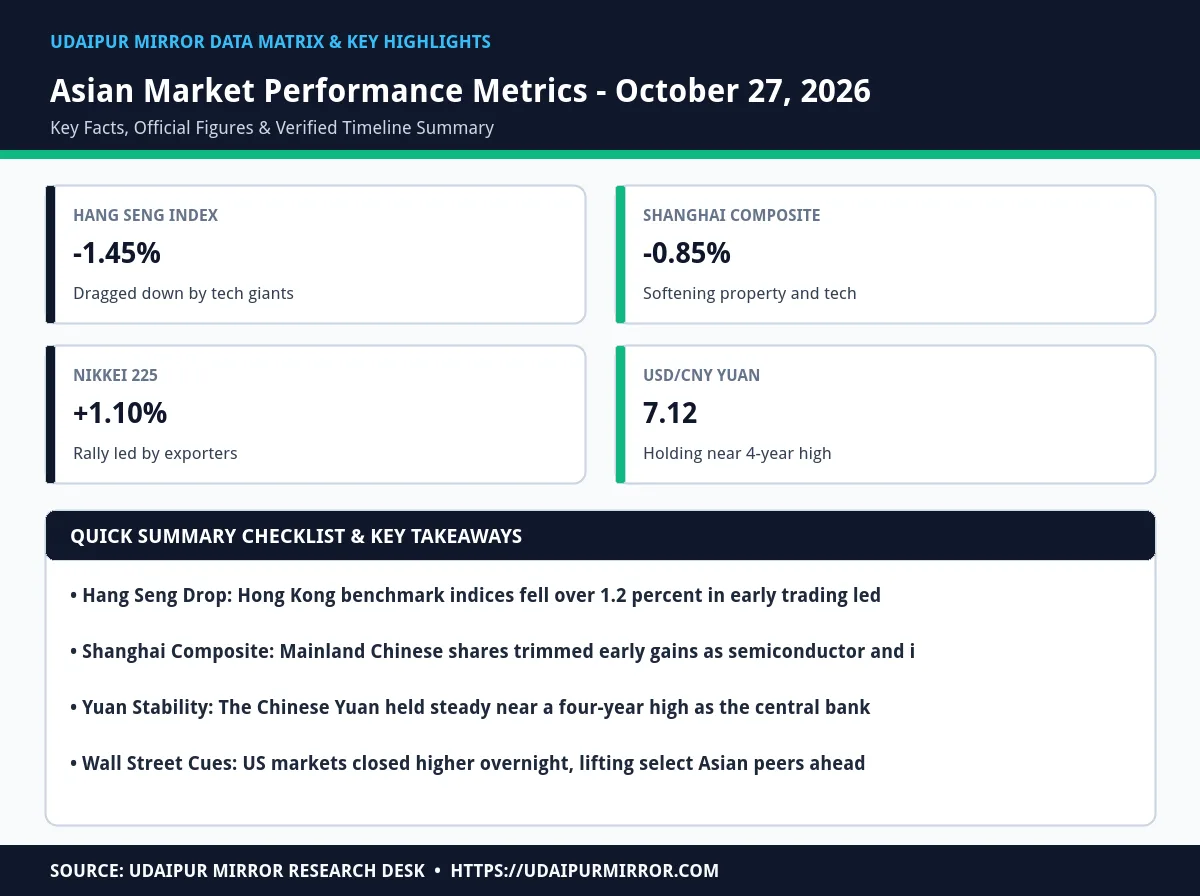
The table below details the performance of key Asian and global financial markers as of Tuesday, October 27, 2026, illustrating the divergence between tech-heavy Chinese exchanges and recovering regional peers like Tokyo.
| Market / Index | Region | Today's Trend | Primary Sector Impact |
|---|---|---|---|
| Hang Seng Index | Hong Kong | Negative (-1.4%) | Technology, Internet Platforms |
| Shanghai Composite | China | Negative (-0.8%) | Semiconductors, Industrials |
| Nikkei 225 | Japan | Positive (+1.1%) | Automotives, Electronics |
| GIFT Nifty | India | Neutral/Steady | Banking, IT Services |
| S&P 500 Futures | United States | Flat to Positive | AI Infrastructure, Mega-cap Tech |
Even as equities faced downward pressure, the Chinese Yuan remained remarkably resilient, holding near a four-year high against the US dollar. The People’s Bank of China (PBoC) has actively managed the currency’s daily fixing rates, successfully tempering the pace of appreciation to protect export competitiveness while curbing speculative capital inflows.
Currency traders are closely monitoring central bank actions, as a strong yuan acts as a double-edged sword—reducing import costs for raw materials while challenging profit margins for domestic manufacturers who rely heavily on overseas sales. This delicate balancing act by monetary authorities is critical for stabilizing domestic financial markets against external volatility.
“The PBoC's measured approach to currency valuation prevents disruptive spikes while ensuring macroeconomic stability amidst global monetary shifts.” — Head of Currency Research, International Banking Group
International market sentiment on Tuesday was supported by overnight gains on Wall Street, where artificial intelligence stocks rallied following significant initial public offering filings and robust corporate updates. Nvidia and other chipmakers registered notable gains, inspiring positive spillover effects across Japanese and European exchanges.
However, investors worldwide remain on high alert as the US Federal Reserve’s upcoming policy meeting looms. Anticipation regarding interest rate trajectories continues to dictate bond yields and equity risk premiums. Any hawkish surprises from the Fed could trigger sudden capital outflows from emerging and developing Asian markets, affecting currencies and stock exchanges globally. (Also read: Debt on Indian Government: Complete Breakdown of Public Debt, Debt-to-GDP Ratio & Sustainability [2026]).
“Global liquidity is currently dictated by central bank guidance. Investors are balancing optimism over AI innovation with caution over sustained high interest rates.” — Global Markets Economist
For Indian investors and macroeconomic planners, developments in Greater China and global tech sectors hold significant weight. Indian benchmark indices, mirrored by steady GIFT Nifty movements, have absorbed the mixed Asian cues with resilience. However, foreign institutional investor (FII) flows into Indian equities remain sensitive to shifts in regional capital allocation.
Domestic technology firms, which have recently experienced volatility following global IT sell-offs, are closely tracking overseas sentiment. As cross-border investments react to shifting central bank policies and tech valuations, Indian market participants are advised to maintain a diversified portfolio, balancing high-growth opportunities with defensive macroeconomic assets.
“Indian markets continue to demonstrate structural independence, yet remain attuned to broader Asian liquidity trends and global tech sector valuations.” — Chief Investment Officer, Domestic Asset Management Firm
Equities in China and Hong Kong declined due to an extended sell-off in technology shares, ongoing regulatory pressures, and cautious investor sentiment ahead of central bank meetings.
The Chinese Yuan has held steady near a four-year high as the People’s Bank of China actively tempers its appreciation pace to maintain export competitiveness.
Overnight gains on Wall Street, driven by artificial intelligence stock rallies and tech sector resilience, provided temporary support to select Asian markets like Japan.
While Indian benchmark indices have remained relatively steady, shifts in regional liquidity and global tech valuations directly influence foreign institutional flows and domestic IT stocks.
Add Udaipur Mirror as a preferred source on Google to see more of our travel guides in your AI overviews.