Office Address
14, Residency Road, Udaipur, Rajasthan 313001
Office Address
14, Residency Road, Udaipur, Rajasthan 313001

WASHINGTON / NEW DELHI: As Washington reassesses its international economic stance heading into late 2026, key political figures are reinforcing the importance of strategic partnerships despite shifting global trade frameworks. Highlighting bilateral economic resilience, senior political leadership reaffirmed that India remains an indispensable partner, even as administrative teams evaluate the broader us tariffs on india trade impact across critical industrial sectors, supply chains, and emerging global markets.
⚡ Quick Highlights: US Tariffs on India Trade Impact: Rubio Calls India Ally
During a high-level briefing regarding Washington’s future economic and foreign trade policies, key leadership reaffirmed that New Delhi remains a cornerstone of American strategic posture in the Indo-Pacific region. Addressing concerns regarding proposed import tariffs, official statements underscored that any economic policy under consideration is undergoing thorough internal impact studies to prevent unintended fallout on key allies.
The US administration is evaluating various tariff structures aimed at rebalancing global trade deficits and reshoring critical industrial capacity. However, policymakers acknowledge that unilateral trade barriers can create inflationary pressures at home and disrupt established trade corridors. Consequently, bilateral consultations between Indian trade negotiators and US representatives are expected to intensify before any official structural changes are finalized. (Also read: Mcap of Nine of Top-10 Most Valued Firms Surges by ₹3.65 Lakh Cr as TCS Leads Market Rally).
“India is an essential and irreplaceable ally in the Indo-Pacific. Any future trade or tariff frameworks are being rigorously evaluated to ensure that strategic partnerships remain strong while protecting national economic interests.” — Marco Rubio, Senior US Official
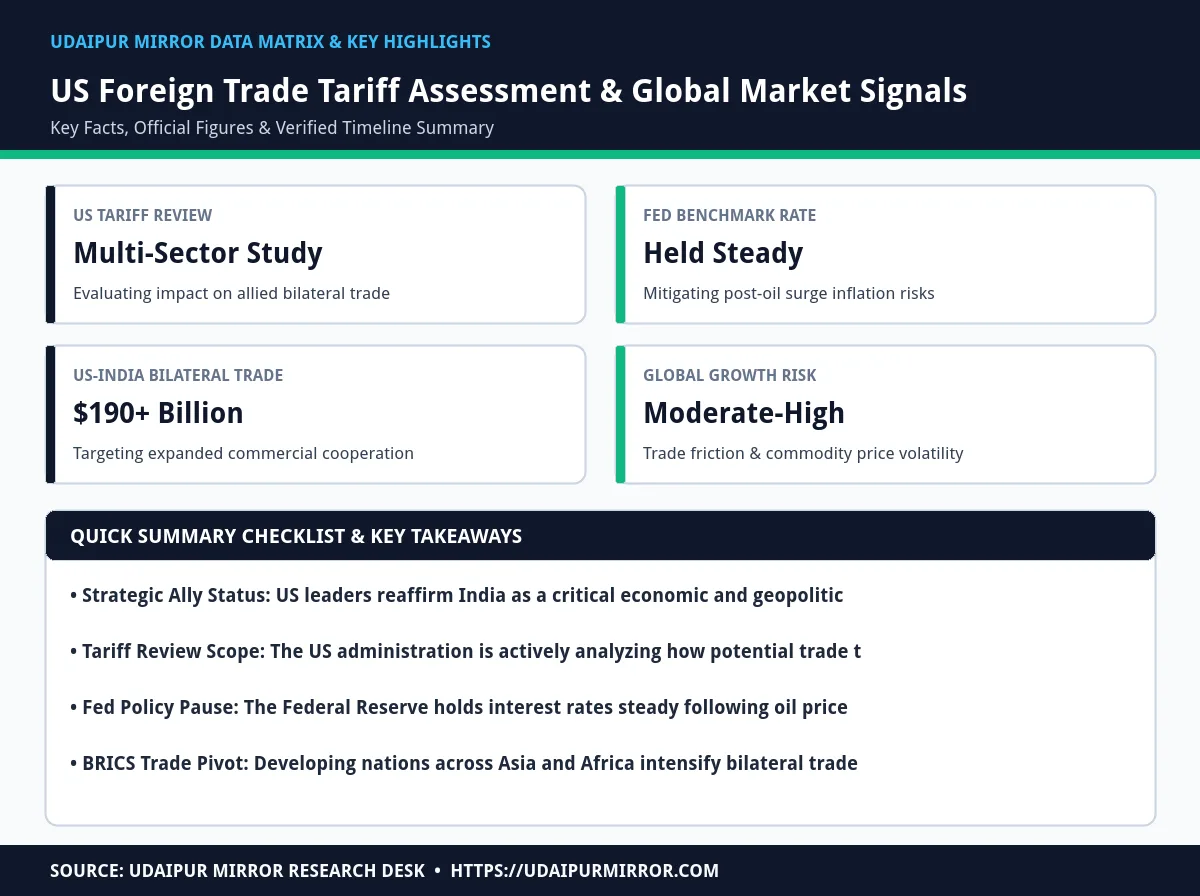
The potential imposition of targeted or baseline import tariffs by the US administration presents varying levels of exposure across key Indian export sectors. The table below outlines projected export values, estimated duty risk levels, and mitigation pathways for fiscal year 2026-27.
| Sector / Category | Proposed US Duty Impact | India Export Value (Est. FY26) | Risk Exposure Level | Strategic Mitigation Strategy |
|---|---|---|---|---|
| IT & Technology Services | Low (Service-based) | $125 Billion | Low | Offshore expansion & direct US enterprise contracts |
| Pharmaceuticals & Generics | Moderate (Active Ingredients) | $12.5 Billion | Medium | US FDA compliance & domestic manufacturing hubs |
| Textiles & Apparel | High (10-15% Import Surcharge) | $8.2 Billion | High | Market diversification to Europe & ASEAN region |
| Automobile Parts & Metals | Moderate (Targeted Tariffs) | $6.8 Billion | Medium-High | Joint ventures & localized assembly in US plants |
| Gems & Jewellery | High (Luxury Duty Surcharge) | $9.1 Billion | High | Bilateral trade corridor agreements & duty relief |
| Engineering Goods | Moderate (Capital Duty) | $14.4 Billion | Medium | High-value precision manufacturing upgrade |
The global trade conversation unfolds against a complex macroeconomic backdrop. The Federal Reserve recently decided to hold interest rates steady following oil price spikes triggered by geopolitical tensions in the Middle East. Central banks worldwide are balancing inflation management against the imperative to support industrial growth.
Despite international monetary uncertainties, the domestic equity market has displayed noticeable strength driven by robust quarterly operational performance among top IT and banking majors. As previously detailed in our coverage of Mcap of Nine of Top-10 Most Valued Firms Surges by ₹3.65 Lakh Cr as TCS Leads Market Rally, institutional investors continue to find confidence in India’s strong internal demand drivers and corporate earnings trajectory.
“Navigating trade friction requires central bank agility and fiscal stability. Maintaining interest rate pauses allows major economies to absorb energy price shocks without stifling private investment.” — Global Macro Analysis Desk, Udaipur Mirror

Trade tariffs inevitably impact capital-intensive sectors such as steel, aluminum, auto components, and heavy industrial goods. While service-led sectors like software development face minimal direct tariff disruption, physical manufacturing goods could encounter duty adjustments if non-tariff exemptions are not secured.
Indian metal manufacturing giants and export-oriented conglomerates are closely monitoring international commodity trends and capital expenditure plans. Investors tracking heavy industrial stocks can review our detailed analysis on Hindalco Share Price Analysis Today: Stock Rally, Novelis Capex, and Metals Setup Ahead of Dussehra Trading to understand how global trade policies and raw material cycles impact domestic metal producers.
“Diversified industrial conglomerates with localized manufacturing units in North America are best positioned to hedge against cross-border trade friction.” — Senior Market Strategist
As protectionist rhetoric rises across Western capitals, developing markets across Asia, Africa, and South America are accelerating economic integration under regional trade alliances such as BRICS and ASEAN. This strategic shift includes expanded local currency settlement agreements and reduced dependence on single-market export destinations.
For Indian exporters, diversifying international order books into Middle Eastern, European, and African corridors serves as an essential buffer against potential legislative changes in North America. Trade bodies in New Delhi are encouraging small and medium enterprises (SMEs) to explore multi-lateral free trade agreements currently being negotiated across global markets.
“Trade corridor diversification is no longer just a long-term goal—it is a present-day risk mitigation requirement for global supply chain players.” — International Trade Council Representative
Moving forward through the fourth quarter of 2026, market participants will closely watch trade policy announcements coming out of Washington, foreign institutional investor (FII) capital movements, and raw material cost dynamics. Strategic alliance status grants India significant diplomatic leverage, making blanket tariff implementations unlikely without customized exemptions.
Industry leaders recommend that export-heavy firms focus on high-value technology integration, supply chain efficiency, and long-term customer partnerships. By maintaining cost competitiveness and regulatory compliance, Indian corporates can comfortably navigate evolving international tariff regimes.
“Bilateral commerce between democratic allies relies on economic interdependence. Strategic clarity and open diplomatic channels will ensure shared growth.” — Chief Economist, International Trade Desk
US official Marco Rubio highlighted India as a critical and indispensable strategic ally while stating that the administration is carefully studying the broader economic impact of any proposed trade tariffs before taking official action.
Physical manufacturing goods like textiles, engineering goods, and metals face potential duty exposure, whereas service-based sectors like IT remain largely insulated due to their direct integration into US enterprise operations.
The Federal Reserve held interest rates unchanged to balance inflation control following crude oil price surges caused by Middle East geopolitical developments against broader economic growth requirements.
Indian exporters are mitigating risks by expanding trade into alternative BRICS and ASEAN corridors, establishing localized production hubs in target markets, and negotiating high-value long-term supply agreements.
Add Udaipur Mirror as a preferred source on Google to see more of our travel guides in your AI overviews.