Office Address
14, Residency Road, Udaipur, Rajasthan 313001
Office Address
14, Residency Road, Udaipur, Rajasthan 313001


NEW DELHI: Indian retail investors who reaped handsome profits by investing in US tech giants like Apple, Nvidia, Alphabet, or Microsoft are facing a key tax compliance query as the tax filing season approaches for FY 2026-27. A primary point of confusion centers on us stock tax exemption india guidelines and whether foreign equity capital gains qualify for the standard ₹1.25 lakh annual long-term capital gains (LTCG) exemption available under Section 112A of the Income Tax Act. Tax experts clarify that foreign equities sold on international exchanges like NASDAQ or NYSE are completely ineligible for this exemption, as it is strictly reserved for domestic equities subject to Indian Securities Transaction Tax (STT).
⚡ Quick Highlights: US Stock Tax Exemption India: Apple & Nvidia Profit Rules
Under the Indian Income Tax Act, 1961, Section 112A provides a specific tax relief mechanism allowing resident individual taxpayers an annual tax exemption on long-term capital gains up to ₹1.25 lakh (increased from ₹1 lakh in recent budget reforms). However, this specific exemption is strictly conditional upon the payment of Securities Transaction Tax (STT) at both the time of acquisition and sale of the equity asset.
Because overseas stock exchanges such as the NASDAQ or the New York Stock Exchange (NYSE) do not levy Indian Securities Transaction Tax, shares of US corporations like Apple, Nvidia, Amazon, or Tesla automatically fall outside the purview of Section 112A. Consequently, every single rupee of long-term capital gain realized on US shares is subject to taxation without any baseline tax-free threshold.
Investors comparing global stock gains with domestic market rallies must keep this tax differential in mind. As highlighted in market commentary on Mcap of Nine of Top-10 Most Valued Firms Surges by ₹3.65 Lakh Cr as TCS Leads Market Rally, Indian domestic equities benefit from lower short-term tax rates and statutory threshold exemptions that foreign investments do not enjoy.
“Section 112A benefits are tied directly to Securities Transaction Tax. Foreign equities traded on US exchanges do not pay STT, making every rupee of long-term profit taxable under Section 112 at 12.5%.” — Senior Tax Partner, National Tax Advisory Council
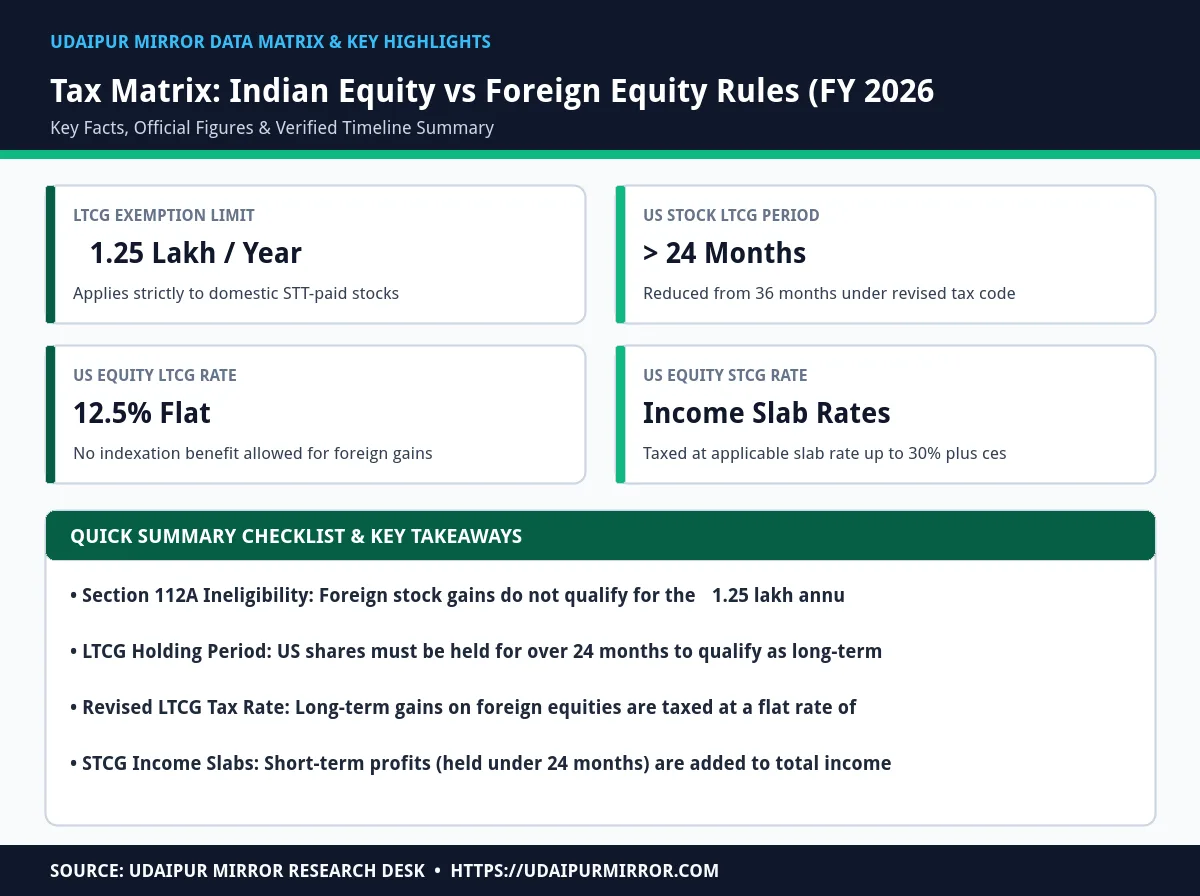
Understanding the exact tax classification, holding thresholds, and exemption limits is essential before filing income tax returns on international stock investments. The table below outlines how Indian tax authorities treat gains from foreign stocks like Apple and Nvidia compared to domestic stocks.
| Asset Category | LTCG Holding Period Threshold | LTCG Tax Rate | Annual Exemption Limit | STCG Tax Rate |
|---|---|---|---|---|
| Indian Listed Shares (STT Paid) | > 12 Months | 12.5% | ₹1.25 Lakh (Section 112A) | 20% (Section 111A) |
| US Listed Shares (Apple, Nvidia) | > 24 Months | 12.5% | NIL (No Exemption) | Slab Rate (Up to 30%+Cess) |
| Indian Equity Mutual Funds | > 12 Months | 12.5% | ₹1.25 Lakh (Section 112A) | 20% (Section 111A) |
| US Funds / International ETFs | > 24 Months | 12.5% | NIL (No Exemption) | Slab Rate (Up to 30%+Cess) |
| Unlisted Indian Equities | > 24 Months | 12.5% | NIL (No Exemption) | Slab Rate (Up to 30%+Cess) |
To correctly compute tax obligations on international stocks, investors must first determine whether their capital gains are classified as Short-Term Capital Gains (STCG) or Long-Term Capital Gains (LTCG). Under the streamlined tax framework effective for FY 2026-27, the threshold holding period for foreign listed securities is set at 24 months.
If an investor holds Apple or Nvidia shares for 24 months or less before selling, the resulting profit is treated as Short-Term Capital Gains. STCG on foreign shares is added directly to the taxpayer’s annual total income and taxed according to their applicable income tax slab rate under the New Tax Regime or Old Tax Regime (which can reach up to 30% plus applicable surcharge and 4% Health and Education Cess).
Conversely, if the shares are held for more than 24 months, the gains are categorized as Long-Term Capital Gains. Foreign LTCG is taxed at a flat rate of 12.5% (plus surcharge and cess). Notably, the benefit of indexation—which allowed investors to adjust purchase costs for inflation—has been eliminated across all asset classes, including foreign equities.
“Holding foreign equities for over two years locks in the lower 12.5% tax rate, avoiding top tax slabs of 30% plus surcharges on short-term trades.” — Chartered Accountant & Financial Planner

Calculating capital gains on foreign shares involves a two-fold computation: tracking stock price movements in US Dollars (USD) and accounting for currency exchange rate fluctuations between the USD and the Indian Rupee (INR). Indian tax laws mandate that all transaction amounts be converted into INR using Rule 115 of the Income Tax Rules.
Under Rule 115, the purchase price, sale proceeds, and expenditure incurred must be converted using the State Bank of India (SBI) Telegraphic Transfer Buying Rate (TTBR) prevailing on the last day of the month preceding the month in which the stock was acquired or sold. This means that even if a stock’s price remains flat in USD terms, an appreciation of the US Dollar against the Rupee can generate a taxable capital gain in INR terms.
Global macroeconomic factors, trade policies, and currency volatility heavily influence foreign equity returns. As discussed in Marco Rubio Calls India Key Ally as US Evaluates Economic Impact of Proposed Trade Tariffs, shift in cross-border trade tariffs directly impacts exchange rate stability, requiring investors to carefully record transaction dates and currency values for precise tax filing.
“Currency gains are taxable gains in India. Rupee depreciation increases your cost basis and sale value in INR terms, making SBI TTBR rates crucial for audit defense.” — International Tax Specialist
Apart from capital gains, Indian investors in US companies frequently receive cash dividends. Dividend income from US corporations is subject to US withholding tax at a default rate of 25% under the Double Taxation Avoidance Agreement (DTAA) between India and the United States (reduced from the standard 30% non-resident rate).
In India, foreign dividends are added to the investor’s total income and taxed at their applicable income tax slab rate. However, to prevent double taxation, Indian tax laws allow investors to claim Foreign Tax Credit (FTC) under Section 90 of the Income Tax Act by filing Form 67 online prior to filing their income tax return.
By successfully submitting Form 67 along with proof of US tax withheld (such as Form 1042-S provided by US brokers), investors can offset the 25% tax withheld in the US against their total Indian tax liability on that dividend income, subject to conditions under DTAA regulations.
“Filing Form 67 on time is mandatory to claim Foreign Tax Credit. Missing this deadline can lead to losing credit for the 25% tax withheld in the US.” — Tax Compliance Advisory
Failure to report foreign stock holdings in Income Tax Returns carries severe legal penalties under the Black Money (Undisclosed Foreign Income and Assets) and Imposition of Tax Act, 2015. Every Indian resident individual who holds foreign shares—even if purchased with a small amount or held through fractional shares—must disclose them under Schedule FA (Foreign Assets) in ITR-2 or ITR-3.
Schedule FA requires detailed disclosures including foreign broker details, peak holding value during the calendar year, closing market value, total gross interest/dividends received, and gross proceeds from sales. Non-disclosure or inaccurate reporting under Schedule FA can attract a flat penalty of ₹10 lakh per assessment year under the Black Money Act, regardless of whether tax was evaded.
Tax consultants advise retail investors to download annual tax statements from foreign trading platforms (such as Vested, IndMoney, DriveWealth, or Interactive Brokers) well in advance of tax filing deadlines to ensure complete alignment between Schedule FA, Schedule CG (Capital Gains), and Form 26AS/AIS records.
“Even if you made zero sales and zero profit, holding a single share of Apple or Nvidia requires disclosure under Schedule FA. Non-reporting attracts a ₹10 lakh penalty.” — Senior Legal Counsel
No. The ₹1.25 lakh annual LTCG tax exemption under Section 112A applies strictly to domestic equities and equity mutual funds that pay Indian Securities Transaction Tax (STT). Since US stock trades on NASDAQ or NYSE do not pay STT, all profits are fully taxable from the first rupee.
The threshold holding period for US shares to qualify as long-term capital assets is 24 months. If held for more than 24 months, gains are taxed at a flat LTCG rate of 12.5% without indexation benefits.
If US stocks are held for 24 months or less before being sold, profits are treated as Short-Term Capital Gains (STCG). STCG is added to your total income and taxed according to your applicable personal income tax slab rate.
Failing to disclose foreign assets in Schedule FA of ITR-2 or ITR-3 can invite severe penalties under the Black Money Act, 2015, including a flat penalty of ₹10 lakh per assessment year, even if there was no intentional tax evasion.
Add Udaipur Mirror as a preferred source on Google to see more of our travel guides in your AI overviews.