Office Address
14, Residency Road, Udaipur, Rajasthan 313001
Office Address
14, Residency Road, Udaipur, Rajasthan 313001

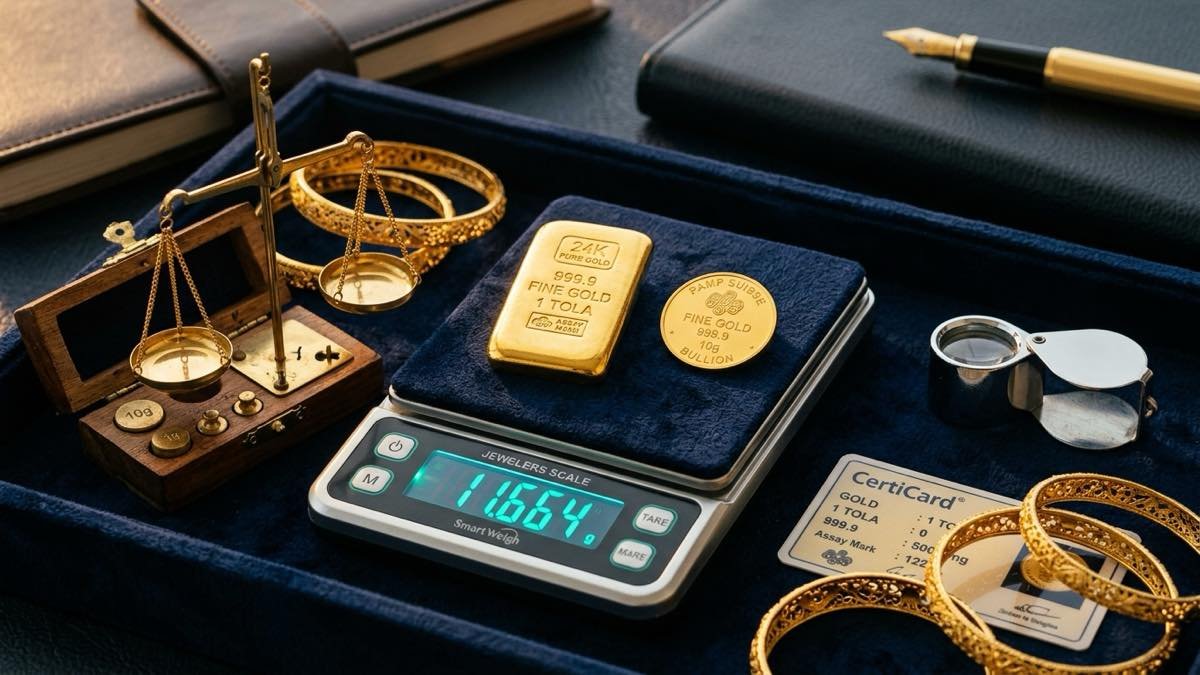
Understanding the exact weight difference between a traditional tola and modern metric measurements is essential for gold buyers and jewellery investors, especially as minor miscalculations can translate to thousands of rupees in price discrepancies.
In traditional Indian bullion markets, jewellers and buyers often use the term “1 tola” interchangeably with 10 grams. However, mathematically and historically, 1 Tola of gold equals 11.6638 grams—not 10 grams.
This leaves a weight gap of exactly 1.66 grams. At prevailing market rates for 22-karat gold, that 1.66-gram discrepancy can amount to a value difference of over ₹22,000 on a single traditional unit purchase. Recognizing whether a quoted price applies to a true tola (11.66g) or a metric block (10g) is crucial for accurate budgeting.
The tola is an ancient South Asian unit of mass used for weighing precious metals and commodities. Its exact standard was formalized during the British colonial era when the British East India Company standardized it at 180 troy grains, translating precisely to 11.6638 grams in 1833.
Beyond weight units, precious metal buyers frequently encounter confusion regarding gold purities:
Because pure 24K gold is inherently soft and malleable, crafting intricate necklaces, bangles, or rings requires alloying. Mixing other metals makes 22K gold significantly harder and more durable for daily wear. Lower purity does not imply poor quality—it is a deliberate manufacturing choice for jewelry integrity, mirroring precision standards seen in recent Udaipur bullion market price trends.
1 tola of gold equals exactly 11.6638 grams, standardized by the British East India Company in 1833, though retail markets sometimes loosely approximate it to 10 grams.
24-karat gold is 99.9% pure and soft, whereas 22-karat gold is 91.6% pure with added alloy metals like copper or silver to provide durability for jewellery making.
Pure gold is too soft to hold gemstone settings or resist everyday wear. Alloying gold to 22 karats hardens the metal while retaining high purity and rich color.
Disclaimer: This article is for informational and educational purposes regarding gold measurement units and purity standards. Buyers should verify exact weights and hallmarking certifications with certified jewellers.
Add Udaipur Mirror as a preferred source on Google to see more of our travel guides in your AI overviews.






[…] Mohan Reddy Regrets Backing CEC Selection Law; TDP and BJP Mount Counterattack 2 hours ago ⚡ Business 1 Tola Gold Weight vs 10 Grams: Difference, History & 22K vs 24K Purity Guide 2 hours … Business Cleartrip FY26 Loss Widens 28% to ₹805 Cr as Discounts Surge | Udaipur Mirror 2 hours […]