Office Address
14, Residency Road, Udaipur, Rajasthan 313001
Office Address
14, Residency Road, Udaipur, Rajasthan 313001


NEW DELHI / LONDON: Global currency and financial markets witnessed significant volatility on Monday as the euro falls french political unrest and elevated energy prices continue to weigh heavily on European investor sentiment. The single European currency slid across major forex pairs, creating a stark contrast with rallies in Asian currencies like China’s yuan, which touched a four-year peak following robust domestic economic growth figures.
⚡ Quick Highlights: Euro Falls Amid French Political Unrest & High Energy Costs
The European common currency faced acute selling pressure during early Monday trade across international forex hubs. Political divisions in France regarding fiscal austerity measures and structural budget cuts have raised yield spreads on sovereign debt, casting uncertainty over executive governance in Paris. Financial analysts note that the prolonged parliamentary impasse is preventing coherent fiscal policy execution at a delicate macroeconomic juncture.
Compounding the political stress is the persistence of high natural gas and power prices across Central Europe. Industrial manufacturers in France and Germany continue to face compressed profit margins, dampening expectations for private sector capital investment in the fourth quarter of 2026. As investors seek defensive allocation away from volatile currencies into bullion, traditional gold pricing guidelines like 1 Tola Gold Weight vs 10 Grams: Difference, History & 22K vs 24K Purity Guide become essential for domestic buyers navigating safe-haven inflows.
“The convergence of fiscal stalemates in core Eurozone nations and sticky utility costs is limiting the European Central Bank's options, leaving the euro vulnerable to foreign capital outflows.” — Senior Forex Strategist, London Financial Desk
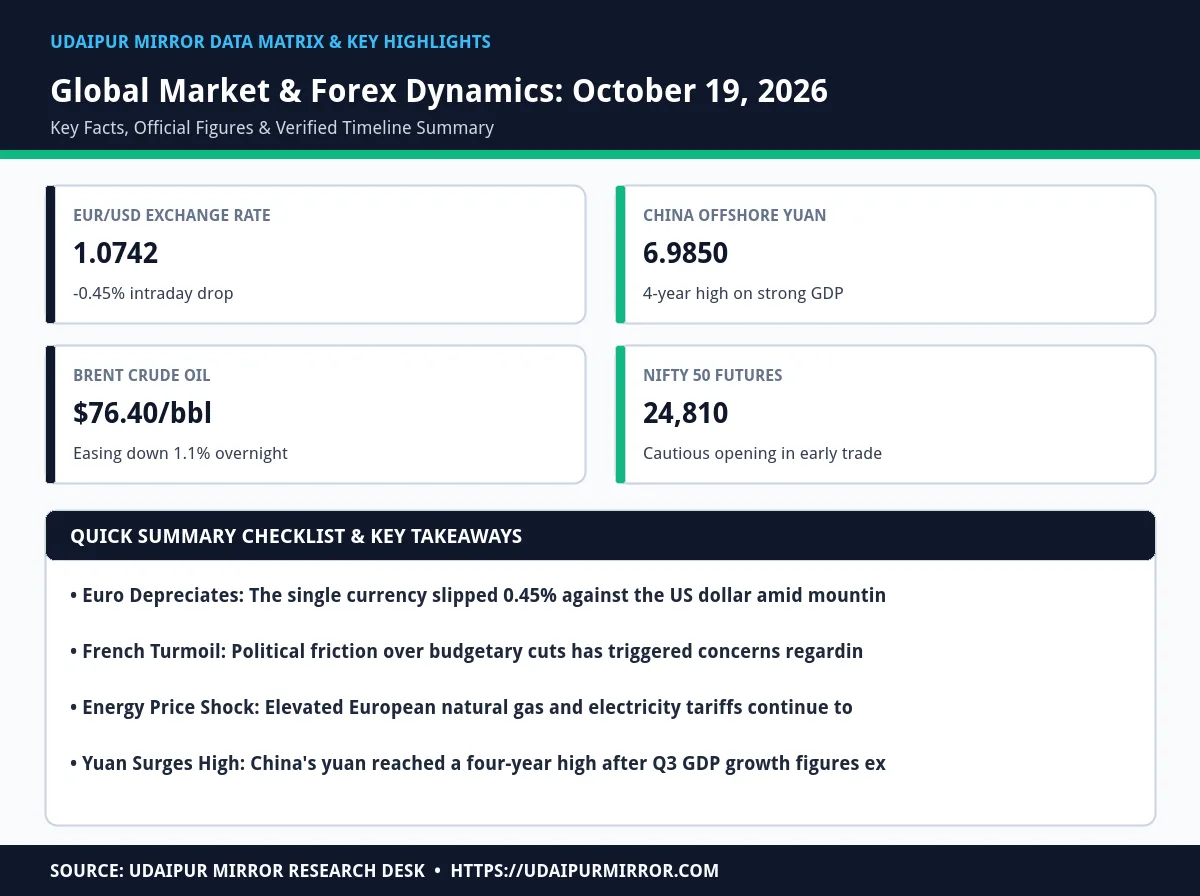
The table below provides a comprehensive summary of key global market indicators, exchange rates, and commodity benchmarks tracking reaction to European political headwinds and Asian macro data.
| Financial Asset / Currency | Current Level (19 Oct 2026) | Intraday Change (%) | Key Market Driver | Impact on Indian Markets |
|---|---|---|---|---|
| EUR / USD Pair | 1.0742 | -0.45% | French fiscal budget deadlock and high energy bills | Strengthens USD index, mild pressure on Rupee |
| USD / CNY Pair | 6.9850 | +0.38% | China Q3 GDP beating expectations at 5.2% | Boosts regional trade sentiment in Asia |
| Brent Crude Oil | $76.40 / barrel | -1.12% | Supply stabilization and Wall St bond buying | Lowers import bill and eases domestic inflation |
| European Stoxx 600 | 508.35 points | -0.62% | Selling pressure in industrial and banking stocks | Keeps global risk sentiment subdued |
| Asian MSCI Index | 172.40 points | -0.28% | Caution ahead of central bank commentary | Flat opening for domestic benchmarks |
| Gold Spot (USD/oz) | $2,725.50 | +0.15% | Safe-haven demand due to European uncertainty | Supports domestic bullion demand and safe pricing |
In sharp contrast to the weakness seen in European currency markets, Asia presented a divergent economic picture on October 19, 2026. China’s offshore yuan rallied to a four-year high against the US dollar following the release of third-quarter gross domestic product (GDP) figures that beat market estimates. The strong expansion figures eased fears of a sharp growth slowdown in the world’s second-largest economy.
Despite the positive macro data from Beijing, broader Asian equities displayed caution. Equity indices in Tokyo and Seoul traded slightly lower, reflecting spillover concerns from European industrial cooling and caution ahead of upcoming central bank meetings in Western economies.

International crude oil prices eased slightly during overnight and early Asian sessions, providing crucial relief to bond markets and energy-importing economies. Brent crude fell over 1% to trade near $76.40 per barrel, driven by supply stabilization and reduced immediate geopolitical risk premiums in trade corridors.
The retreat in energy futures helped Wall Street equity futures and sovereign treasury bonds stabilize. Lower energy inputs are expected to help moderate global headline inflation, giving central bank policymakers greater flexibility as they evaluate rate cuts heading into late 2026. (Also read: Flipkart's 2014 Big Billion Day Meltdown: How a Crash Created India's Shopping Festival).
For Indian financial markets, the confluence of a declining euro and softening crude oil yields a mixed macro outcome. Lower international oil tariffs directly benefit India’s current account deficit and reduce input cost pressures for manufacturing and logistics firms listed on the BSE and NSE. However, global risk aversion driven by European uncertainty tends to keep foreign portfolio investment (FPI) flows cautious in the short term.
While macro volatility persists globally, India’s structural domestic strength continues to attract long-term capital commitment, as reinforced when FM Nirmala Sitharaman Asserts India Is No Longer a Laggard in Frontier Technologies, highlighting the nation’s rising technological resilience and industrial momentum.
Market experts recommend that retail and institutional investors adopt a balanced asset allocation strategy during this period of heightened currency re-alignments. Diversifying exposures across equities, fixed income instruments, and physical assets helps mitigate risks associated with sudden geopolitical or currency moves.
Tracking central bank policy signals from the European Central Bank, the Federal Reserve, and the Reserve Bank of India will remain critical throughout Q4 2026 as global markets adapt to evolving growth and energy cost parameters.
The euro depreciated due to political friction over the national budget in France, coupled with high European energy costs that threaten industrial competitiveness and economic growth.
China’s yuan hit a four-year high as stronger-than-expected Q3 GDP figures eased concerns about economic deceleration and reduced immediate demand for heavy stimulus measures.
Lower crude oil prices provide relief to India’s import bill, balancing foreign capital outflows triggered by global risk aversion. Domestic benchmark indices like Nifty and Sensex remained relatively stable.
Gold spot prices saw moderate safe-haven buying as investors sought hedge assets against European currency weakness and broader geopolitical uncertainty.
Add Udaipur Mirror as a preferred source on Google to see more of our travel guides in your AI overviews.