Office Address
14, Residency Road, Udaipur, Rajasthan 313001
Office Address
14, Residency Road, Udaipur, Rajasthan 313001


NEW DELHI: NEW DELHI — Union Finance Minister Nirmala Sitharaman stated that the country has decisively shed its past image as a slow adopter, establishing rapid strides in frontier technologies in india digital growth through massive investments in artificial intelligence, domestic semiconductor production, and high-performance computing infrastructure.
⚡ Quick Highlights: FM Sitharaman on India Frontier Tech Leadership
Addressing policy makers and industry leaders, Union Finance Minister Nirmala Sitharaman emphasized that India has firmly positioned itself at the forefront of the global digital revolution. ‘India is no longer a laggard in frontier technologies. We are designing, engineering, and scaling solutions that power both domestic governance and global industries,’ Sitharaman noted during her keynote address.
The Finance Minister pointed out that the government’s strategic focus on building robust Digital Public Infrastructure (DPI) laid the groundwork for rapid adoption in complex domains such as Generative AI, machine learning, and advanced robotics. Unlike previous technology cycles where adoption lagged Western economies by decades, Indian enterprises and researchers are co-creating cutting-edge software and hardware architectures alongside global technology hubs.
This fundamental transformation is backed by systemic regulatory reforms, targeted Production Linked Incentive (PLI) schemes, and substantial budget allocations designed to build end-to-end technological self-reliance across critical supply chains. (Also read: Flipkart's 2014 Big Billion Day Meltdown: How a Crash Created India's Shopping Festival).
“India is no longer a laggard in frontier technologies. We are designing, engineering, and scaling solutions that power both domestic governance and global industries.” — Nirmala Sitharaman, Union Minister of Finance
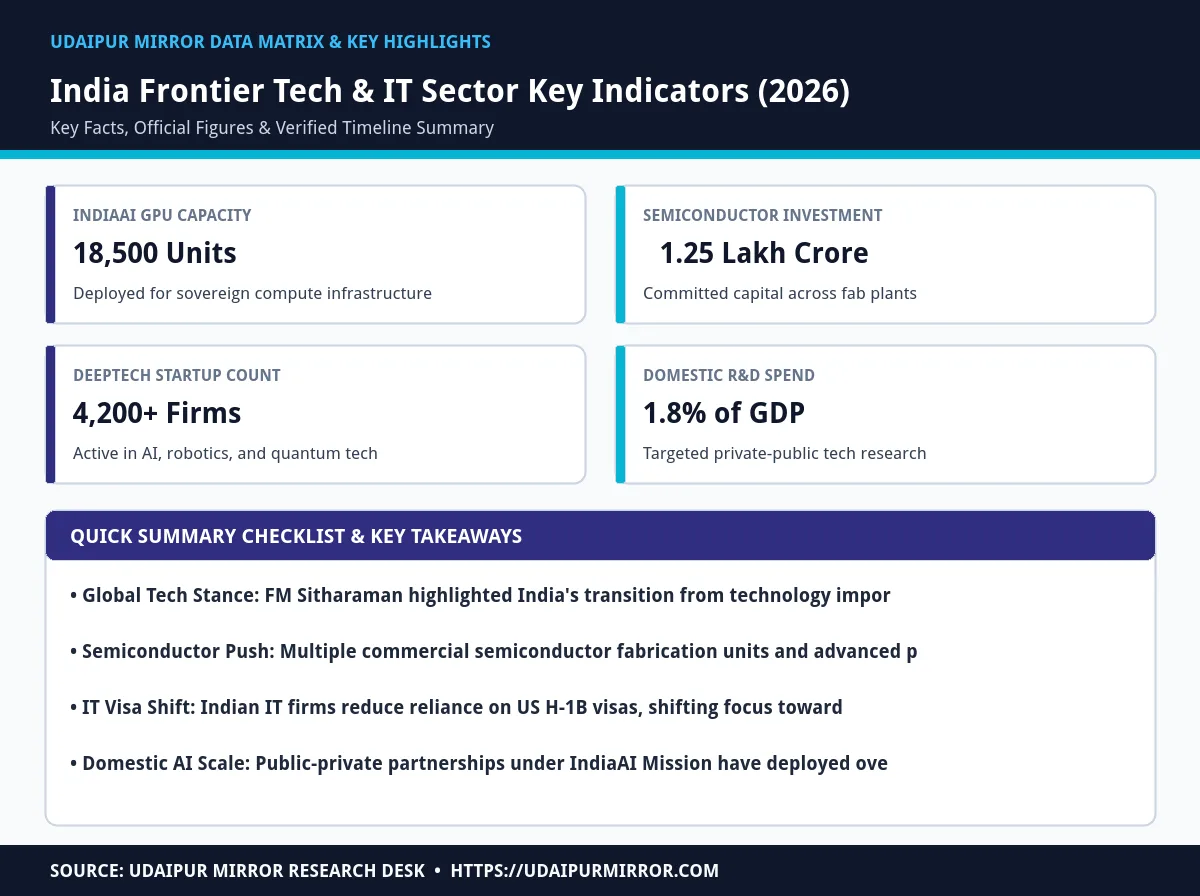
The following table outlines the strategic focus areas, government allocation metrics, and enterprise adoption milestones defining India’s technology sector leadership in FY 2026-27.
| Technology Sector | Primary Strategic Focus | Government Incentive | Enterprise Adoption Rate | Key Milestone Target |
|---|---|---|---|---|
| Artificial Intelligence | Sovereign LLMs & Enterprise Automation | ₹10,372 Cr (IndiaAI Mission) | 68% in Top Enterprises | Compute access for 5,000 startups |
| Semiconductors | Fab Construction & ATMP Facilities | PLI Scheme ($10 Billion) | 35% Local Sourcing | First commercial 28nm chip output |
| Quantum Computing | Algorithms & Cryptographic Defense | ₹6,003 Cr (Quantum Mission) | 18% Early Testing | 100-qubit quantum processor trial |
| 5G/6G Networks | Open RAN & Telecom Equipment Assembly | ₹12,195 Cr PLI Telecom | 82% National Coverage | 6G standardization whitepaper submission |
| Cloud & Data Centers | Hyperscale Green Data Parks | State Infra Grants | 74% Cloud Migration | 3.5 GW operational data center capacity |
A cornerstone of India’s frontier technology strategy is the development of a comprehensive semiconductor ecosystem. With multiple silicon fabrication units and Assembly, Testing, Marking, and Packaging (ATMP) facilities moving toward full operational capacity in Gujarat and Assam, India is transitioning from a chip design hub into a full-stack hardware producer.
Just as retail tech platforms learned critical infrastructure lessons from historical scale challenges—such as Flipkart’s 2014 Big Billion Day Meltdown—India’s tech architects are designing computing infrastructure capable of handling unprecedented transaction volumes without service degradation.
Industry leaders note that local fabrication capabilities drastically reduce supply chain vulnerabilities for Indian automotive, defense, and telecommunication sectors, ensuring sustained economic resilience amidst shifting global geopolitical dynamics.
“Domestic chip fabrication paired with world-class software capabilities gives India unprecedented strategic autonomy in the global digital economy.” — Senior Electronics & IT Ministry Official

Concurrently, India’s traditional IT services majors—including Tata Consultancy Services (TCS), Infosys, Wipro, and HCLTech—are undergoing a massive structural realigning. As visa application volumes for overseas talent deployment like the H-1B fall due to changing international immigration norms and tightening regulatory scrutiny in the United States, Indian IT giants are expanding their domestic and regional delivery hubs.
Rather than relying primarily on labor-arbitrage models, IT corporations are refocusing capital toward building proprietary AI agents, cloud integration platforms, and enterprise cybersecurity solutions. Global organizations are increasingly selecting Indian service providers as major digital workplace integration partners, mirroring international performance recognitions across digital work assessment benchmarks.
This pivot reflects a broader financial rebalancing across corporate technology balance sheets. Financial metrics across tech-adjacent sectors reveal how companies adapt under operational cost pressures, similar to trends seen in commercial travel technology where Cleartrip FY26 Loss Widens 28% to ₹805 Cr due to heavy promotional investments to capture long-term user market share.
“The shift toward localized high-value engineering and AI delivery models is transforming Indian IT services from execution partners to strategic tech architects.” — Lead Analyst, Global Technology Advisory
On the institutional finance front, equity markets are witnessing a tactical shift in how fund managers view technology stocks. Mutual fund allocations toward legacy IT services stocks hit lower percentage bands in recent operational quarters as portfolio managers reallocate capital into high-growth manufacturing, clean energy, and hardware tech equities.
Analysts highlight that while short-term market adjustments reflect valuation recalibrations, the underlying foundation of India’s technology ecosystem remains robust. Capital flows are increasingly targeting early-stage deeptech start-ups developing advanced solutions in robotics, space technology, satellite communications, and bio-computation.
This institutional shift aligns with the government’s broader economic agenda, which encourages venture capital funds and private equity firms to back foundational research rather than purely consumer-facing aggregator applications.
“Capital allocation is moving from transactional tech services toward IP-led deeptech innovation that offers defensible, long-term global competitiveness.” — Chief Investment Officer, Leading Asset Management Company
Looking toward the end of the decade, the Indian government has mapped out an ambitious multi-phase program to secure leadership in quantum computing, 6G communication protocols, and synthetic biology. Under the National Quantum Mission, hybrid quantum-classical computing testbeds are being deployed across major research clusters.
The integration of advanced tech stacks into everyday governance, public healthcare, agriculture, and municipal planning is expected to create millions of specialized technical jobs. By combining scale, data richness, and deep technical talent, India is constructing a resilient blueprint for sustained technological sovereignty in an increasingly complex multipolar world.
“Our objective for 2030 is clear: India will not just participate in global technological standard-setting; we will lead it.” — Ministry of Electronics and Information Technology Spokesperson
Finance Minister Nirmala Sitharaman stated that India is ‘no longer a laggard’ in frontier technologies, highlighting rapid domestic progress in artificial intelligence, semiconductor manufacturing, quantum computing, and digital public infrastructure.
The IndiaAI Mission has allocated over ₹10,300 crore to deploy public computing capacity, offering start-ups and researchers access to over 10,000 GPUs to build sovereign Large Language Models and localized AI applications.
Indian IT majors like TCS, Infosys, and HCLTech are reducing H-1B submissions due to changing US immigration regulations and a strategic shift toward domestic enterprise AI solution development and regional cloud delivery centers.
India’s deeptech growth is primarily driven by semiconductor design and fabrication, generative AI, quantum computing algorithms, 5G/6G telecom architecture, and high-performance green data center infrastructure.
Add Udaipur Mirror as a preferred source on Google to see more of our travel guides in your AI overviews.






[…] French Political Unrest and Rising Energy Costs Drag Down Global Market Sentiment 1 hour ago ⚡ Apps FM Nirmala Sitharaman Asserts India Is No Longer a Laggard in Frontier Technologies 2 hours ag… Business Flipkart's 2014 Big Billion Day Meltdown: How a Crash Created India's Shopping […]