Office Address
14, Residency Road, Udaipur, Rajasthan 313001
Office Address
14, Residency Road, Udaipur, Rajasthan 313001


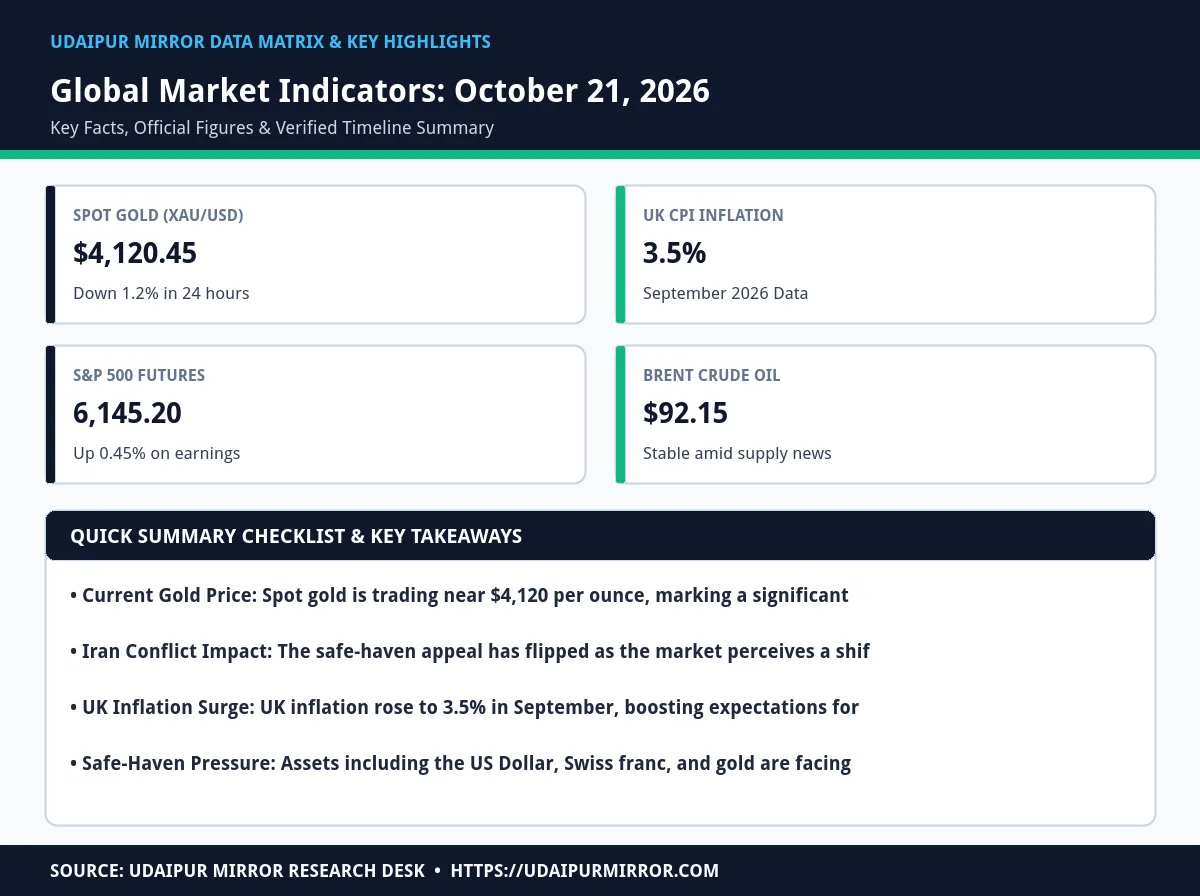
UDAIPUR: In a significant shift for global commodity markets on Wednesday, October 21, 2026, gold prices decline october 2026 as the yellow metal retreated toward the $4,120 per ounce level. This downward trajectory comes as the safe-haven appeal of bullion faces a dual challenge: a perceived de-escalation or ‘normalization’ of the Iran conflict and a persistently hawkish outlook from the US Federal Reserve. Investors are recalibrating their portfolios as the risk-on sentiment returns to Asian and Wall Street equities, leaving traditional hedges like gold, the Swiss franc, and German bonds under notable selling pressure.
⚡ Quick Highlights: Gold Prices Drop to $4,120: Iran Conflict & Fed Impact
The international bullion market is witnessing a sharp correction as gold prices decline october 2026, dropping nearly 26% from its recent all-time record. This plunge signifies a massive shift in investor psychology. For much of 2026, gold was the undisputed king of the portfolio, driven by fears of a widening Middle East conflict. However, as the situation involving Iran enters a new phase of tactical maneuvering rather than outright escalation, the ‘fear premium’ is rapidly evaporating.
Market analysts suggest that the technical breach of the $4,200 support level triggered automated sell orders, accelerating the slide toward $4,120. This movement is also reflected in the domestic Indian markets, where investors are closely watching the impact on jewelry demand and sovereign gold bonds. Also read: Tonbo Imaging IPO GMP Today: Listing Gain Expectations Soar as Subscription Opens Alongside Jio IPO for insights into how primary market liquidity is diverting funds from traditional commodities.
“The safe-haven appeal that sustained gold at record levels has been turned upside down as the Iran conflict reaches a stalemate and central banks prioritize inflation control.” — Senior Market Strategist, Yahoo Finance
The following table outlines the performance and current standing of major asset classes as of Wednesday morning, highlighting the shift away from safe havens.
| Asset Class | Current Value | 24h Change | Market Sentiment |
|---|---|---|---|
| Spot Gold | $4,120.00 | -1.15% | Bearish |
| US Dollar Index (DXY) | 104.20 | -0.30% | Neutral |
| MSCI Asia Pacific | 184.50 | +0.85% | Bullish |
| 10-Year US Treasury | 4.42% | +0.05% | Hawkish |
| Bitcoin (BTC) | $98,400 | +2.10% | Bullish |
| Silver (Spot) | $48.20 | -2.40% | Bearish |
The primary driver for gold’s meteoric rise earlier this year was the heightened tension in the Middle East. However, as of October 21, 2026, the narrative has shifted. The ‘safe-haven’ status of gold is under pressure because the anticipated regional conflagration has not materialized in the catastrophic manner many feared. Instead, diplomatic backchannels and a shift in military posturing have led traders to book profits on their long gold positions.
This de-escalation has simultaneously put other safe-haven assets like the Swiss franc and German government bonds under pressure. As the immediate threat of a global energy supply disruption recedes, the necessity of holding gold as a hedge against systemic collapse has diminished, allowing the US Federal Reserve’s interest rate policy to regain its position as the primary price driver.
While geopolitics provided the spark for the recent rally, the cold reality of monetary policy is now dousing the flames. The US Federal Reserve has maintained a hawkish stance, signaling that interest rates will remain ‘higher for longer’ to ensure inflation returns to its 2% target. This environment is inherently hostile to gold, which does not pay interest or dividends.
Compounding the pressure is the latest data from the United Kingdom, where inflation rose to 3.5% in September. This surprise jump has boosted bets for further rate hikes by the Bank of England, contributing to a global trend of tightening liquidity. As yields on sovereign debt rise, the opportunity cost of holding gold increases, further fueling the gold prices decline october 2026 trend.
In the context of shifting investment patterns, even institutional players are re-evaluating their sector allocations. Also read: From Infosys to TCS: How Mutual Funds’ Biggest IT Holdings Have Changed Since the Sector’s Peak to understand how large-scale capital is being redistributed across the Indian equity landscape.
The decline in gold is the inverse of the rising confidence in global equity markets. Asian stocks saw a healthy uptick on Wednesday morning, tracking a positive session on Wall Street. Corporate earnings for the third quarter of 2026 have generally exceeded expectations, particularly in the technology and manufacturing sectors, prompting investors to move away from defensive positions.
The ‘Risk-On’ sentiment is palpable. With the US Dollar Index (DXY) showing slight weakness and the Swiss franc losing ground, the capital is flowing into emerging markets and high-beta stocks. This transition suggests that the market is betting on a ‘soft landing’ for the global economy, a scenario where gold typically underperforms compared to growth-oriented assets.
For the Indian investor, the decline in international gold prices translates to a complex scenario. While the drop to $4,120 offers a more attractive entry point for physical gold buyers ahead of the upcoming festive and wedding seasons, the volatility remains a concern. Domestic prices in India are also influenced by the USD/INR exchange rate, which has remained relatively stable despite global fluctuations.
Financial advisors in Udaipur and across Rajasthan are suggesting a ‘wait and watch’ approach. With gold having plunged 26% from its record, there is a possibility of a short-term bounce, but the prevailing trend remains bearish as long as the Federal Reserve maintains its current trajectory. Investors are encouraged to diversify into equities and high-quality debt while keeping a small, strategic allocation to bullion for long-term hedging.
Gold prices are declining due to a combination of easing geopolitical tensions in the Iran conflict, a hawkish interest rate outlook from the US Federal Reserve, and a shift in investor preference toward equity markets following strong corporate earnings.
As of Wednesday, October 21, 2026, spot gold is trading near the $4,120 per ounce mark, having corrected significantly from its previous record highs.
The rise in UK inflation to 3.5% in September has increased expectations for higher interest rates globally. Higher interest rates make non-yielding assets like gold less attractive compared to interest-bearing bonds, putting downward pressure on prices.
With gold prices down 26% from their peak, it may be an attractive entry point for long-term investors. However, given the current bearish trend and the Fed’s hawkish stance, some analysts suggest buying in staggered tranches rather than a lump sum.
Add Udaipur Mirror as a preferred source on Google to see more of our travel guides in your AI overviews.