Office Address
14, Residency Road, Udaipur, Rajasthan 313001
Office Address
14, Residency Road, Udaipur, Rajasthan 313001


MUMBAI / NEW DELHI: Global financial systems encountered a dramatic session on Friday, October 23, 2026, as the intense global markets tech selloff that rattled Wall Street finally began to decelerate across major Asian stock exchanges. Investors are currently weighing a volatile mix of surging energy costs, evolving monetary policy paths, and escalating geopolitical tensions in energy corridors. While US indices such as the S&P 500 and Nasdaq experienced downward pressure earlier due to artificial intelligence jitters easing expectations of imminent Federal Reserve rate cuts, Asian bourses demonstrated remarkable resilience during early Friday transactions, offering steady momentum to broader macroeconomic sentiment.
⚡ Quick Highlights: Global Markets Tech Selloff Slows, Oil Hits 5-Month High
Wall Street experienced a turbulent session prior to the Asian trading hours, with both the S&P 500 and the Nasdaq Composite slipping under corrective pressure. Market analysts point out that recent jitters surrounding artificial intelligence valuations and enterprise monetization timelines have forced institutional investors to re-evaluate risk parameters. Furthermore, sticky macroeconomic data has eased aggressive market bets on immediate US Federal Reserve monetary easing, keeping Treasury yields elevated and prompting capital rotation away from high-multiple growth equities.
Despite these headwinds in Western markets, global liquidity remains dynamic. Enterprises continue to scale advanced computing infrastructure, reflecting ongoing digital transformation waves globally. For instance, strategic corporate tie-ups such as Tech Mahindra SpaceXSI AI integration highlight how enterprise automation continues to drive long-term business value regardless of near-term stock market fluctuations.
“The moderation in Asian tech selling provides a much-needed psychological cushion, but escalating energy costs remain the primary wildcard for global central banks.” — Global Macro Strategist, Mumbai Financial Desk
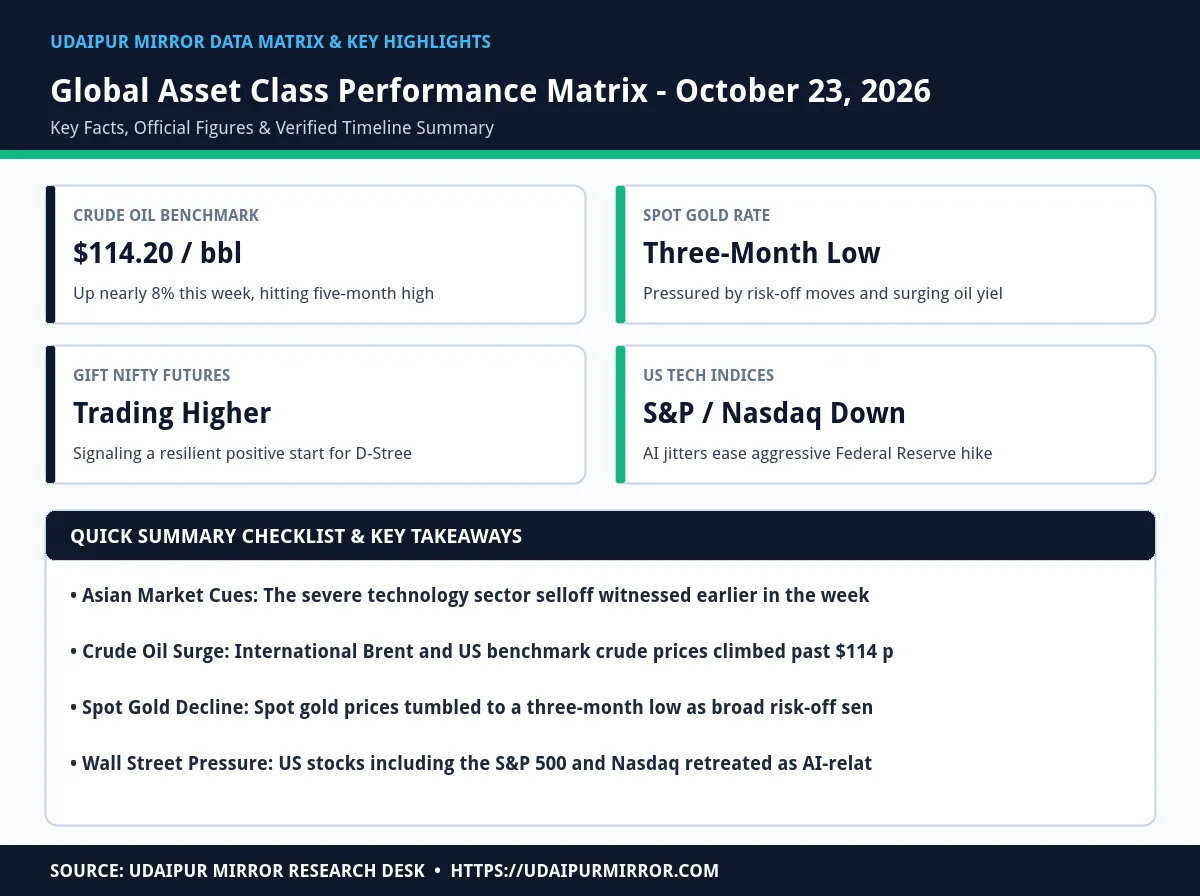
The following data breakdown outlines the current valuation metrics, weekly percentage shifts, and immediate market direction for key global asset classes and regional indices as of Friday, October 23, 2026.
| Asset Class / Index | Current Level / Price | Weekly Change | Market Trend | Impact on Indian Economy |
|---|---|---|---|---|
| Crude Oil (Brent/WTI) | $114.15 per barrel | +7.8% | Bullish / 5-Month High | Negative (Inflationary pressures, higher import bill) |
| Spot Gold | Three-Month Low | -3.4% | Bearish / Risk-Off | Neutral (Lower domestic bullion import costs) |
| Nasdaq Composite | Corrective Phase | -2.1% | Cautious / Volatile | Moderate Negative (IT services margin caution) |
| GIFT Nifty Futures | Firmly Positive | +0.6% | Bullish Opening | Positive (Strong domestic institutional buying support) |
| US 10-Year Treasury Yield | Elevated Range | +12 bps | Stable to Firm | Negative (Foreign portfolio capital outflows) |
International energy markets are currently witnessing their most volatile stretch in months. Crude oil benchmarks breached the $114 per barrel threshold, clocking a staggering weekly gain of nearly 8 percent. This sharp upward trajectory is primarily driven by intensified security attacks on critical global energy production and transit infrastructure.
For net-importer economies like India, a sustained surge in crude oil poses immediate fiscal challenges. Higher imported energy costs directly threaten domestic retail fuel margins, push wholesale inflation higher, and widen the current account deficit. Financial market participants are closely monitoring Reserve Bank of India policy responses as imported cost pressures test domestic macroeconomic stability.
“Oil crossing $114 per barrel acts as an immediate tax on global growth, complicating central bank inflation management across emerging markets.” — Senior Commodities Analyst
Even as energy commodities rally sharply, precious metals have faced intense liquidation pressure. Spot gold tumbled to a three-month low during overnight trading sessions as broader risk-off moves compelled institutional traders to cover margin calls and reallocate capital into liquid cash instruments and rising sovereign yields.
The divergence between soaring oil prices and slumping gold valuations underscores the unique nature of the current macroeconomic environment. While gold traditionally serves as an inflation hedge, the immediate dominance of US dollar strength and high real interest rates has temporarily eclipsed its safe-haven appeal. (Also read: Tonbo Imaging IPO Allotment Status Online: Check Share Allotment and Basis).
“Gold's slide to a three-month low demonstrates that liquidity demands and surging US yields can temporarily overwhelm traditional safe-haven dynamics.” — Bullion Market Specialist
Providing relief to international investors, the severe technology selloff that originated in US markets moderated significantly across Asian bourses. Major indexes in Tokyo, Seoul, and Hong Kong absorbed the initial shockwaves without cascading into panic selling. This stabilization has set a constructive tone for emerging markets across the region.
Back home, Indian financial markets (D-Street) are poised for a positive start today, with GIFT Nifty trading firmly higher. Domestic institutional flows and robust retail participation continue to cushion Indian equities against external macro shocks. Meanwhile, investors tracking primary markets continue to evaluate opportunities, keeping an eye on updates such as Tonbo Imaging IPO allotment status online alongside broader index movements.
“D-Street's ability to decouple from global tech volatility highlights the structural depth and domestic liquidity driving Indian equities in 2026.” — Head of Institutional Research
Global markets experienced a tech selloff due to rising artificial intelligence valuation jitters, profit-booking in high-multiple growth stocks, and tempered expectations regarding imminent US Federal Reserve interest rate cuts.
Crude oil prices surged past $114 per barrel, gaining nearly 8% for the week, driven primarily by escalating security attacks on critical global energy production and transit infrastructure.
Spot gold prices fell to a three-month low as broad risk-off liquidations, surging US Treasury yields, and strong dollar demand prompted institutional investors to rebalance portfolios away from precious metals.
Despite external headwinds and rising oil prices, Indian markets are poised for a positive start today, supported by robust domestic institutional inflows and firm GIFT Nifty trading indicators.
Add Udaipur Mirror as a preferred source on Google to see more of our travel guides in your AI overviews.