Office Address
14, Residency Road, Udaipur, Rajasthan 313001
Office Address
14, Residency Road, Udaipur, Rajasthan 313001


MUMBAI / NEW DELHI: NEW DELHI — Regional financial markets experienced a notable relief rally on Thursday morning, providing much-needed breathing room to investors tracking global equities. As asian stocks rise coreweave shock concerns gradually dissipate, regional indices are attempting to find a stable footing after days of heavy tech-sector liquidation and geopolitical headwinds across international markets.
⚡ Quick Highlights: Asian Stocks Rise After CoreWeave Shock & Indonesia Downgrade
Asian stock markets exhibited signs of resilience during Thursday’s trading session, recovering from a severe three-month low triggered earlier in the week by intense tech angst and Gulf geopolitical tensions. Traders rushed to re-evaluate portfolios as panic surrounding infrastructure valuations eased, allowing buyers to step back into oversold growth and technology counters. While broader tech-driven volatility remains a talking point on trading floors—much like discussions surrounding shifting momentum in I.T. stocks set for more gains—the immediate contagion risk appears contained for the moment.
Market analysts noted that while the initial panic has subsided, structural concerns regarding corporate debt and high-growth capital expenditure have not entirely disappeared. Institutional investors are maintaining a selective approach, prioritizing balance-sheet strength over aggressive speculative growth plays across both developed and emerging Asian exchanges. (Also read: I.T. Stocks Set For More Gains? Sharad Avasthi On Infosys, TCS, Wipro And Tech Mahindra).
“The market reaction reflects a transition from outright panic to calculated risk reassessment. CoreWeave's valuation shock acted as a wake-up call, but underlying fundamentals in several Asian economies remain robust.” — Chief Macro Strategist, Singapore
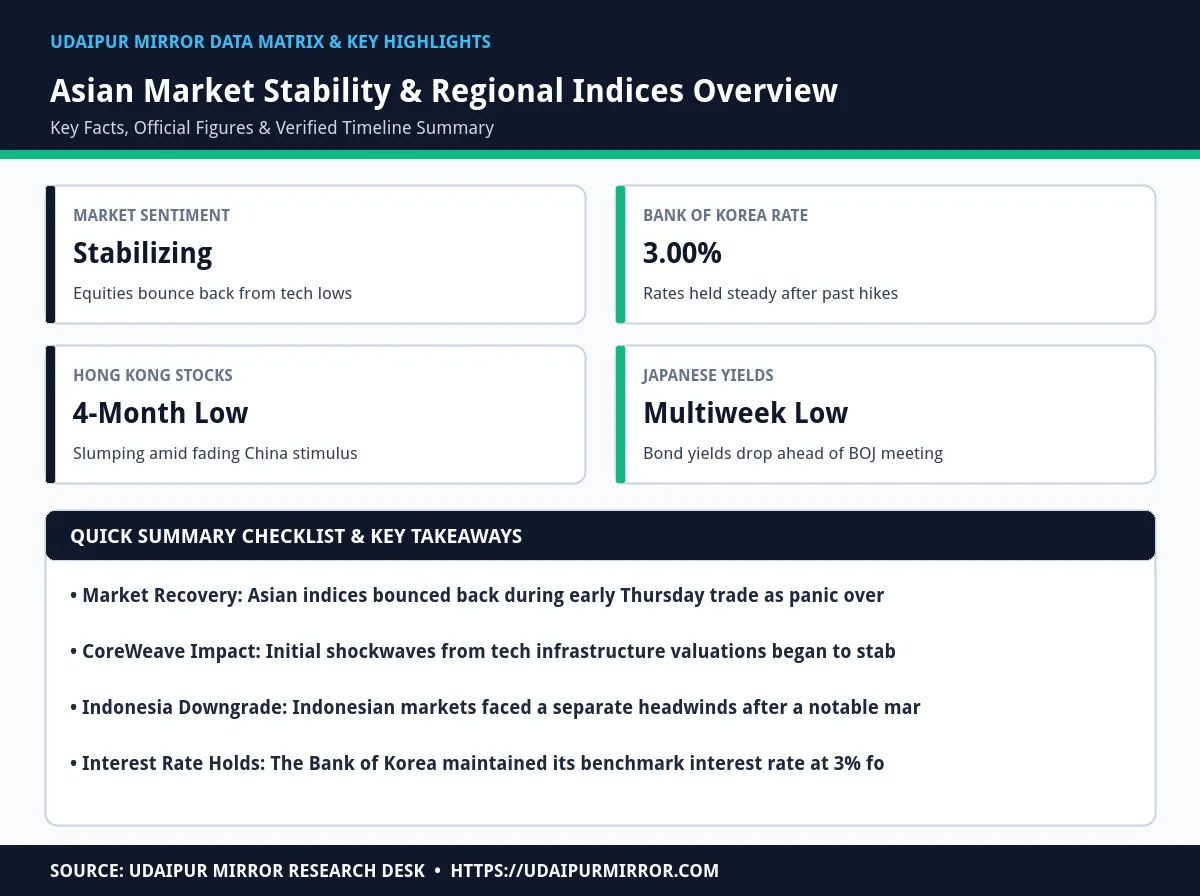
The following data matrix outlines the current market standing, monetary policy stances, and key economic indicators across major Asian financial hubs as of Thursday, October 22, 2026.
| Country / Region | Index / Institution | Current Status | Key Policy / Trend |
|---|---|---|---|
| South Korea | Bank of Korea | Hold at 3.00% | Paused after back-to-back rate hikes |
| Indonesia | Jakarta Composite | Downgraded | Facing localized capital outflow pressures |
| Japan | Japanese Government Bonds | Yields Lower | Multiweek lows ahead of BOJ decision |
| Hong Kong | Hang Seng Index | 4-Month Low | Weighed down by fading stimulus hopes |
| Regional Average | MSCI Asia Pacific | Tentative Recovery | Rebounding from technology-led sell-off |
Even as broader regional sentiment turned positive, Indonesia faced a localized market downgrade that drew sharp focus from emerging market fund managers. The rating and valuation adjustment reflects growing concerns over domestic fiscal parameters and shifting foreign portfolio allocations.
Market participants in Jakarta observed moderate selling pressure across large-cap banking and commodity counters. However, local policymakers have stepped up communication efforts to assure foreign investors of the nation’s resilient underlying economic growth and disciplined fiscal management framework, aiming to curb excessive capital flight.
“Emerging markets are facing a bifurcated reality where localized governance and fiscal metrics heavily influence investor appetite, independent of regional tech trends.” — Head of ASEAN Research
Monetary policy divergence continued to shape currency and debt markets across Asia. The Bank of Korea formally announced it is holding interest rates steady at 3% following a series of back-to-back rate hikes implemented earlier to combat stubborn domestic inflationary pressures. This pause was largely priced in by debt markets, offering stability to the South Korean won.
Meanwhile, in Japan, government bond yields slipped to multiweek lows as institutional investors squared positions ahead of the highly anticipated Bank of Japan (BOJ) policy meeting. The subdued yield environment has kept pressure on the Japanese yen, forcing currency traders to watch for any hawkish verbal intervention from Tokyo policymakers. Similar shifts in consumer spending and competitive market landscapes—such as those observed in the evolving battle seen when Flipkart disrupts India’s food delivery duopoly—demonstrate how rapid strategic pivots define modern economic ecosystems.
“Asian central banks are walking a tightrope between domestic inflation control and defending currency valuations against a persistent US dollar.” — Senior Currency Economist, Tokyo
For Indian investors, the stabilization of Asian markets offers a neutral-to-positive opening cue, shielding domestic equities from severe imported volatility. While local indices continue to track global macroeconomic cues, robust domestic participation and strong corporate earnings expectations have cushioned Indian benchmark indices against external shocks.
Furthermore, international commodity prices, including Brent crude oil and gold rates, remain vital barometers for India’s current account deficit and inflationary trajectory. Investors are advised to maintain a diversified portfolio approach, keeping a close eye on global central bank signals and foreign institutional capital flows throughout the upcoming corporate earnings season.
“India remains a relative bright spot in the emerging market universe, drawing sustained domestic inflows even as regional peers navigate rating downgrades and capital shifts.” — Principal Portfolio Manager, Mumbai
Asian stock markets experienced significant volatility and hit three-month lows due to intense technology sector angst following the CoreWeave valuation shock, combined with lingering Gulf geopolitical tensions.
Indonesia faced a market downgrade due to localized fiscal adjustments and shifting foreign portfolio allocations, prompting institutional investors to reassess risk in emerging market assets.
The Bank of Korea decided to hold its benchmark interest rate steady at 3.0% following a series of back-to-back rate hikes implemented earlier to manage domestic inflation.
While global tech angst and regional rating adjustments create external headwinds, Indian markets continue to benefit from strong domestic liquidity and robust corporate earnings, insulating them from severe contagion.
Add Udaipur Mirror as a preferred source on Google to see more of our travel guides in your AI overviews.