Office Address
14, Residency Road, Udaipur, Rajasthan 313001
Office Address
14, Residency Road, Udaipur, Rajasthan 313001

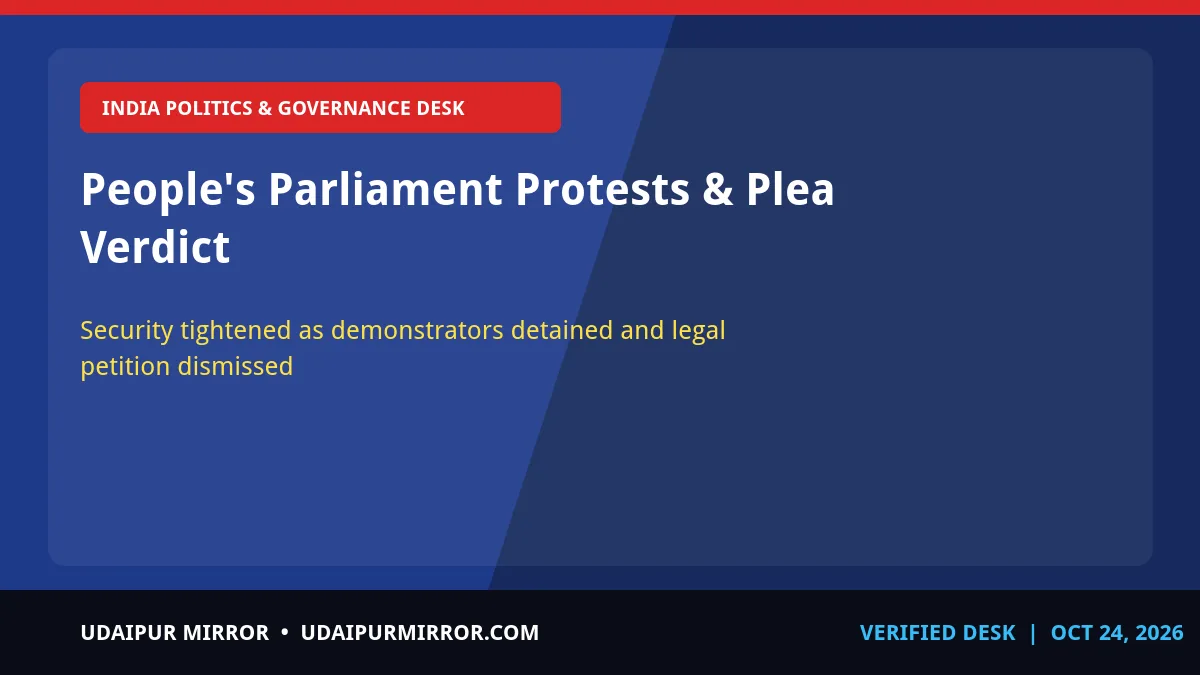
NEW DELHI: NEW DELHI — Tensions escalated sharply across the national capital as law enforcement authorities clamped down on demonstrations, leading to multiple detentions during the unauthorized peoples parliament protest detained events. The unfolding situation has drawn intense nationwide scrutiny, intersecting with ongoing debates surrounding institutional accountability, administrative transparency, and civil liberties. Amid these high-stakes developments, judicial authorities also delivered a significant legal blow by officially rejecting the petition filed by prominent figure Neha Bora, intensifying political discussions across various legislative and civic forums.
⚡ Quick Highlights: Protesters Detained at People's Parliament; Neha Bora Plea Rejected
The decision by civil groups to assemble a symbolic ‘People’s Parliament’ was met with swift administrative resistance as security agencies deployed heavy barricades and preventive measures across strategic points. Authorities maintained that the gathering lacked the requisite statutory permissions, posing potential risks to public order in sensitive administrative zones. In related civic news, citizens seeking legal recourse often navigate complex institutional frameworks, much like how bank consumers recently triumphed through Udaipur Permanent Lok Adalat Penalizes Bank for Withholding Fixed Deposit Payout in separate administrative domains.
As demonstrators attempted to voice their concerns regarding governance transparency and administrative accountability, police forces intervened. Multiple prominent activists and participants were swiftly detained and transported to nearby holding facilities. Opposition leaders and civil rights organizations have strongly criticized the police action, calling it an authoritarian suppression of democratic dissent. (Also read: Udaipur Permanent Lok Adalat Penalizes Bank for Withholding Fixed Deposit Payout Despite Registered Will | बैंक की लापरवाही पर सख्त कार्रवाई).
“Preventive detentions of peaceful citizens attempting to hold a symbolic dialogue undermine the foundational pillars of our constitutional democracy.” — Civil Rights Coalition Spokesperson
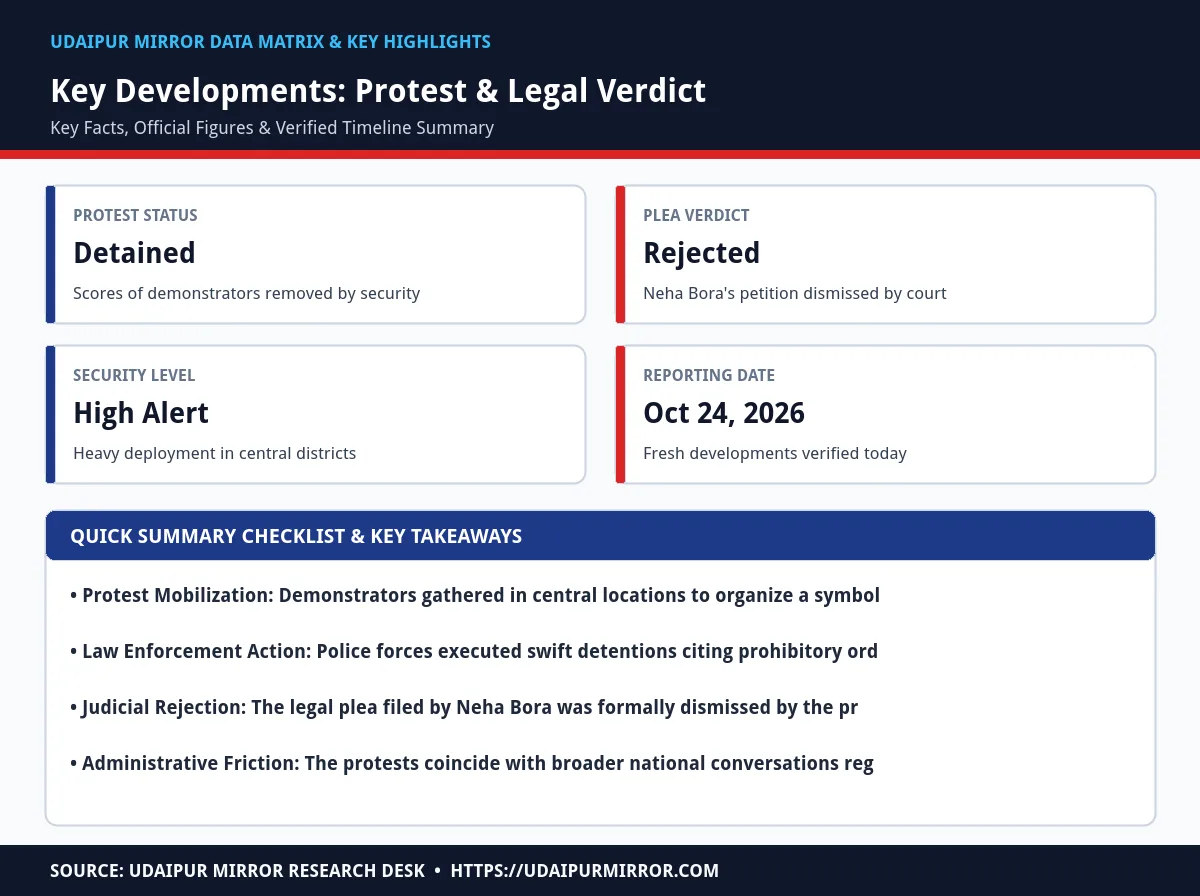
The sequence of events leading up to the detentions at the ‘People’s Parliament’ and the subsequent dismissal of legal petitions reflects a rapidly evolving political landscape across national governance structures.
| Date & Time | Event Category | Primary Development | Official Response |
|---|---|---|---|
| Oct 23, 2026 – 15:59 | RTI Disclosure | Files reveal inaction on official complaints | Administrative review initiated |
| Oct 24, 2026 – 01:10 | Political Statement | Leaders flag institutional breakdowns | Demands for formal inquiry raised |
| Oct 24, 2026 – 02:05 | Civil Protest | ‘People’s Parliament’ assembly held | Police intervention and mass detentions |
| Oct 24, 2026 – Day | Legal Proceedings | Neha Bora’s plea reviewed in court | Petition officially rejected by bench |
In tandem with the street protests, the legal arena witnessed a crucial development as the presiding judicial bench formally rejected the petition filed by Neha Bora. Legal counsels for the petitioner had argued for urgent interim interventions concerning institutional grievances, but the court found the arguments insufficient for immediate relief. Experts note that judicial scrutiny on such matters requires exhaustive evidentiary backing.
The rejection of the plea effectively closes one legal avenue for the petitioners, though legal teams are currently deliberating whether to file a review petition or escalate the matter to a higher appellate division. This judicial outcome adds another layer of complexity to an already charged socio-political climate.
“The court has evaluated the submissions on merit and found the petition devoid of statutory grounds for immediate intervention.” — Senior Legal Analyst
The weekend developments do not occur in a vacuum; they follow closely on the heels of explosive Right to Information (RTI) disclosures that brought administrative friction into the public spotlight. Recent documents indicated that top bureaucratic offices did not act on informal complaints lodged by election commissioners, sparking fierce debates across national media channels. Local administrative bodies elsewhere continue to upgrade public safety infrastructure, paralleling how Udaipur Traffic Police Receive 10 Advanced Solar Barricades to manage public movement effectively.
Political heavyweights and lawmakers have seized upon these RTI revelations to demand sweeping reforms in how institutional grievances are handled. The intersection of these bureaucratic controversies with street-level agitations has amplified public interest in national governance standards. (Also read: Udaipur Traffic Police Receive 10 Advanced Solar Barricades to Boost Night Visibility and Road Safety | यातायात पुलिस को मिले 10 सोलर बैरिकेड्स).
“RTI letters act as primary evidence of an institutional breakdown that requires urgent legislative correction and transparency.” — Jawahar Sircar, Prominent Public Figure
As political parties prepare for upcoming electoral cycles and parliamentary sessions, the handling of the ‘People’s Parliament’ and the ongoing bureaucratic disputes are expected to dominate legislative debates. The ruling administration faces mounting pressure to address transparency concerns, while opposition factions seek to capitalize on public discontent surrounding administrative handling of dissent.
Political analysts suggest that the coming weeks will witness heightened friction both inside and outside legislative assemblies as civil society groups demand greater accountability and adherence to democratic norms.
“The interplay between street activism and institutional governance will define the political narrative in the lead-up to the next parliamentary season.” — Senior Political Commentator
The protests were organized by civil groups and activists to voice concerns regarding governance transparency, administrative accountability, and recent institutional controversies.
Police detained the protesters citing the lack of statutory permissions for the gathering and the enforcement of prohibitory orders in sensitive security zones.
The presiding judicial bench officially rejected Neha Bora’s plea, citing a lack of sufficient legal grounds for immediate interim intervention.
Recent RTI revelations regarding bureaucratic inaction on internal plaints have heightened public debate on institutional transparency, providing backdrop context to the protests.
Add Udaipur Mirror as a preferred source on Google to see more of our travel guides in your AI overviews.