Office Address
14, Residency Road, Udaipur, Rajasthan 313001
Office Address
14, Residency Road, Udaipur, Rajasthan 313001

Jaipur / Udaipur: Understanding sarpanch ki zimedari (the duties, powers, and legal responsibilities of a village Sarpanch) is fundamental to empowering grassroots democracy and ensuring accountable rural administration across India. Under Part IX of the Indian Constitution, the 73rd Constitutional Amendment Act of 1992, and respective State Panchayati Raj Acts (such as the Rajasthan Panchayati Raj Act, 1994), the Sarpanch acts as the democratically elected executive head and primary citizen representative of the Gram Panchayat, entrusted with executing socio-economic development, village infrastructure, welfare disbursements, and transparent local governance.
⚡ Quick Highlights: Sarpanch Ki Zimedari: Powers, Duties & Gram Panchayat Rights Explained
In the three-tier Panchayati Raj system of India (Gram Panchayat at village level, Panchayat Samiti at block level, and Zila Parishad at district level), the Sarpanch (सरपंच / ग्राम प्रधान / मुखिया) is the foremost grassroots representative. Enshrined in the 73rd Constitutional Amendment Act, 1992 and codified under state laws such as the Rajasthan Panchayati Raj Act, 1994 (Section 32), the Sarpanch is vested with executive and supervisory powers to steer local self-government across 29 subjects listed in the Eleventh Schedule.
हिंदी में समझें (Hindi Overview): भारतीय संविधान के अनुच्छेद 243 और 73वें संविधान संशोधन के तहत ग्राम पंचायत को लोकतंत्र की सबसे मजबूत प्राथमिक इकाई माना गया है। गांव की मतदाता सूची में दर्ज वयस्क नागरिकों द्वारा प्रत्यक्ष मतदान से सरपंच का चुनाव 5 वर्ष के कार्यकाल के लिए किया जाता है। सरपंच ग्राम पंचायत का अध्यक्ष और कार्यकारी प्रमुख होता है। उसका मुख्य दायित्व केवल सरकारी योजनाओं का क्रियान्वयन करना नहीं है, बल्कि गांव के अंतिम व्यक्ति तक न्याय, विकास, पेयजल, शिक्षा और स्वच्छता की बुनियादी सुविधाएं बिना किसी भेदभाव के पहुंचाना है।
The office of the Sarpanch is not merely ceremonial; it represents executive responsibility. In active democratic exercises such as the Udaipur Panchayat Elections voter participation, the Sarpanch collaborates with elected Ward Panches and the permanent state administrative officer—the Gram Vikas Adhikari (VDO / ग्राम विकास अधिकारी)—to prepare and execute the annual Gram Panchayat Development Plan (GPDP) to allocate state and central grants equitably.
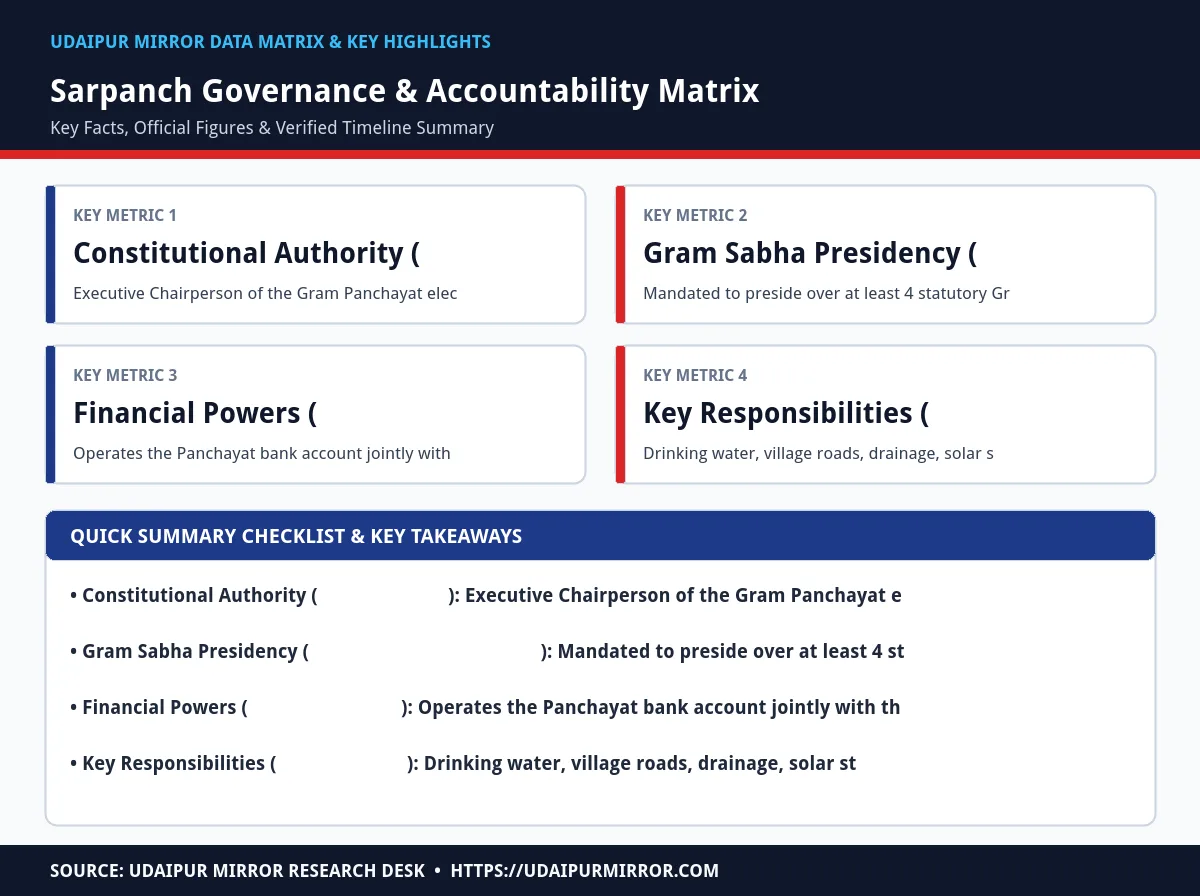
This structured reference matrix outlines the essential governance domains, statutory duties, administrative partners, and legal rights available to citizens for verifying each responsibility of a village Sarpanch:
| Governance Domain (कार्य क्षेत्र) | Sarpanch Core Duty (सरपंच की प्रमुख जिम्मेदारी) | Governing Law / Scheme (कानून व योजना) | Administrative Partner (सहयोगी अधिकारी) | Citizen Verification Right (नागरिकों का अधिकार) |
|---|---|---|---|---|
| Village Infrastructure & Roads | Construction of CC roads, drainage channels, street lights, and boundary walls | 15th Finance Commission & SFC Grants | Gram Vikas Adhikari (VDO) & Junior Engineer (JEN) | Inspect work estimates & tender documents via RTI / e-GramSwaraj |
| Drinking Water & Sanitation | Repairing handpumps, water tank pipelines, ODF-Plus soak pits, and community toilets | Jal Jeevan Mission & Swachh Bharat Mission (G) | PHED Engineer & Village Sanitation Committee | Demand potable water testing and water safety plans in Gram Sabha |
| Rural Employment Guarantee | Issuing 100-day Job Cards, allocating muster roll works, and building farm ponds | MGNREGA Act, 2005 | Gram Rozgar Sahayak (GRS) & Program Officer (BDO) | Scrutinize daily attendance and demand unemployment allowance if work delayed |
| Housing & Land Pattas | Sanctioning PMAY-G beneficiary houses and distributing residential abadi pattas | Pradhan Mantri Awas Yojana (G) & State Abadi Rules | VDO, Tehsildar & Patwari | Verify SECC socio-economic priority list on AwaasSoft portal |
| Education & Child Nutrition | Monitoring primary school infrastructure, Mid-Day Meal hygiene, and Anganwadis | Samagra Shiksha & Poshan Abhiyaan | School Headmaster & Anganwadi Worker | Participate in School Management Committee (SMC) open meetings |
| Health & Social Security | Verifying Old-Age/Widow pensions, immunization drives, and disability certificates | National Social Assistance Programme (NSAP) | ANM, ASHA Sahayogini & Social Welfare Dept | Inspect pension eligibility rolls displayed on Panchayat notice boards |
| Vital Civil Registration | Timely registration of births, deaths, and marriages without unofficial levies | Registration of Births and Deaths Act, 1969 | Local Registrar (VDO / Sarpanch) | Free certificate within statutory 21-day timeline via Pehchan portal |
The operational duties of a village Sarpanch span multiple governance sectors. Below is a detailed breakdown of the 10 most critical responsibilities that every citizen must know:
1. Gram Sabha Convening & Execution (ग्राम सभा का आयोजन व बैठकें): A Sarpanch is legally mandated to convene and chair at least 4 mandatory Gram Sabhas every year (Republic Day on 26 January, Labour Day on 1 May, Independence Day on 15 August, and Gandhi Jayanti on 2 October), along with regular monthly Gram Panchayat meetings. The Sarpanch must table all income, expenditure, and beneficiary lists before the open assembly.
2. Village Infrastructure & Connectivity (गांव का भौतिक ढांचा व सड़कें): Construction and maintenance of internal village cement concrete (CC) roads, interconnecting gravel pathways, drainage systems (पक्की नालियां), public chaupals, and solar/LED streetlights across all wards (frequently integrated with clean energy schemes like the PM Surya Ghar Scheme in India).
3. Safe Drinking Water & Sanitation (पेयजल व्यवस्था व स्वच्छ भारत मिशन): Head of the Village Water and Sanitation Committee (VWSC). Overseeing Jal Jeevan Mission pipe connectivity, regular servicing of community handpumps, maintenance of public borewells, and driving Swachh Bharat Mission (Grameen) ODF-Plus protocols including solid and liquid waste management (SLWM).
4. MGNREGA Employment & Job Cards (मनरेगा में रोजगार व जॉब कार्ड): Issuing 100-day guaranteed employment Job Cards to any adult applicant without political bias, drafting annual work shelves (pond deepening, farm ponds, anicut construction), verifying daily muster rolls, and ensuring fair timely wage disbursement.
5. Primary Education & Mid-Day Meal Supervision (शिक्षा व मिड-डे मील): Supervising local Government Primary and Upper Primary Schools, checking student attendance, ensuring clean drinking water and functional toilets for girls, and monitoring the quality and hygiene of the Mid-Day Meal scheme.
6. Public Health, Anganwadi & Immunization (स्वास्थ्य, पोषण व आंगनबाड़ी): Collaborating with Auxiliary Nurse Midwives (ANM) and ASHA Sahayoginis to ensure 100% child immunization, maternal healthcare checkups, distribution of supplementary nutrition through Anganwadi centers, and conducting regular sanitation fogging during monsoon outbreaks.
7. Abadi Land Pattas & Housing Schemes (आबादी भूमि पट्टे व पीएम आवास): Processing residential land lease deeds (आबादी पट्टा) under state statutory rules (e.g. Prashasan Gaon Ke Sang campaign), transparently approving eligible homeless families for the Pradhan Mantri Awas Yojana – Gramin (PMAY-G), and preventing illegal encroachment on pasture (Gauchar) land.
8. Vital Statistics Registration (जन्म, मृत्यु व विवाह पंजीयन): Operating as or assisting the local Registrar to ensure prompt, transparent, and fee-exempt issuance of Birth, Death, and Marriage Certificates through the Pehchan portal.
9. Social Security Pensions & Welfare (सामाजिक सुरक्षा पेंशन व पालनहार): Identifying and recommending genuine elderly persons, widows, and specially-abled individuals for state Old-Age Pension, Widow Pension, Divyang Pension, and the Palanhar scheme for orphan children.
10. Disaster Relief & Village Dispute Resolution (आपदा प्रबंधन व आपसी समन्वय): Mobilizing emergency relief during hailstorms, droughts, crop failures, floods, or residential fires in coordination with the Revenue Patwari and Tehsildar, while acting as an impartial mediator for minor community disputes.
One of the most common public misconceptions is that a Sarpanch has absolute authority over village funds. The legal framework provides strict institutional checks and balances:
Joint Account Operation (संयुक्त खाता संचालन): Under the Panchayati Raj financial code, all funds received by the Gram Panchayat are deposited in official bank accounts operated jointly by the Sarpanch and the Gram Vikas Adhikari (VDO / Panchayat Secretary). Neither the Sarpanch nor the Secretary can withdraw cash or transfer funds independently. Every cheque, digital payment voucher, and treasury sanction requires dual digital authorization.
Primary Sources of Panchayat Funds:
1. Central Finance Commission (15th FC Grants): Divided into Basic (Untied) grants for open local priorities, and Tied grants earmarked strictly for drinking water, rainwater harvesting, and sanitation management.
2. State Finance Commission (SFC Grants): Dedicated devolution grants from the state treasury for administrative overheads, street lighting, and civil asset maintenance.
3. Centrally Sponsored Schemes: Project-specific transfers for MGNREGA, Swachh Bharat Mission, PMAY-G, and Jal Jeevan Mission.
4. Own Source Revenue (OSR / पंचायत की निजी आय): Local levies on weekly haat markets, lease auctions of village ponds for fisheries, grazing land fees, and non-agricultural property registration charges.
Mandatory Digital Transparency via e-GramSwaraj & PFMS: Under Government of India guidelines, all developmental works must be approved in the Annual Action Plan on the e-GramSwaraj portal. Before any contractor or vendor is paid, geo-tagged and timestamped photographs of the completed work must be uploaded via the mActionSoft app, followed by digital payments processed directly to bank accounts via the Public Financial Management System (PFMS) using Digital Signature Certificates (DSC) of both the Sarpanch and VDO.
The Constitution establishes the Gram Sabha as the permanent sovereign legislative body of the village, holding executive power accountable. Residents, including active election aspirants highlighted during Udaipur Panchayat candidate scrutiny, are empowered with multiple legal safeguards:
1. Social Audit (सामाजिक अंकेक्षण): During Gram Sabha sessions, every villager has the legal right to scrutinize the cashbook, muster rolls, asset register, and measurement books (MB) of all completed works. An independent Social Audit team conducts door-to-door physical verifications of works executed under MGNREGA and housing schemes.
2. Right to Information (RTI Act, 2005): Under the RTI Act, any citizen can submit an application (with a nominal fee of ₹10) to the Public Information Officer (VDO) seeking certified copies of bills, muster rolls, work orders, tender documents, and bank statements of the Gram Panchayat.
3. Motion of No-Confidence (अविश्वास प्रस्ताव – धारा 37): Under Section 37 of the Rajasthan Panchayati Raj Act, if the Sarpanch fails to discharge duties or loses the confidence of the council, the elected Ward Panches can move a Motion of No-Confidence after completing 2 years of tenure. If supported by a three-fourths (3/4th) majority of the total members present and voting, the Sarpanch stands immediately removed from office.
4. Inquiries, Suspension & Removal for Corruption (जांच और बर्खास्तगी – धारा 38): If there is prima facie evidence of financial embezzlement, misuse of authority, or forging documents, citizens can submit a written complaint with supporting proof to the Block Development Officer (BDO), Chief Executive Officer (CEO Zila Parishad), or the District Collector. Under Section 38, the State Government holds the power to place the Sarpanch under suspension pending inquiry and permanently remove them from office upon substantiated findings.
The main responsibility of a Sarpanch is to lead the Gram Panchayat in executing village development plans, convening regular Gram Sabhas, maintaining basic infrastructure (roads, water, lights, drains), ensuring fair distribution of welfare schemes like MGNREGA and PMAY-G, and acting as an impartial executive representative for all village residents.
No. Under Panchayati Raj laws, all Gram Panchayat bank accounts are operated jointly by the Sarpanch and the Gram Vikas Adhikari (VDO / Panchayat Secretary). Both signatures (manual or digital via DSC on PFMS) are legally mandatory for any financial transaction or voucher release.
A Sarpanch is legally required to convene at least 4 statutory Gram Sabhas each year: on 26 January (Republic Day), 1 May (Labour Day), 15 August (Independence Day), and 2 October (Gandhi Jayanti), in addition to regular monthly Gram Panchayat ward meetings.
Citizens can submit written complaints with supporting documents to the Block Development Officer (BDO), Chief Executive Officer (CEO) of the Zila Parishad, District Collector, or the State Lokayukta / Panchayati Raj Vigilance wing under Section 38 of the State Panchayati Raj Act.
Yes. A Sarpanch can be removed either through a Motion of No-Confidence passed by a 3/4th majority of Ward Panches after completion of 2 years of tenure (Section 37), or by direct suspension and dismissal by the State Government following a substantiated inquiry into corruption or abuse of power (Section 38).
Add Udaipur Mirror as a preferred source on Google to see more of our travel guides in your AI overviews.




[…] छात्राओं का शानदार प्रदर्शन 3 seconds ago ⚡ Elections Sarpanch Powers, Roles and Responsibilities: Complete Guide to Gram Panchayat Governance … News Udaipur Airport Rolls Out Winter Schedule with 31 Daily Flights: Mumbai Gets 10 and Delhi 8 […]
[…] छात्राओं का शानदार प्रदर्शन 31 minutes ago ⚡ Elections Sarpanch Powers, Roles and Responsibilities: Complete Guide to Gram Panchayat Governance … News Udaipur Airport Rolls Out Winter Schedule with 31 Daily Flights: Mumbai Gets 10 and Delhi 8 […]