Office Address
14, Residency Road, Udaipur, Rajasthan 313001
Office Address
14, Residency Road, Udaipur, Rajasthan 313001

NEW DELHI / UDAIPUR: NEW DELHI / UDAIPUR — As households across India increasingly transition toward renewable energy to slash mounting electricity expenses, understanding the core eligibility criteria of pm surya ghar scheme has become paramount for residential consumers. Launched to promote rooftop solar adoption through substantial financial backing, the national initiative provides structured capital subsidies directly to eligible citizens who install grid-connected photovoltaic systems. With regional adaptations emerging—such as top-up incentives announced recently in states like Gujarat—prospective applicants must meticulously verify their structural suitability, utility connections, and ownership credentials before initiating online registration on the national portal. Furthermore, staying informed about these energy frameworks complements broader regional planning, much like reviewing civic updates before urban travel or civic participation, as seen in recent local administrative developments such as the Udaipur Panchayat Elections 2026.
⚡ Quick Highlights: PM Surya Ghar Scheme Eligibility 2026: Subsidy & Rules
The primary prerequisite for partaking in the national rooftop solar campaign is that the applicant must be an Indian citizen possessing a legally owned residential dwelling. Commercial complexes, industrial units, and rented or temporary structures do not qualify for the central financial assistance under domestic categories. Furthermore, the designated rooftop space must have unhindered, shadow-free access throughout daylight hours to guarantee optimal power generation. DISCOMs conduct preliminary feasibility assessments to check whether the existing distribution transformer has adequate capacity to absorb the solar power injected from the consumer premises.
When evaluating options for property upgrades or assessing civic infrastructure to optimize household living conditions, citizens often look at urban planning updates. While reviewing home enhancements, residents also track local municipal developments, such as the ongoing civic scrutiny highlighted in reports regarding Udaipur Ward 32 road construction delays, which underscore the importance of proper infrastructural clearances.
“Transitioning to residential rooftop solar not only slashes carbon footprints but provides absolute financial immunity against rising grid tariffs for middle-class families.” — Renewable Energy Policy Analyst
To ensure seamless approval and subsidy disbursement, applicants must verify that their paperwork and property parameters match the strict guidelines enforced by the Ministry of New and Renewable Energy (MNRE).
| Parameter Category | Mandatory Requirement | Acceptable Documentation | Verification Agency |
|---|---|---|---|
| Applicant Identity | Indian Citizenship & Roof Ownership | Aadhaar Card, Property Deed, or Municipal Tax Receipt | National Portal / DISCOM |
| Power Connection | Active Residential Domestic Meter | Recent Electricity Bill (Last 3 months) | Local Distribution Company |
| Bank Details | Aadhaar-linked Savings Account | Cancelled Cheque, Passbook Copy, or Bank Statement | Direct Benefit Transfer (DBT) |
| Technical Feasibility | Shade-free Roof Area (10 sq.m per kW) | Site Photos and Structural Assessment | Registered Vendor / DISCOM |
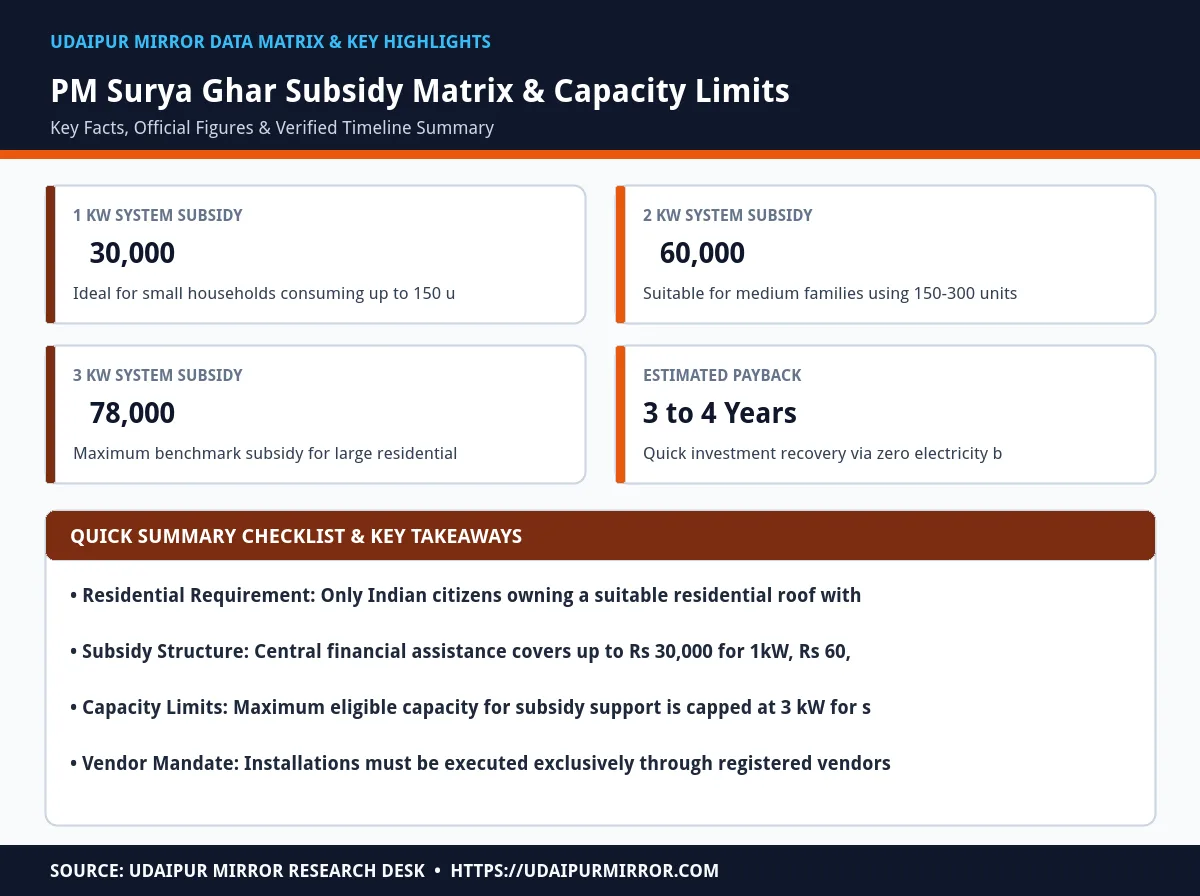
Understanding how the subsidy is calculated is essential for financial planning before placing an order with an empanelled vendor. The central government offers a fixed subsidy per kilowatt for systems up to 3 kW capacity. For a 1 kW setup, consumers receive ₹30,000, while a 2 kW setup attracts ₹60,000. For systems rated between 2 kW and 3 kW, the total subsidy is capped at ₹78,000. Any capacity exceeding 3 kW does not receive additional central subsidy support for the extra generation capacity, though state-level top-up schemes in regions like Gujarat may offer supplemental relief for smaller consumers.
The application process is entirely digitized through the unified national portal, eliminating middlemen and bureaucratic delays. Consumers must first register on the portal by selecting their state, electricity distribution company (DISCOM), and entering their consumer account number along with a valid mobile number. Once logged in, applicants submit the rooftop solar plant application and await technical feasibility approval from their local DISCOM engineer, which typically takes up to 15 working days.
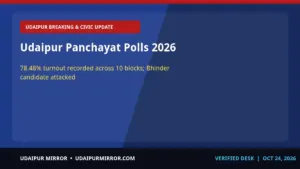
After receiving feasibility clearance, consumers must procure the solar system exclusively from a registered vendor listed on the portal. Upon successful installation, the vendor submits the plant details and installation certificate online, following which a DISCOM official visits the site to install a bidirectional net meter. Once the net metering test is successfully completed, a commissioning certificate is generated, and the subsidy amount is directly credited to the consumer’s Aadhaar-linked bank account within 30 days. (Also read: Udaipur Panchayat Elections 2026: High Voter Turnout, Bhinder Candidate Assaulted & Administrative Logistics | उदयपुर पंचायत चुनाव).
A smooth subsidy disbursal relies heavily on the accuracy of uploaded documents during the registration phase. Applicants must keep scanned copies of their latest electricity bill, identity proof such as an Aadhaar card, property ownership proof, cancelled cheque or bank passbook details, and passport-sized photographs ready. Discrepancies between the name on the electricity bill and the bank account or identity documents can trigger automated application rejections, necessitating physical grievance redressal at local DISCOM offices.
For residents planning comprehensive home improvements alongside solar upgrades, exploring regional sightseeing or lifestyle guides such as the Udaipur Sightseeing Guide 2026 offers great ideas for balancing domestic leisure with home infrastructure planning.
The maximum central subsidy under the scheme is ₹78,000 for residential rooftop solar systems of 3 kW capacity or higher.
No, the subsidy scheme is strictly restricted to residential domestic consumers who own the rooftop space.
Once the solar plant is installed, inspected, and the net meter is successfully commissioned, the subsidy is credited to the beneficiary’s bank account within 30 days.
No, to qualify for the central subsidy, installations must be carried out exclusively by vendors empanelled and registered on the official national PM Surya Ghar portal.
Add Udaipur Mirror as a preferred source on Google to see more of our travel guides in your AI overviews.



[…] and Bhinder Clash | उदयपुर पंचायत चुनाव 18 minutes ago ⚡ Articles Eligibility Criteria of PM Surya Ghar Scheme in India: Complete Guide for Households 40 mi… Articles Udaipur Sightseeing Guide 2026: Updated Itineraries, Ticket Prices and Lake Timings 41 […]