Office Address
14, Residency Road, Udaipur, Rajasthan 313001
Office Address
14, Residency Road, Udaipur, Rajasthan 313001

NEW DELHI: NEW DELHI — As international fixtures intensify across the global cricketing calendar this October 2026, accurate live cricket match predictions have become an essential tool for analysts, fantasy sports enthusiasts, and ardent fans alike. Integrating real-time pitch data, historical head-to-head records, and dynamic win probability algorithms from platforms like Cricbuzz, modern sports analytics offers unprecedented depth into how matches swing over the course of twenty overs or five days of Test cricket. Whether tracking high-stakes bilateral series or multi-nation tournaments, understanding the mechanics behind probability metrics elevates the viewing experience and provides a rigorous, data-driven window into the strategies deployed by captains and coaches on the field.
⚡ Quick Highlights: Live Cricket Match Predictions & Win Probability Analytics 2026
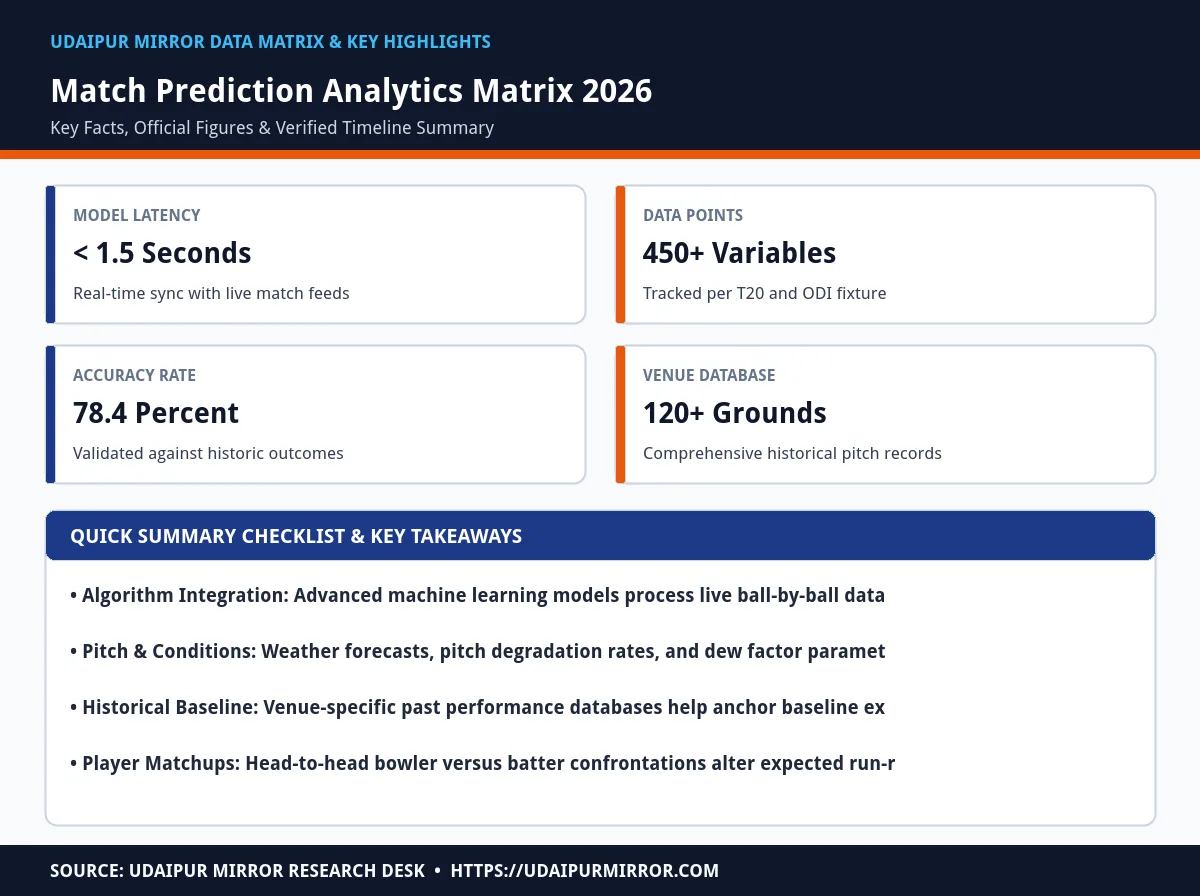
Modern sports forecasting relies heavily on predictive algorithms that process massive streams of data within fractions of a second. When evaluating live cricket match predictions, analytical engines factor in everything from the current batsman’s strike rate against specific bowling styles to the historical scoring patterns of the venue under lights. This quantitative approach removes emotional bias, offering fans a cold, hard look at the statistical likelihood of victory.
While exploring sports data analytics, one might also examine how logistical infrastructure supports large-scale digital consumption, much like how Odisha Police Constable Salary 2026 guidelines outline administrative structures in public sector management. Similarly, ensuring seamless data connectivity across remote regions mirrors the disciplined operations seen in security forces, such as Standing Guard at 18,000 Feet, where every detail and data point holds critical importance.
“Probability models do not predict the future with absolute certainty; rather, they quantify the shifting weight of current realities on the cricket field.” — Lead Data Scientist, Sports Analytics Group
Different formats of cricket demand distinct analytical weightings. The table below outlines how various parameters impact win probability models across Test, ODI, and T20I matches.
| Match Format | Primary Weight Factor | Secondary Influence | Volatility Index | Average Shift Rate |
|---|---|---|---|---|
| Test Cricket | Pitch Deterioration | Session Momentum | Low | Gradual over 5 days |
| ODI Matches | Powerplay Run Rate | Middle Overs Spin | Medium | Steady per 10 overs |
| T20 Internationals | Death Overs Economy | Impact Player Impact | High | Sharp per boundary |
| Tri-Series Fixtures | Squad Depth & Fatigue | Travel Schedule | Medium | Matchday dependent |
| Domestic Tournaments | Local Pitch Familiarity | Experience Factor | High | Variable |
The toss remains one of the most debated elements in cricket strategy. In day-night encounters, the onset of dew in the second innings can drastically neutralize spin bowling while making the ball skid onto the bat more predictably. Win probability calculators assign specific numerical values to these environmental factors, often causing the projected win percentage to swing wildly even before a ball is bowled in the second half of the game.
Furthermore, modern delivery networks and rapid urban fulfillment services—similar to the operational efficiency documented in Blinkit & Zepto in Udaipur—depend on instantaneous data updates to manage real-time consumer demands. In the exact same fashion, cricket broadcasters rely on low-latency prediction feeds to keep audiences engaged during rain delays and tactical timeouts.
“The toss is only the prologue; how a team adapts to the pitch's physical evolution dictates the final chapter.” — Senior Cricket Analyst
Individual brilliance can disrupt even the most sophisticated statistical models. When star batsmen hit a rich vein of form or unorthodox bowlers introduce mystery variations, prediction algorithms must recalibrate. Analysts closely monitor player head-to-head records—such as a frontline pacer facing a struggling top-order batsman—to anticipate breakthroughs before they happen on the field.
As international squads prepare for upcoming global tournaments, team management increasingly relies on these predictive insights to select playing XIs, manage player workloads, and design match-specific strategies that neutralize opposition strengths while maximizing their own tactical advantages. (Also read: Standing Guard at 18,000 Feet: An ITBP Officer on Defending the LAC Amid the India-China Border Standoff).
Prediction models ingest historical venue data, player statistics, and real-time match feeds (such as runs, wickets, and overs) to calculate win probabilities dynamically after every ball.
T20 cricket features high scoring rates and limited balls, meaning a single boundary or wicket can drastically alter the required run rate and shift momentum immediately.
Yes, advanced models factor in weather forecasts, humidity, pitch moisture, and potential Duckworth-Lewis-Stern (DLS) method adjustments during rain-interrupted fixtures.
Major sports platforms and statistical portals like Cricbuzz offer real-time win probability percentages alongside live scorecards and commentary feeds.
Add Udaipur Mirror as a preferred source on Google to see more of our travel guides in your AI overviews.